
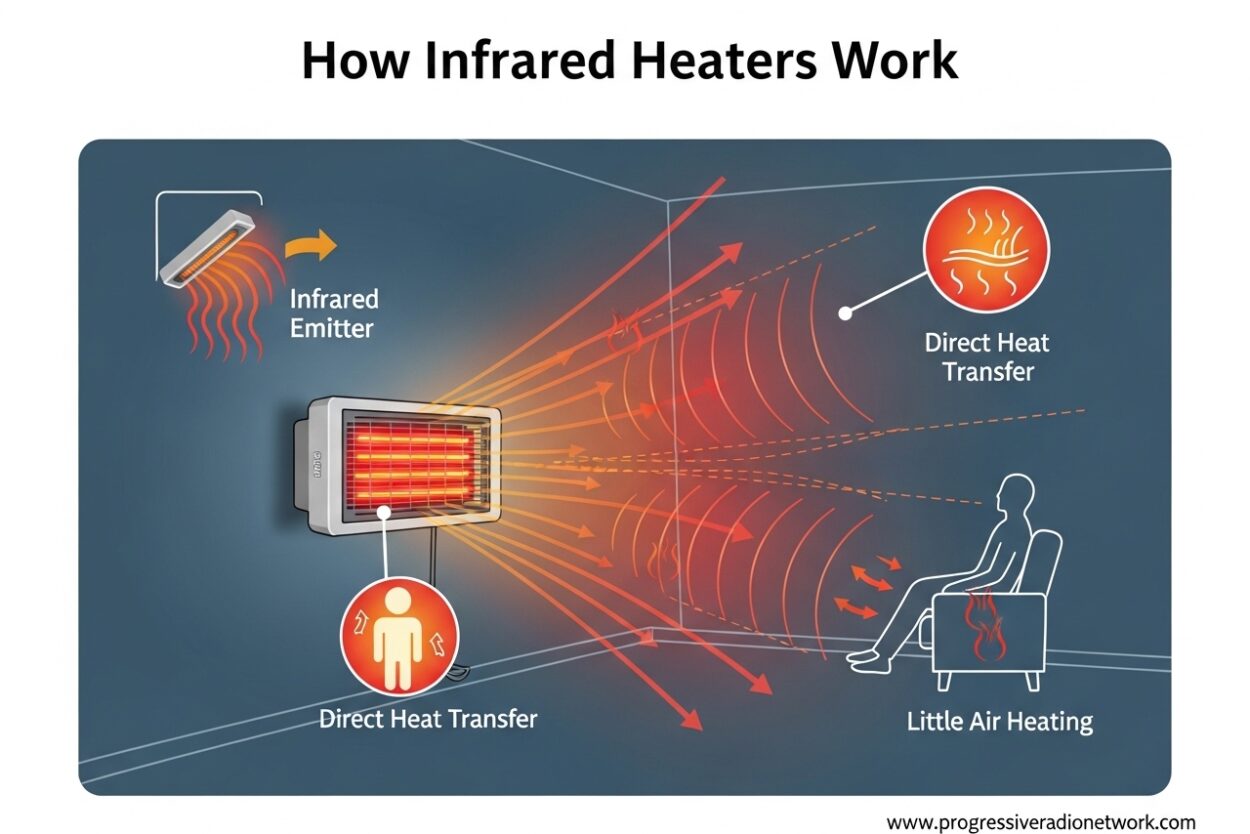
Infrared heaters work by converting electricity into electromagnetic waves that directly warm objects and people in their path, similar to how the sun heats the Earth. Unlike traditional heaters that warm the air first, infrared heating transfers energy directly through invisible light waves in the electromagnetic spectrum. Understanding how infrared heaters work can help you make smarter decisions about home heating and potentially reduce your energy bills.
The Science Behind Infrared Heating
Infrared radiation was discovered in 1800 by astronomer William Herschel while he was experimenting with prisms and thermometers. He found that temperature increased just beyond the red light spectrum, leading him to discover this invisible form of energy. This discovery revolutionized our understanding of heat and light.
Infrared waves sit on the electromagnetic spectrum between visible light and microwaves. They’re invisible to human eyes but we feel them as heat. All objects emit infrared radiation naturally—that’s why thermal cameras can detect heat signatures. When you stand near a campfire or feel sunlight on your face, you’re experiencing infrared heating in action.
The electromagnetic spectrum organizes different types of radiation by wavelength. Infrared waves range from 0.75 micrometers to 1000 micrometers, divided into three categories: near-infrared, mid-infrared, and far-infrared. Each type has different heating properties and applications.
What makes infrared unique is its ability to transfer energy without contact. The waves travel in straight lines until they hit a solid object, which absorbs the energy and converts it to heat. This is fundamentally different from how convection heating works, which relies on warming air molecules.
How Infrared Heaters Work
Infrared heaters work by passing electricity through a heating element until it becomes hot enough to emit electromagnetic waves in the infrared spectrum. This process involves several components working together to convert electrical energy into radiant heat efficiently.
The heating element is the heart of any infrared heater. When electricity flows through this element, resistance causes it to heat up rapidly. Once the element reaches the right temperature (typically 900-1200°C for quartz elements), it begins emitting infrared waves that travel outward at the speed of light.
These waves don’t heat the air they pass through. Instead, they continue traveling until they strike a solid surface—walls, furniture, floors, or people. When absorbed, these surfaces warm up and become secondary heat sources, gradually releasing warmth back into the room. This creates a comfortable heating effect that feels natural because it mimics the sun’s warmth.
The efficiency of this conversion is impressive. Modern infrared heaters convert up to 95% of input energy directly into heat, with minimal waste. This high efficiency comes from the direct nature of infrared energy transfer—there’s no heat lost to ductwork, air leakage, or the inefficiencies of heating air that just wants to rise to the ceiling.
Infrared vs Convection vs Conduction: Understanding Heat Transfer
Heat moves through three mechanisms: conduction, convection, and radiation. Understanding these differences explains why infrared heating feels different from traditional heating systems and why it can be more efficient in certain situations.
Conduction is heat transfer through direct contact. When you touch a hot stove, conduction burns your hand. In heating systems, conduction plays a minor role—it’s how warmth spreads from a heated floor surface to your feet.
Convection heats by warming air, which then circulates and transfers heat. Traditional forced-air furnaces and baseboard heaters work this way. The problem? Hot air rises to the ceiling, leaving your feet cold while your head stays warm. Convection heating also loses efficiency through drafts, open doors, and poor insulation.
Radiation (infrared) travels as electromagnetic waves that heat objects directly. No air movement is required. The waves travel in straight lines until absorbed by solids. This means no wasted energy heating empty space or air that immediately escapes through gaps.
Infrared heating offers several advantages: instant warmth (no waiting for air to heat up), silent operation (no fans or ducts), and no air circulation that spreads dust or allergens. However, it only heats what’s in its line of sight, which can be a limitation in large or irregularly shaped spaces.
Types of Infrared Heaters by Wavelength
Infrared heaters are categorized by the wavelength they emit, which determines their heating characteristics and best applications. The three main types each have distinct advantages.
Near-infrared (short-wave) heaters emit wavelengths from 0.76 to 1.4 micrometers. These produce intense, immediate heat with a bright visible glow. They’re ideal for outdoor spaces, warehouses, and any area where instant warmth is needed. The tradeoff is that they can feel harsh if you’re too close and the light can be distracting indoors.
Medium-wave infrared heaters operate at 1.4 to 3 micrometers. They provide a balance between intensity and comfort. The visible glow is softer than near-infrared, and they still deliver relatively quick heating. These work well for patio heaters, commercial spaces, and spot heating applications.
Far-infrared (long-wave) heaters emit wavelengths from 3 to 1000 micrometers. They produce no visible light and create a gentle, comfortable warmth. Far-infrared is the preferred choice for home heating panels, saunas, and any space where comfort is prioritized over instant heat. The lower intensity means they’re safer for prolonged exposure and won’t dry out your eyes or skin.
Most residential infrared heaters use far-infrared technology because it’s comfortable, efficient, and safe for continuous use. Industrial and commercial applications often use near or medium-wave heaters where rapid heating is more important than subtle comfort.
Heating Element Materials: Quartz, Ceramic, and Carbon Fiber
The heating element material determines how efficiently an infrared heater converts electricity into radiant energy. Three main materials dominate the market, each with distinct characteristics.
Quartz elements use tungsten filaments enclosed in quartz tubes. Quartz is transparent to infrared waves, allowing almost all generated energy to pass through. These elements heat up quickly (within seconds) and produce intense, focused heat. Quartz heaters are ideal for spot heating and outdoor applications. They typically last 5,000-20,000 hours depending on quality.
Ceramic emitters use heating coils embedded in ceramic plates. The ceramic material absorbs heat and emits far-infrared waves efficiently. Ceramic heaters heat up more slowly than quartz but provide more even, comfortable warmth. They’re quieter, more durable (20,000-50,000 hour lifespan), and better suited for continuous indoor use. The ceramic construction also makes them more resistant to shock and vibration.
Carbon fiber elements represent newer technology. These heaters use carbon fiber ribbons or sheets as heating elements. Carbon fiber heats quickly, emits far-infrared waves efficiently, and offers the longest lifespan (up to 100,000 hours). They’re lightweight, flexible, and can be molded into various shapes. Carbon fiber heaters are often found in premium heating panels and high-end applications.
For most home applications, ceramic or carbon fiber heaters offer the best combination of comfort, efficiency, and longevity. Quartz excels in situations requiring instant, intense heat like workshops or outdoor patios.
Energy Efficiency and Running Costs
Infrared heaters can reduce energy costs through targeted heating and high conversion efficiency. Understanding the real costs helps determine if infrared heating makes sense for your situation.
Let’s calculate actual running costs. A standard 1500-watt infrared heater consumes 1.5 kilowatt-hours (kWh) per hour. At the U.S. average electricity rate of $0.16 per kWh, running this heater for 24 hours would cost $5.76 per day. That’s $172.80 per month if run continuously.
However, most users don’t run infrared heaters continuously. Because infrared provides targeted warmth, you only need to heat occupied spaces. A typical use pattern might be 4 hours per day in the evening. That reduces daily cost to $0.96 and monthly cost to roughly $28.80—much more reasonable for supplemental heating.
The zone heating capability is where real savings happen. Instead of heating your entire home to 70°F, you can maintain the main areas at 65°F and use infrared heaters to bring specific rooms to comfort when occupied. This can reduce overall heating costs by 20-50% depending on your setup.
Infrared also eliminates duct losses, which account for 20-30% of energy waste in forced-air systems. The direct heating means no energy is wasted warming air that immediately escapes through leaks or rises uselessly to the ceiling.
Best Applications for Infrared Heating
Infrared heating excels in specific situations but isn’t ideal for every application. Understanding where it works best helps set realistic expectations.
Home heating panels mounted on walls or ceilings provide efficient whole-room heating. They work particularly well in well-insulated homes and can serve as primary heat sources in mild climates. The panels warm walls and floors, which then radiate heat back into the room evenly.
Garages and workshops benefit tremendously from infrared heaters. Because these spaces are often poorly insulated and have high ceilings, forced-air heating struggles. Infrared heaters mounted overhead direct warmth exactly where needed—your workbench or parking spot—without wasting energy heating empty space.
Outdoor patios use high-intensity infrared heaters to extend outdoor dining season. Unlike convection heaters that blow away in the wind, infrared waves travel unaffected to warm people directly. Electric or gas-powered infrared patio heaters can create comfortable warmth even in cool weather.
Industrial and commercial applications include warehouse heating, paint drying, food processing, and construction site warming. Infrared’s instant heat and directional properties make it ideal for processes requiring precise temperature control or spot heating in large facilities.
Infrared saunas use far-infrared heaters to create therapeutic heat that penetrates deeper into tissue than traditional saunas. The gentle warming promotes relaxation and various health claims without the extreme temperatures of conventional saunas.
Safety and Health Considerations
Safety is a common concern with any heating technology. Infrared heaters have specific safety considerations that are important to understand.
Is infrared radiation dangerous? This is one of the most common misconceptions. The infrared used in residential heaters is far-infrared, which is completely safe and actually the same type of heat your body produces naturally. Unlike UV radiation, infrared doesn’t damage DNA or cause cancer. Scientific consensus confirms that far-infrared heating at household levels poses no health risks.
Burn safety requires attention with any heater. The heating elements in quartz and some ceramic heaters can reach very high temperatures. Most quality heaters include protective grills and safety tip-over switches that shut off the unit if knocked over. Far-infrared panels typically stay cooler to the touch while still providing effective heating.
Allergy benefits are a significant advantage of infrared heating. Unlike forced-air systems that circulate dust, pollen, and pet dander throughout your home, infrared heaters work without moving air. This can provide relief for allergy sufferers and create a healthier indoor environment.
Electrical safety is standard—ensure your heater has UL or ETL certification, never use extension cords with portable heaters, and keep flammable materials at least three feet away. Modern heaters include overheat protection that shuts down the unit if internal temperatures exceed safe limits.
Eye comfort is worth considering with near-infrared heaters that produce bright light. Prolonged exposure to intense near-infrared can cause eye fatigue or dryness. Far-infrared heaters don’t produce visible light and don’t have this issue.
Disadvantages and Limitations of Infrared Heating
No heating technology is perfect. Infrared heating has specific limitations that may make it unsuitable for certain situations.
Line-of-sight requirement is the biggest limitation. Infrared waves travel in straight lines and cannot go around corners. Objects blocking the heater create shadows where heating is reduced. This means proper placement is critical, and infrared may not work well in rooms with complex layouts or lots of obstructions.
Limited zone coverage means infrared heats what’s directly in front of it, not the whole room automatically. This can be an advantage for targeted heating but a disadvantage if you want whole-house warmth. Multiple heaters or strategic placement may be needed for comprehensive coverage.
Cool air feeling occurs because infrared doesn’t heat air directly. Even in a room warmed by infrared, the air can feel cool when you walk around, especially near windows or exterior walls. Some users find this uncomfortable compared to the all-around warmth of convection heating.
No residual heating once the heater turns off. Because infrared primarily heats surfaces rather than air, rooms cool quickly when the heater stops. Convection systems keep air warm longer after shutting down because of the thermal mass of heated air.
Installation considerations include proper placement for maximum effectiveness and electrical requirements for larger units. Wall-mounted panels need professional installation in some cases, and ceiling-mounted units require structural support.
Frequently Asked Questions
What are the disadvantages of infrared heating?
Infrared heating requires line-of-sight to work effectively, meaning it only heats objects directly in its path. It can create cool spots in rooms with obstructions and doesn’t provide residual warmth after turning off. Some users find the air still feels cool even when surfaces are warm, and multiple units may be needed for whole-home heating.
How much does it cost to run a 1500 watt infrared heater for 24 hours?
A 1500-watt infrared heater uses 1.5 kWh per hour. At the U.S. average electricity rate of $0.16 per kWh, running it for 24 hours costs approximately $5.76 per day or $172.80 per month. However, most users run heaters only 4-6 hours daily for occupied spaces, reducing monthly costs to $30-50.
Do infrared heaters take a lot of electricity?
Infrared heaters use the same amount of electricity as other electric resistance heaters—typically 750-1500 watts for portable units. However, they often feel warmer because they heat people directly rather than air. The high efficiency (up to 95% energy conversion) means very little electricity is wasted, though operating costs remain similar to other electric heating.
Can you leave infrared heaters on all night?
Yes, most modern infrared heaters are designed for safe overnight operation. Look for models with tip-over protection, overheat shutoff, and cool-touch exteriors. Far-infrared panels are particularly safe for continuous use because they operate at lower surface temperatures and contain no moving parts that could fail.
Does infrared heating really work?
Yes, infrared heating is scientifically proven and widely used. The technology works through electromagnetic radiation—the same way the sun warms Earth. Infrared heaters convert up to 95% of input energy directly into heat, making them more efficient than many convection systems that lose energy through ductwork and air leakage.
Can infrared heaters cause cancer?
No, infrared heaters do not cause cancer. The infrared radiation used in residential heaters is far-infrared, which is completely different from ionizing radiation like X-rays or UV light. Far-infrared is non-ionizing and simply causes molecules to vibrate, creating warmth. It’s the same type of heat your body naturally produces.
Do infrared heaters heat the air?
No, infrared heaters do not directly heat the air. They heat solid objects (walls, floors, furniture, people) through electromagnetic waves. These objects then warm the air indirectly through contact. This is why infrared heaters can make a room feel comfortable even when the air temperature reads lower than with convection heating.
How long does it take for an infrared heater to warm up a room?
Infrared heaters begin emitting warmth almost immediately—usually within seconds to minutes depending on the element type (quartz heats fastest, ceramic slowest). However, you’ll feel warm right away because the waves heat your body directly, not the air. Full room warming takes 30-60 minutes as walls and floors absorb and re-radiate the heat.
Conclusion
Understanding how infrared heaters work reveals why this technology has gained popularity for both residential and commercial heating applications. By converting electricity directly into electromagnetic waves that warm objects and people, infrared heaters offer efficient targeted heating that feels natural and comfortable.
Infrared heating works best when you need zone heating, want to avoid air circulation that spreads allergens, or have poorly insulated spaces where convection heating struggles. The instant warmth, silent operation, and high energy conversion efficiency make infrared heaters particularly effective for garages, patios, workshops, and supplemental home heating.
While infrared heating has limitations—primarily its line-of-sight requirement and limited zone coverage—the technology continues evolving with improved elements and smarter controls. For many homeowners and businesses, understanding how infrared heaters work is the first step toward more efficient, targeted heating solutions that can reduce energy costs while improving comfort.





Leave a Comment