
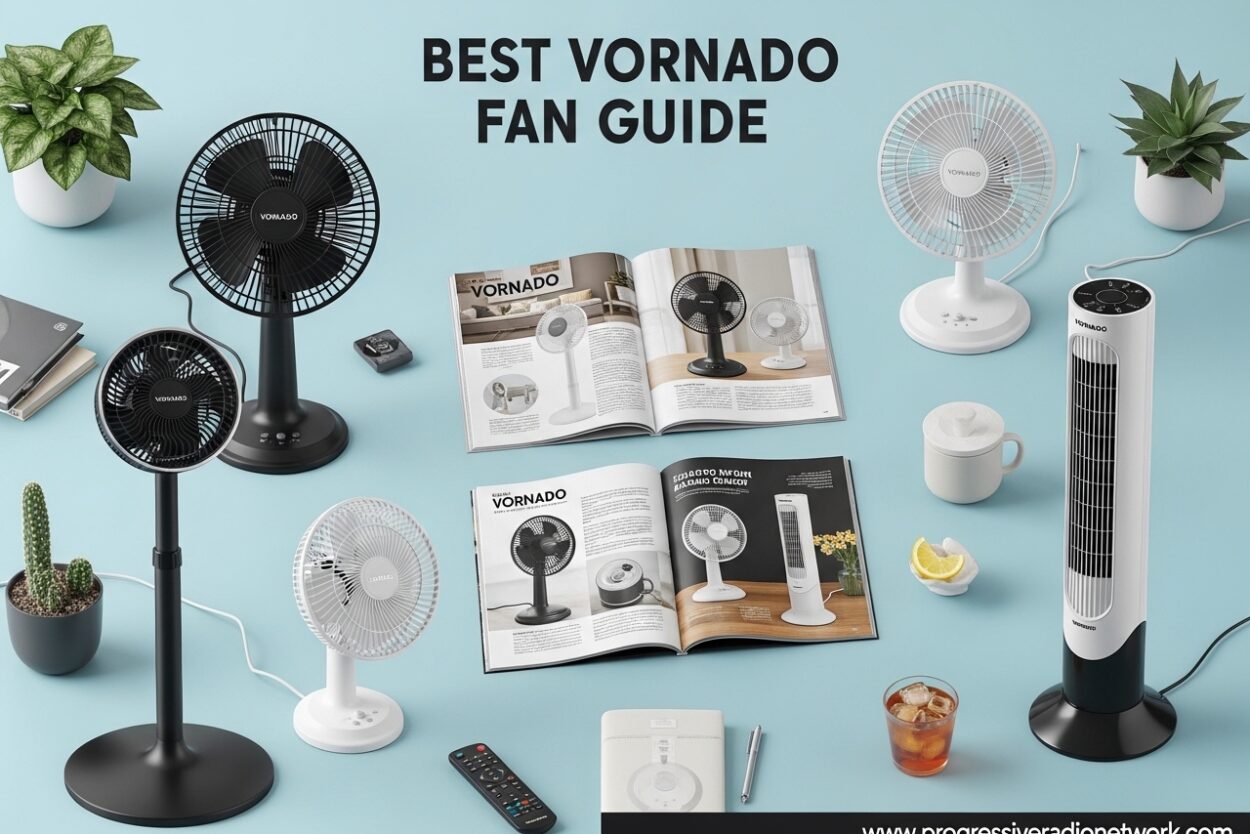
If you’re tired of fans that only blow air in one direction while the rest of your room stays stuffy, you’re not alone. The Best Vornado Fan Guide will show you why Vornado’s air circulation technology works differently than traditional fans, and how to choose the right model for your space.
Vornado fans have been around since the 1940s, but their unique approach to moving air has made them a favorite among homeowners, renters, and even testing labs like Wirecutter. Unlike regular fans that create a focused breeze you feel only when standing directly in front of them, Vornado air circulators use Vortex Action to move air throughout your entire room.
This guide covers everything you need to know about Vornado fans, from how the technology works to choosing the right size for your space, proper positioning, maintenance, and whether they’re actually worth the investment.
What is Vornado Air Circulation Technology?
Vornado Air Circulation Technology, called Vortex Action, is fundamentally different from how traditional fans operate. While a standard fan pushes air in a straight line that eventually dissipates, Vornado air circulators create a spiral of air that travels across the room, bounces off walls, and circulates back continuously.
The key to Vortex Action lies in Vornado’s specially designed blades and inlet guide cone. This combination draws air in through the back and directs it into a tight, helical beam pattern that can travel up to 75 feet. This means you feel consistent airflow throughout the entire space, not just in one spot.
Think of it like the difference between a flashlight beam and ambient room lighting. A traditional fan is like a flashlight—intense but focused in one direction. A Vornado air circulator fills the whole room with moving air, similar to how good lighting illuminates an entire space rather than just one corner.
How Vortex Action Works
Vortex Action works through three key design elements that work together. The deep-pitch blades are angled and shaped to grab air more aggressively than standard fan blades. The inlet guide cone smooths and directs airflow before it reaches the blades. The spiral housing helps direct air into a tight beam pattern that doesn’t dissipate as quickly as traditional fan output.
When you turn on a Vornado fan, you’re not just creating wind—you’re establishing continuous air circulation throughout the room. This is why Vornado fans are positioned toward walls rather than people, which seems counterintuitive until you understand how the technology works.
Whole-Room Circulation vs Directional Airflow
Traditional fans provide directional airflow that cools whatever is directly in their path. This is why you constantly need to adjust oscillating fans or move them around the room. The cooling effect is temporary and localized.
Vornado air circulators provide whole-room circulation. Once the air is moving in a continuous vortex pattern, the entire space benefits from the air movement. This means more consistent temperatures, better distribution of conditioned air (whether from AC or heating), and no need for constant adjustment.
For many users, this difference is why they can supplement or even replace air conditioning with a Vornado fan. By continuously circulating the cool air that settles near the floor, the whole room feels more comfortable without the energy cost of running AC constantly.
The Science Behind Helical Airflow Patterns
The helical airflow pattern created by Vornado fans is essentially a spiraling column of air that maintains its integrity over distance. This is different from the conical pattern of traditional fans, which spreads out and loses velocity quickly.
When Vornado’s spiral beam of air hits a wall, it doesn’t just stop—it splits and travels along the wall, eventually returning to the fan to be re-circulated. This creates a continuous cycle of air movement that requires less energy to maintain than repeatedly starting and stopping airflow.
This is also why Vornado fans are effective at mixing air layers. Hot air rises, cold air sinks, and Vornado circulation helps blend these layers for more even temperature distribution throughout your space.
Key Features to Consider When Choosing a Vornado Fan
When selecting a Vornado fan, several key features determine performance, noise level, and suitability for your specific needs. Understanding these differences helps you choose the right model rather than just picking the most popular one.
The motor type, speed control options, noise output, and build quality all significantly impact your daily experience with the fan. Let’s break down what matters most.
AC vs DC Motors Explained
Vornado offers fans with both AC (alternating current) and DC (direct current) motors, and the difference matters. AC motors are the traditional option—foundational, proven, and typically less expensive. They’re reliable workhorses that power Vornado’s classic models like the 630 and 660.
DC motors are the modern evolution. They’re more energy-efficient, often using up to 80% less electricity than equivalent AC motors. They’re also quieter, especially at lower speeds, and offer more precise speed control. Models like the 533DC, 633DC, and 683DC feature DC technology.
The trade-off is primarily cost. DC motor models typically cost more upfront, but the energy savings can offset this over time, especially if you run the fan continuously during warm months. For bedrooms where noise matters, DC motors generally have an advantage.
Variable Speed Controls
Vornado fans approach speed control differently than traditional fans. Instead of the standard three-speed switch (low, medium, high), many Vornado models feature variable speed dials that offer precise control across a continuum.
This variable speed control lets you fine-tune the airflow to your exact preference. You’re not locked into preset speeds that might be too low or too high for your situation. For night use, you can dial it back to barely-there airflow. For hot afternoons, crank it up for maximum circulation.
Some premium models include remote controls and even smart home compatibility. These features add convenience but also cost. Consider how often you’ll adjust the fan and whether the convenience is worth the premium for your use case.
Noise Considerations
Honesty time: Vornado fans are not silent, especially on higher settings. The powerful airflow that makes them effective also creates noise. On high speeds, most Vornado models produce 50-60 decibels—roughly equivalent to normal conversation or background music.
However, many users find the noise more tolerable than traditional fans because it’s a steady whoosh rather than the rhythmic buffeting you get from oscillating fans. The sound is consistent, which many people find easier to tune out.
For bedrooms, DC motor models are generally quieter on low settings. The 133DC is specifically designed as a whisper-quiet option for small spaces. Just understand that “whisper-quiet” doesn’t mean silent—there’s still audible airflow, which is the physics of moving air.
Build Quality and Warranty
Vornado’s build quality is generally solid across their lineup. The classic models feature sturdy plastic housings and metal grilles. Higher-end models like the Silver Swan feature premium materials and retro styling that doubles as decor.
All Vornado fans come with a five-year warranty, which is significantly longer than most competitors who typically offer only one to two years. This warranty reflects Vornado’s confidence in their product’s durability and is frequently cited by long-term users as a key reason they chose the brand.
From forum reports, many users have Vornado fans that have lasted 5-10 years with regular use. However, coastal users should note that salt air can accelerate rust on metal components, particularly the grille and internal parts.
How to Choose the Right Size Vornado Fan for Your Space
Choosing the right Vornado fan size for your room is crucial for optimal performance. Too small, and you won’t get adequate circulation. Too large, and you’re wasting energy and money on capacity you don’t need.
Vornado offers fans designed for different room sizes, from small personal spaces to large open areas. Matching the fan to your space ensures you get the performance you need without overkill.
Small Rooms (Up to 150 sq ft)
For bedrooms, home offices, dorm rooms, and other small spaces up to 150 square feet, compact Vornado models are ideal. The Vornado 133DC is specifically designed for these spaces, offering powerful circulation in a small footprint that fits easily on nightstands or desks.
The classic Vornado 533DC is another excellent small-room option. It provides enough airflow to thoroughly circulate air in bedrooms while consuming minimal energy thanks to its DC motor. These smaller models are also ideal for directing airflow from a window AC unit throughout a room.
For truly tiny spaces or personal use, the Vornado Flippi series offers ultra-compact designs that can be positioned on even the smallest surfaces while still delivering effective personal circulation.
Medium Rooms (150-300 sq ft)
Medium-sized bedrooms, living rooms, and home offices in the 150-300 square foot range are the sweet spot for Vornado’s most popular models. The Vornado 630 is widely considered the standard for medium rooms and is Wirecutter’s top pick for room fans.
The Vornado 660 is another excellent medium-room option, offering similar performance to the 630 with a slightly different design aesthetic. Both provide ample airflow to thoroughly circulate air in typical bedroom or small living room dimensions.
The DC motor version of these medium-sized fans, the 633DC, offers the same performance with improved energy efficiency and quieter operation—worth considering if you’ll be running the fan for long periods or primarily use lower speed settings.
Large Rooms (300+ sq ft)
For large living rooms, open concept spaces, great rooms, and areas over 300 square feet, Vornado offers larger, more powerful models. The Vornado 683DC is designed specifically for large spaces, with a bigger blade diameter and more powerful motor to move air effectively across greater distances.
The Vornado Strata is another option for large rooms, featuring a unique vertical design that can be directed upward to circulate air across ceiling height or horizontally for traditional room-wide circulation. Its flexibility makes it ideal for vaulted ceilings or open floor plans.
For truly large spaces or whole-house circulation, some users strategically position multiple Vornado fans to create overlapping circulation zones. This approach can be more effective and energy-efficient than trying to force one oversized fan to do the job alone.
Whole-House Circulation Strategies
Vornado fans can be used strategically for whole-house air circulation, potentially reducing your reliance on air conditioning. By placing fans in key locations and understanding airflow patterns, you can create a circulation system that moves conditioned air throughout your home.
One effective strategy is placing a Vornado fan near air conditioning vents to help distribute the cool air more evenly throughout your home. This prevents cold spots and allows you to set your AC a few degrees higher while maintaining comfort.
Another approach uses Vornado fans to create cross-ventilation by positioning them near open windows or doors. This brings in fresh air while exhausting stale air, particularly effective during cooler parts of the day when outdoor temperatures are comfortable.
Vornado Fan Positioning Guide
Proper positioning is crucial for getting the best performance from your Vornado fan. Unlike traditional fans that you point directly at yourself, Vornado air circulators work best when positioned toward walls or corners, allowing the Vortex Action to bounce and circulate throughout the room.
The angle and placement of your fan significantly affect its effectiveness. Understanding proper positioning helps you get maximum benefit from your Vornado’s circulation technology.
Best Placement for Different Room Layouts
For square rooms, the optimal placement is in a corner, angled diagonally across the room. This allows the air beam to travel the maximum distance before hitting the opposite wall, creating the most effective circulation pattern. Aim the fan so it hits the wall at a 45-degree angle rather than straight on.
Rectangular rooms benefit from fan placement at one end, aimed toward the longer wall. This maximizes the travel distance of the air beam before it bounces back. If you have a particularly long room, you might need to experiment with placement to find the sweet spot where circulation feels most consistent.
For bedrooms, placing the Vornado near the foot of the bed, aimed toward the opposite wall, provides whole-room circulation without direct airflow on your face while sleeping. This positioning maintains comfort while avoiding the discomfort of constant breeze on exposed skin.
Avoiding Common Positioning Mistakes
The most common mistake with Vornado fans is treating them like traditional fans—pointing them directly at people or seating areas. This defeats the purpose of Vortex Action and results in uneven cooling. Remember, Vornado fans circulate air, not create directed breeze.
Another mistake is placing the fan too close to walls. Vornado fans need some clearance for proper air intake. Aim for at least 12-18 inches of clearance behind the fan to allow unrestricted airflow into the inlet.
Avoid placing Vornado fans on soft surfaces like beds or upholstered furniture, which can vibrate and create additional noise. Use a firm, stable surface like a nightstand, table, or the floor for optimal performance and minimal noise transmission.
Vornado vs Tower Fans: Why Air Circulators Win
The debate between Vornado air circulators and tower fans has been settled by most experts, with Vornado-style air circulation coming out clearly ahead. Wirecutter famously stopped recommending tower fans entirely after extensive testing showed they underperform compared to air circulators.
Understanding why air circulators outperform tower fans helps you make an informed decision and avoid the common mistake of choosing style over substance when it comes to cooling your space.
Why Oscillation Doesn’t Equal Circulation
Tower fans rely on oscillation to distribute air, sweeping back and forth to cover a wider area. While this seems like a good idea in theory, in practice it creates intermittent, directional airflow that cools only when the fan is pointed directly at you.
Vornado air circulators don’t oscillate because they don’t need to. The Vortex Action creates whole-room circulation without moving parts. The air beam reaches every corner of the room continuously, not just when the fan happens to be pointing in that direction.
The result is more consistent, comfortable cooling. With a tower fan, you feel alternating periods of breeze and stillness. With a Vornado, you feel constant, gentle air movement throughout the entire space. The difference is particularly noticeable over extended periods.
Energy Efficiency Comparison
Vornado air circulators are typically more energy-efficient than tower fans, especially models with DC motors. Because they circulate air effectively rather than just creating a localized breeze, you can run them at lower speeds while still maintaining comfort.
Tower fans often need to run at higher speeds to create adequate cooling, consuming more electricity. Their vertical design also creates more airflow resistance, requiring more energy to move the same amount of air as a Vornado’s optimized blade and housing design.
For users looking to supplement or reduce air conditioning usage, Vornado fans are generally more effective at distributing conditioned air throughout a room. This allows you to set your thermostat higher while maintaining comfort, resulting in greater energy savings overall.
Maintenance and Cleaning Tips
Regular maintenance keeps your Vornado fan running efficiently and extends its lifespan. The good news is that Vornado fans are designed for easy cleaning, with most models requiring just basic maintenance to keep them performing at their best.
Dust, pet hair, and debris can accumulate over time, reducing airflow and potentially causing noise issues. Establishing a regular cleaning routine prevents these problems and ensures optimal performance.
Basic Cleaning Routine
For routine maintenance, a simple weekly cleaning during peak use seasons is usually sufficient. Use a vacuum cleaner with a brush attachment to remove dust from the exterior grille and intake areas. This prevents buildup that can restrict airflow and strain the motor.
For a deeper clean, unplug the fan and remove the front grille. Most Vornado models have a twist-lock grille that removes easily—check your manual for specific instructions. Use a soft brush or cloth to wipe down the blades and interior housing, being careful not to bend or damage the blades.
Avoid using water directly on the fan or submerging any parts. Instead, use a slightly damp cloth for cleaning and immediately dry all surfaces before reassembling. This prevents water damage to electrical components and the motor.
Deep Cleaning Steps
Every few months, or more often if you have pets, perform a deeper cleaning. After removing the grille as described above, use compressed air to blow dust from hard-to-reach areas around the motor housing and blade assembly.
For stubborn grime or greasy buildup, especially in kitchen environments, use a mild detergent solution on a cloth to carefully clean the blades and housing interior. Rinse the cloth frequently and avoid getting excess moisture into the motor assembly.
Pay special attention to the air intake areas on the back of the fan. Any obstruction here significantly reduces performance. Use a vacuum with a narrow attachment or compressed air to thoroughly clean these intake vents.
Troubleshooting Common Issues
If your Vornado fan develops unusual noise, first check for loose grilles or fasteners. Tighten any screws and ensure the front grille is securely locked in place. Rattling often comes from loose components rather than motor problems.
Reduced airflow usually indicates dirty blades or blocked intakes. A thorough cleaning typically restores performance. If cleaning doesn’t help, check that the speed control is functioning properly and that the fan is receiving adequate power.
For motor issues or unusual smells, unplug the fan immediately. These problems may require professional service. Fortunately, Vornado’s five-year warranty covers most issues, and their customer service has a good reputation even for out-of-warranty assistance.
Are Vornado Fans Worth the Investment?
At first glance, Vornado fans often cost more than generic department store fans, leading many to wonder if the premium is justified. The answer depends on your priorities, but for many users, the combination of performance, durability, and energy savings makes Vornado fans a worthwhile investment.
Looking beyond the initial price tag to total cost of ownership, warranty coverage, and actual performance in real-world conditions reveals why Vornado has maintained its reputation for decades.
Long-Term Durability Insights
Forum reports from long-term users frequently mention Vornado fans lasting 5-10 years with regular use. This longevity significantly offsets the higher initial cost when compared to cheaper fans that may need replacement every year or two.
The five-year warranty that comes with all Vornado fans provides additional value. Most competitors offer only one to two years of coverage, making Vornado’s warranty a statement of confidence in their product’s durability. When issues do arise, Vornado’s customer service has a solid reputation for standing behind their products.
However, coastal users should be aware that salt air can accelerate corrosion, particularly on metal grille components. Some beach-area users report reduced lifespan, though this is an environmental factor rather than a product defect. In these environments, more frequent cleaning and possibly covering the fan when not in use can extend its life.
Energy Cost Savings Potential
Vornado fans can reduce your cooling costs by supplementing or reducing air conditioning usage. By effectively circulating cool air throughout your space, you can typically set your thermostat 3-5 degrees higher while maintaining the same comfort level.
DC motor models offer additional energy savings, consuming up to 80% less electricity than equivalent AC motor fans. For users who run fans continuously during warm months, these savings can add up significantly over time, potentially offsetting the higher initial cost of DC models.
Many users report that Vornado fans allow them to avoid using air conditioning entirely during moderate weather, relying on open windows combined with air circulation for comfort. This can result in substantial energy savings compared to running AC whenever temperatures rise above comfortable levels.
FAQ
What is the best way to use a Vornado fan?
Position your Vornado fan toward a wall or corner, not directly at yourself. This allows the Vortex Action to bounce off surfaces and circulate throughout the entire room. Aim for at least 12-18 inches of clearance behind the fan for proper air intake, and angle the fan to hit walls at 45 degrees for optimal circulation.
Why do experts no longer recommend tower fans?
Testing by publications like Wirecutter showed that tower fans underperform compared to air circulators. Tower fans rely on oscillation which creates intermittent, directional airflow. Vornado air circulators provide continuous whole-room circulation without oscillation, resulting in more consistent and effective cooling.
Are Vornado fans worth the money?
For most users, yes. Vornado fans typically cost more upfront but last 5-10 years compared to 1-2 years for cheaper fans. The five-year warranty provides additional value, and energy-efficient DC models can reduce electricity costs. Many users find Vornado fans allow them to reduce AC usage, resulting in significant energy savings.
Can you leave a Vornado fan on all the time?
Yes, Vornado fans are designed for continuous operation and many users run them 24/7 during warm months. DC motor models are particularly suited for continuous use due to their energy efficiency. The five-year warranty covers normal use, and forum reports include many users running their Vornados continuously for years without issues.
Which Vornado model is best for bedrooms?
For small bedrooms under 150 sq ft, the Vornado 133DC offers whisper-quiet operation. For medium bedrooms, the 633DC provides excellent circulation with DC motor efficiency. Position the fan near the foot of the bed, aimed toward the opposite wall, for whole-room circulation without direct airflow on your face while sleeping.
How do I clean my Vornado air circulator?
Weekly vacuuming with a brush attachment removes surface dust. For deeper cleaning, unplug the fan and remove the front grille. Use a soft brush or cloth to wipe down blades and housing. Avoid water submersion. For pet owners, compressed air helps remove hair from hard-to-reach areas. Clean more frequently in coastal areas to prevent salt corrosion.
What is Vortex Action technology?
Vortex Action is Vornado’s signature air circulation technology. Unlike traditional fans that blow air in a straight line, Vortex Action creates a spiraling beam of air that travels across the room, bounces off walls, and circulates continuously. This creates whole-room air circulation rather than directional airflow, resulting in more consistent cooling throughout your space.
Are Vornado fans quiet?
Vornado fans are not silent, especially on higher settings where they produce 50-60 decibels. However, many users find the steady airflow noise easier to tune out than traditional fans. DC motor models are quieter on low speeds, making them better for bedrooms. The 133DC is specifically designed as a quiet option for small spaces.
Conclusion
The Best Vornado Fan Guide has covered why Vornado’s air circulation technology works differently than traditional fans, how to choose the right model for your space, and proper positioning and maintenance for optimal performance. Vornado fans offer a proven alternative to both traditional fans and tower fans for whole-room air circulation.
Whether you’re looking to supplement air conditioning, reduce energy costs, or simply improve comfort in your home, Vornado’s Vortex Action technology provides consistent whole-room circulation that traditional fans can’t match. With proper selection and placement, a Vornado fan can transform how you experience air movement in your space.
The five-year warranty, proven durability from long-term users, and energy-efficient options make Vornado fans a worthwhile investment for many households. Consider your room size, noise tolerance, and budget when choosing between models, but understand that any Vornado will outperform a traditional fan in circulation effectiveness.





Leave a Comment