
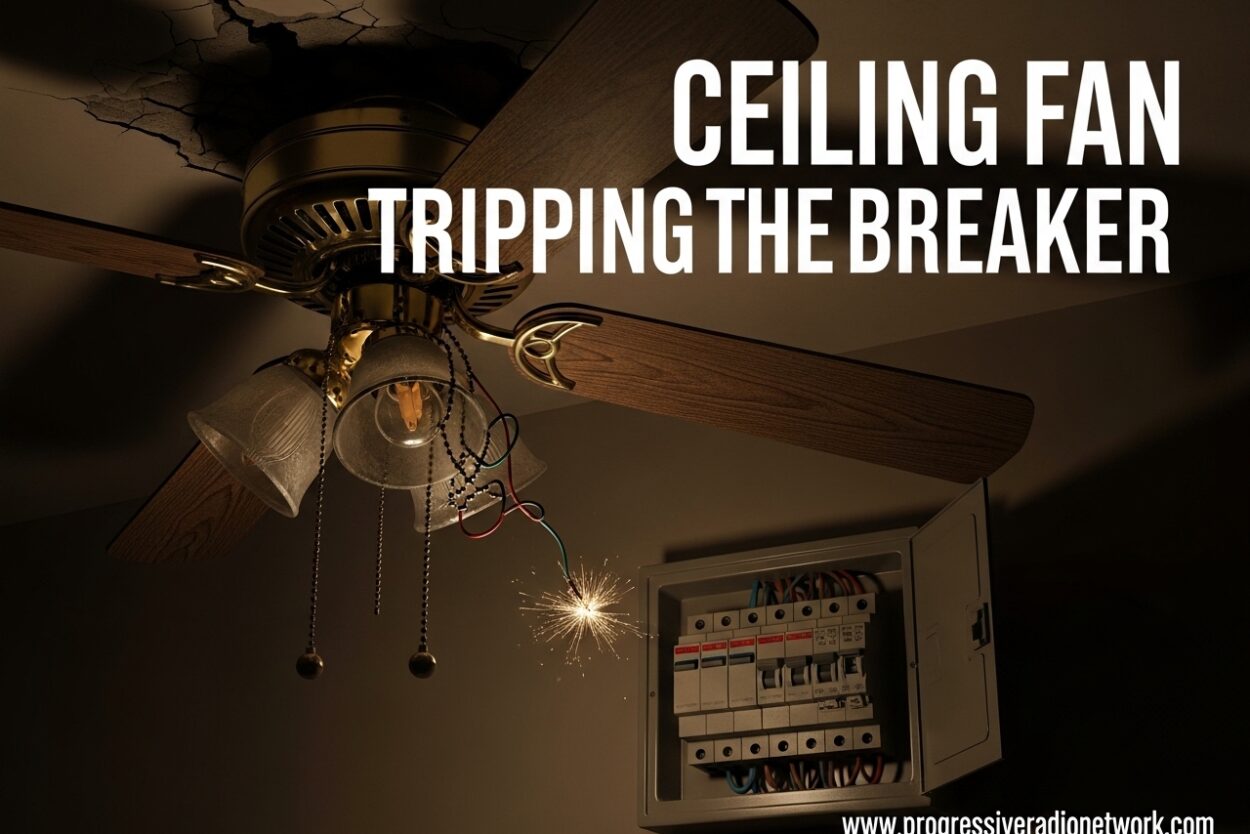
When your ceiling fan starts tripping the circuit breaker, it’s more than an annoyance—it’s a warning sign that something is wrong with your electrical system. I’ve seen this issue countless times, and in most cases, it points to one of a few specific problems that need immediate attention.
Ceiling fan tripping breaker issues usually indicate a short circuit, overloaded circuit, or faulty wiring in or around the fan installation. Ignoring the problem can lead to electrical fires, motor damage, or shock hazards. Each time your breaker trips, it’s doing its job by protecting you from a potentially dangerous situation.
Whether you just installed a new fan that won’t stay on, or an older fan has suddenly started causing problems, this guide will help you diagnose the issue safely and know when it’s time to call a professional.
What Causes a Ceiling Fan to Trip a Breaker?
A ceiling fan tripping breaker happens when the circuit detects abnormal current flow and cuts power to prevent overheating or fire. The breaker is doing exactly what it’s designed to do—protect you from dangerous electrical conditions.
The most common causes include short circuits within the fan motor or wiring, loose wire nut connections, overloaded circuits from too many devices on the same line, and incompatibility with modern AFCI or GFCI breakers. In some cases, the fan’s internal electronics like remote receivers can fail and cause trips.
Understanding which of these is happening in your situation is the first step toward fixing the problem safely.
Immediate vs Delayed Trip Diagnosis
The timing of when your breaker trips gives you important clues about what’s wrong. An immediate trip—within seconds of turning on the fan—usually indicates a short circuit or significant wiring error. Current is flowing where it shouldn’t, creating a direct path that trips the breaker instantly.
A delayed trip—after the fan runs for minutes or hours—suggests a different problem. This pattern often points to motor overload, gradual heating causing insulation breakdown, or an intermittent connection that worsens as components warm up. Fans that trip only on high speed settings typically fall into this category.
If your breaker trips when turning the fan OFF, this is a particularly telling symptom. It usually means the wiring issue is downstream of the switch, possibly in the fan canopy or where wires connect at the ceiling box.
Loose Wiring and Wire Nut Issues
Loose wiring connections are among the most common causes of ceiling fan breaker trips. I’ve found that wire nut connections can loosen over time due to vibration from the fan motor, thermal expansion and contraction, or simply from poor initial installation.
When wire nuts come loose, the wires inside can make intermittent contact or touch each other incorrectly. This creates resistance that generates heat, eventually leading to a short circuit that trips the breaker. The problem may be in the ceiling box where the fan connects to house wiring, or it could be in the wall switch box.
Backstab connections—where wires are pushed into spring-loaded terminals on the back of switches or outlets—are particularly prone to failure. These connections don’t secure wires as securely as screw terminals, and the vibration from a ceiling fan can cause them to fail over time. If your home was built using backstab connections, this could be your culprit.
A loose ground wire touching other components can also cause tripping. While less common, I’ve seen cases where the ground wire makes contact with hot or neutral wires inside the fan housing or switch box, creating an unintended current path.
AFCI/GFCI Breaker Incompatibility
Arc Fault Circuit Interrupter breakers are designed to detect dangerous electrical arcs that can cause fires. However, the normal operation of some ceiling fan motors can trigger these sensitive breakers, creating a frustrating situation where your fan trips the breaker even when nothing is wrong.
Modern ceiling fans with electronic components like remote receivers, variable speed controls, or LED light kits can produce small electrical arcs during normal operation. AFCI breakers may interpret these as dangerous arcs and trip accordingly. This is especially common in newer homes where AFCI protection is required by code for bedroom circuits.
GFCI breakers, typically used in wet locations like bathrooms or outdoor areas, can also be incompatible with ceiling fans. The motor startup current or electronic components may be interpreted as a ground fault, causing nuisance trips.
If you have a new fan and a new home with AFCI breakers, and the fan trips immediately upon installation, incompatibility is a strong possibility. Solutions may include replacing the breaker with a different type, installing a fan without electronic features, or consulting with an electrician about code-compliant workarounds.
Faulty Motor or Internal Short
Ceiling fan motors can develop internal shorts over time, especially in older units or those exposed to moisture. When the motor’s insulation breaks down, electricity can leak between internal windings or to the motor housing, creating a short circuit that trips the breaker.
Before the breaker trips, you might notice warning signs like a buzzing sound from the motor, the fan running slower than normal, or a burning smell. These are all indicators that the motor is failing and should be addressed before complete failure occurs.
I’ve worked on many cases where a ceiling fan worked flawlessly for years, then suddenly started tripping the breaker. In almost every instance, motor degradation was the cause. The insulation inside the motor breaks down over time due to heat, vibration, and normal wear, eventually leading to electrical leakage.
If your fan only trips the breaker on certain speed settings, particularly high speed, this suggests the motor is struggling under load. The higher current draw at high speed may be enough to trigger the breaker when the motor’s condition is compromised.
Remote Receiver Failure
Remote control receivers installed in the fan canopy can fail and cause breaker trips. These small electronic modules convert radio signals from the remote into electrical commands for the fan and light. When they fail internally, they can create short circuits that trip the breaker.
What makes remote receiver failures tricky is that the fan may work normally for a period before problems start. I’ve seen cases where fans with remotes worked fine for months or even years, then suddenly began tripping breakers as the receiver components degraded.
Signs of receiver failure include the fan not responding to remote commands, the light turning on/off unexpectedly, or the fan changing speeds by itself. If you notice any of these symptoms before the breaker starts tripping, the receiver is likely the culprit.
The good news is that remote receivers can often be bypassed for testing purposes. If your fan trips the breaker and has a remote, temporarily disconnecting the receiver and wiring the fan directly can help determine if this component is causing the problem.
Step-by-Step Troubleshooting Guide
Before beginning any electrical troubleshooting, turn off the breaker supplying power to your ceiling fan circuit. Never work on live electrical components. If you’re uncomfortable with any of these steps, it’s time to call an electrician.
Step 1: Turn off the breaker and verify power is off. Use a non-contact voltage tester to confirm there’s no power at the fan or switch. This is the most important safety step.
Step 2: Inspect all wire nut connections. Remove the fan canopy and any switch plates to expose the wiring. Look for loose, discolored, or melted wire nuts. Each connection should be tight with no exposed copper wire visible.
Step 3: Check for backstab connections. If your switches or receptacles use backstab connections, consider replacing them with devices that use screw terminals. Backstabs are notorious for failing, especially with vibration from fans.
Step 4: Examine the fan motor. Look for signs of overheating like discoloration on the motor housing, burning smells, or visible damage to wiring. Spin the fan blades by hand—they should rotate freely without resistance.
Step 5: Test with a multimeter if available. Set your multimeter to resistance mode and test between the hot and neutral wires at the fan. A reading near zero indicates a short circuit, while an extremely high reading suggests an open circuit.
Step 6: Bypass the remote receiver temporarily. If your fan has a remote, disconnect the receiver module and connect the fan directly to house wiring following the manufacturer’s diagram. If the breaker no longer trips, the receiver is faulty.
Step 7: Check for AFCI/GFCI incompatibility. If you have arc fault or ground fault breakers, research whether your fan model is known to cause nuisance trips with these breaker types.
New Installation Wiring Checklist
If you just installed a new ceiling fan and it’s tripping the breaker, start by reviewing your wiring connections. The most common new installation error is mixing up the switch leg—incorrectly identifying which wire is always hot versus which is switched.
Many ceiling installations use 14-2 wire (two conductors plus ground) for simple setups, while more complex installations with separate fan and light controls use 14-6 wire (four conductors plus ground). Mixing up these wires during installation can create immediate short circuits.
Verify that the fan’s black wire (hot for fan) connects to the switched hot wire from the wall, the white wire (neutral) connects to the neutral supply, and the bare or green wire (ground) connects to the ground. If your fan has a blue wire for the light kit, it typically connects to the same switched hot as the black wire, unless you have separate fan and light controls.
Common new installation errors include: all black wires bundled together creating a direct short, the switch leg wire not properly identified, and forgetting to cap unused wires with wire nuts. Double-check each connection against the fan’s wiring diagram.
When to Call an Electrician
Some ceiling fan tripping breaker issues are safe to diagnose yourself, but others require professional expertise. Call an electrician if you notice burning smells, see visible sparking or scorch marks, or if the breaker feels hot to the touch. These are all signs of serious electrical problems that could cause a fire.
If you’re not comfortable working with electricity or don’t have the right tools (voltage tester, multimeter, proper wire strippers), there’s no shame in calling a professional. Electrical work can be dangerous, and your safety is more important than saving money on a service call.
For newer homes still under builder warranty, contact your builder first before attempting any repairs. AFCI breaker issues in new construction are often the builder’s responsibility, especially if the fan was installed by them.
Expect to pay between $100-200 for an electrician’s service call, depending on your location and the complexity of the problem. While this might seem expensive, it’s far less costly than an electrical fire or injury from improper repairs.
FAQ
Can a ceiling fan cause a breaker to trip?
Yes, a ceiling fan can cause a breaker to trip when there’s a short circuit, loose wiring connection, motor failure, or incompatibility with AFCI/GFCI breakers. The breaker trips to protect your home from electrical fires or damage. Each trip indicates an underlying issue that should be diagnosed before using the fan again.
Can a faulty ceiling fan cause a fire?
Yes, a faulty ceiling fan can cause a fire if the problem is ignored. Short circuits generate heat that can ignite surrounding materials, loose connections can arc and spark, and motor failures can produce burning smells. These are all serious fire hazards that require immediate attention.
What’s the average lifespan of a ceiling fan?
The average ceiling fan lasts 15-20 years with proper maintenance. However, motors in cheaper fans may fail after 10 years, while premium models can last 25 years or more. If your fan is approaching or exceeding this age and causing breaker trips, motor failure is a likely cause.
Is it dangerous if the breaker keeps tripping?
Yes, repeatedly tripping breakers indicate a persistent electrical problem that could be dangerous. Each trip is a warning that something is wrong—continuing to reset the breaker without fixing the issue can lead to electrical fires, component damage, or shock hazards. The problem should be diagnosed before using the circuit again.
Should I call an electrician for a trip switch?
Call an electrician if you notice burning smells, see scorch marks or sparks, feel heat at the breaker panel, or are uncomfortable doing electrical work yourself. Also call for new construction still under warranty, or if DIY troubleshooting hasn’t identified the problem. Professional evaluation is safer than risking electrical fire or injury.
Conclusion
Ceiling fan tripping breaker issues should never be ignored. Whether it’s a simple loose wire nut connection, a failing motor, or an AFCI breaker incompatibility, each trip is your electrical system warning you that something needs attention.
Start by observing when the breaker trips—immediately, after running, or when turning off. This timing provides crucial clues about what’s happening. Check your wire connections, especially if you’ve recently installed the fan or done other electrical work. Consider the age of your fan and whether AFCI/GFCI breakers might be causing nuisance trips.
Most importantly, know your limits. If you’re uncomfortable working with electricity, notice burning smells or scorch marks, or can’t identify the problem through basic troubleshooting, call an electrician. The cost of professional service is minor compared to the risk of electrical fire.
Your safety comes first. A tripping breaker is doing its job by alerting you to a problem—respect that warning and address it properly before using the fan again.





Leave a Comment