
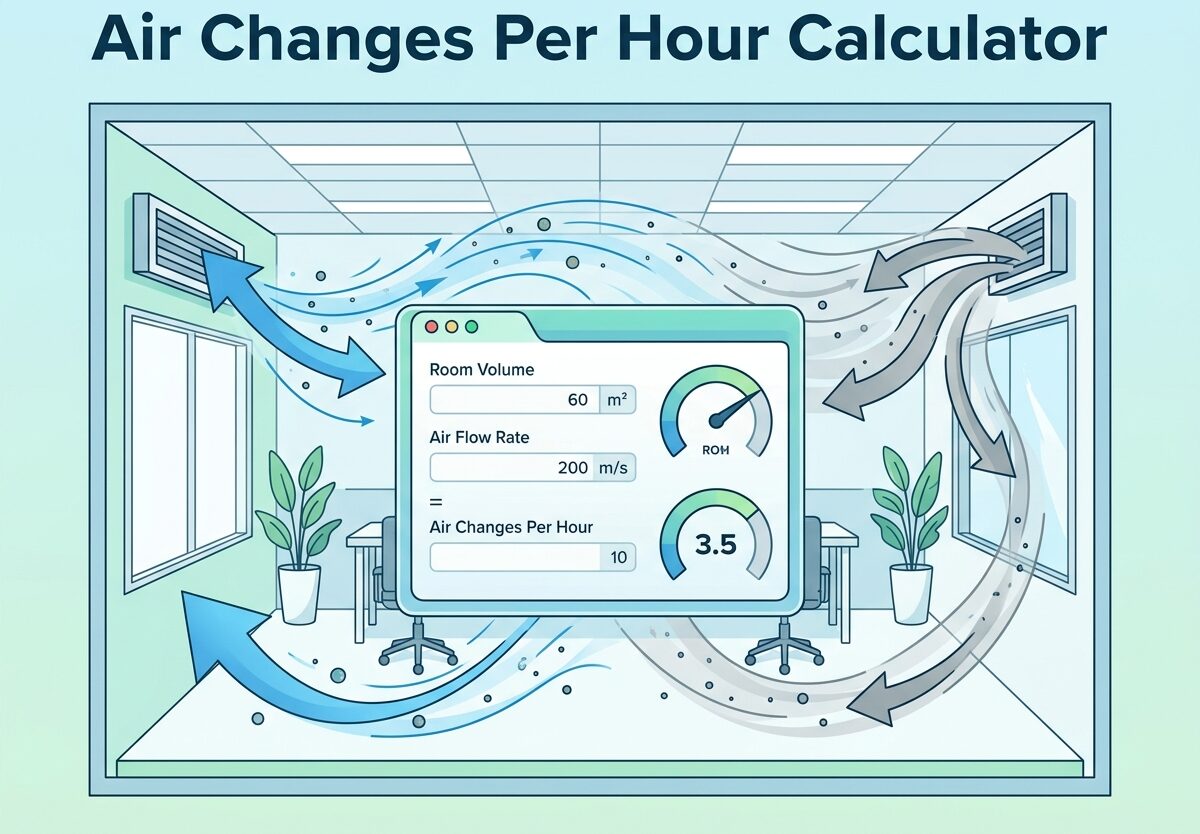
Understanding proper ventilation is essential for maintaining healthy indoor air quality, whether you’re designing a HVAC system, selecting an air purifier, or simply trying to improve airflow in your home. This Air Changes Per Hour Calculator guide will help you understand what ACH means, how to calculate it, and what values are appropriate for different spaces.
Proper air exchange removes contaminants, controls humidity, and ensures fresh air circulates effectively throughout any room or building. Let me walk you through everything you need to know about calculating and optimizing air changes per hour.
What is Air Changes Per Hour (ACH)?
Air Changes Per Hour (ACH), sometimes called Air Changes Rate (ACR) or Air Exchange Rate, measures how many times the total volume of air in a space is completely replaced with fresh air in one hour. This metric is fundamental to understanding ventilation effectiveness and indoor air quality.
When we talk about ACH, we’re essentially measuring the complete replacement of air in a room. A space with 4 ACH experiences four complete air exchanges every hour, or one full exchange every 15 minutes. This continuous replacement removes stale air, airborne contaminants, excess moisture, and helps maintain consistent temperature and humidity levels.
The importance of proper ACH cannot be overstated. Adequate air exchange reduces exposure to airborne pathogens, removes volatile organic compounds (VOCs) from building materials and cleaning products, controls odors, and prevents moisture buildup that can lead to mold growth. Healthcare facilities, laboratories, and commercial kitchens require much higher ACH rates than residential spaces due to their specific air quality needs.
ACH differs from simple airflow measurements because it accounts for room size. A 500 CFM fan might provide excellent ventilation in a small bathroom but inadequate air exchange in a large warehouse. This is why calculating ACH requires knowing both the airflow rate and the room volume.
ACH Formula and Calculation Method
The Air Changes Per Hour calculation uses a straightforward formula that relates airflow rate to room volume. Here’s the complete ACH formula:
ACH = (CFM × 60) ÷ Room Volume
Where CFM is Cubic Feet per Minute (the airflow rate), and Room Volume is calculated as Length × Width × Height in cubic feet. The multiplication by 60 converts the per-minute airflow rate to an hourly rate.
Let me break this down into practical steps you can follow:
Step 1: Measure Room Dimensions
Measure the length, width, and height of your room in feet. For example, a typical bedroom might be 15 feet long, 12 feet wide, and 8 feet high.
Step 2: Calculate Room Volume
Multiply these three dimensions together. Using our example: 15 × 12 × 8 = 1,440 cubic feet of air volume in the room.
Step 3: Determine Airflow Rate (CFM)
Find the CFM rating of your ventilation equipment, fan, or air purifier. This information is typically found on the device specification label or in the product manual. Let’s assume we have a bathroom exhaust fan rated at 100 CFM.
Step 4: Apply the ACH Formula
Using our values: ACH = (100 CFM × 60) ÷ 1,440 cubic feet = 6,000 ÷ 1,440 = 4.17 ACH
This means the bathroom fan would completely replace the air in that room approximately 4.17 times per hour, or roughly once every 14 minutes. This calculation method works for any space, from small residential rooms to large commercial buildings, as long as you know the airflow rate and room volume.
Recommended Air Changes Per Hour by Room Type
Different spaces require different ACH rates based on their intended use, occupancy, and air quality requirements. The following table provides recommended ACH values for common residential, commercial, and specialized applications based on ASHRAE standards and industry best practices.
Residential Applications
Living rooms and bedrooms typically require 3-4 ACH for adequate ventilation. These spaces have lower air contamination risks compared to bathrooms or kitchens, but still benefit from regular air exchange to remove CO2 from breathing and maintain freshness.
Kitchens generally need 7-15 ACH due to cooking fumes, moisture, and potential gas combustion byproducts. Range hoods should provide higher ACH during active cooking, while background ventilation maintains baseline air quality.
Bathrooms require 6-8 ACH to effectively remove moisture and odors. Exhaust fans should be sized to provide at least this level of air exchange to prevent mold growth and maintain comfort.
Garages and workshops need 4-6 ACH minimum, with higher rates (8-10 ACH) when working with chemicals, paints, or generating particulates. Attached garages require careful ventilation to prevent vehicle exhaust from entering living spaces.
Commercial Applications
Office spaces typically require 4-6 ACH to maintain occupant comfort and cognitive function. Higher occupant density may necessitate increased air exchange rates.
Restaurants and dining areas need 8-12 ACH to control cooking odors, remove moisture, and maintain customer comfort. Kitchen areas may require 15-20 ACH or higher depending on cooking intensity and equipment.
Retail stores generally require 4-8 ACH depending on customer density, store size, and whether cooking or other activities occur on-site.
Healthcare and Specialized Facilities
Patient rooms require 4-6 ACH for general ventilation, with higher rates (12+ ACH) for airborne infection isolation rooms. Operating rooms typically need 15-20+ ACH to maintain sterile conditions.
Laboratories vary widely based on their use: general labs need 4-8 ACH, while chemical fume hoods and specialized containment areas may require 12-15+ ACH to safely handle hazardous materials.
Cleanrooms for electronics or pharmaceutical manufacturing often require 20-600+ ACH depending on the required cleanliness classification (ISO class).
Practical Applications and Considerations
Understanding the difference between total ACH and outdoor air ACH is crucial for proper ventilation design. Total ACH includes all air movement in a space, including recirculated air that passes through filters. Outdoor air ACH refers specifically to fresh air brought in from outside, which is what ASHRAE standards typically reference.
In many buildings, HVAC systems provide a mix of recirculated and outdoor air. While recirculated air that passes through high-quality filters can improve air quality, outdoor air is essential for diluting CO2 and removing contaminants that filters cannot capture. Modern building codes specify minimum outdoor air ACH rates for different occupancy types.
Equivalent ACH (eACH) from Air Purifiers
Air purifiers can provide equivalent air changes even when they don’t bring in outdoor air. The concept of equivalent ACH (eACH) helps quantify air purifier effectiveness by calculating how many times per hour the device processes the total room volume. For example, an air purifier with 300 CFM airflow in a 1,440 cubic foot room provides eACH = (300 × 60) ÷ 1,440 = 12.5 air changes per hour.
This eACH concept became particularly relevant during the COVID-19 pandemic, with CDC and ASHRAE recommending 5+ total air changes per hour (including both outdoor air and air cleaner eACH) for reducing airborne transmission risk in occupied spaces.
Metric Unit Calculations
For those using metric measurements, the ACH formula remains conceptually the same but uses cubic meters per hour (m³/h) instead of CFM. The metric formula is: ACH = Airflow Rate (m³/h) ÷ Room Volume (m³). Room volume in metric is Length × Width × Height in meters.
To convert between systems: 1 CFM = 1.699 m³/h. A 100 CFM fan moves approximately 170 m³/h of air. This conversion is helpful when working with international equipment specifications or building codes.
Energy Efficiency Considerations
Higher ACH rates improve air quality but increase energy costs for conditioning outdoor air. Energy recovery ventilators (ERVs) and heat recovery ventilators (HRVs) can precondition incoming outdoor air using exhaust air heat, reducing the energy penalty of higher ventilation rates. In climates with extreme temperatures, balancing air quality goals with energy efficiency requires careful system design.
For existing spaces, measuring actual airflow can be challenging without specialized equipment. If CFM ratings are unavailable, airflow capture hoods or anemometer measurements can provide accurate readings. Some ventilation professionals use tracer gas testing to determine actual air exchange rates in complex spaces.
Frequently Asked Questions
How do you calculate air change per hour?
To calculate air change per hour, multiply your airflow rate in CFM by 60, then divide by the room volume in cubic feet. The formula is ACH = (CFM × 60) ÷ Room Volume. For example, a 200 CFM fan in a 1,200 cubic foot room provides ACH = (200 × 60) ÷ 1,200 = 10 air changes per hour.
What is 4 air changes per hour?
4 air changes per hour means the complete volume of air in a space is replaced with fresh air four times every hour, or once every 15 minutes. This is a typical ventilation rate for residential living rooms and bedrooms, providing adequate air exchange for comfort and indoor air quality without excessive energy costs.
How many air changes per hour for a living room?
Living rooms typically require 3-4 air changes per hour for adequate ventilation. This rate balances air quality needs with energy efficiency, removing CO2 from breathing and maintaining freshness without excessive conditioning costs. Higher occupant density or activities that generate pollutants may warrant increased ACH.
What is the minimum outdoor air changes per hour?
Minimum outdoor air ACH requirements vary by building type and occupancy, but ASHRAE 62.1 typically specifies 0.35-0.5 ACH of outdoor air for residential spaces, with higher rates for commercial buildings. Outdoor air ACH refers specifically to fresh air brought in from outside, separate from recirculated air. These minimums ensure adequate dilution of CO2 and other contaminants.
Conclusion
Calculating and understanding Air Changes Per Hour is essential for anyone concerned with indoor air quality, whether you’re a homeowner selecting ventilation equipment, a facility manager optimizing HVAC systems, or a healthcare professional maintaining safe environments. The ACH formula provides a standardized way to measure and compare ventilation effectiveness across different spaces and applications.
Use this Air Changes Per Hour Calculator knowledge to evaluate your current ventilation, select appropriately sized equipment, and ensure your spaces meet recommended air exchange standards. Proper ACH levels protect health, improve comfort, and create safer indoor environments for everyone.

Leave a Comment