
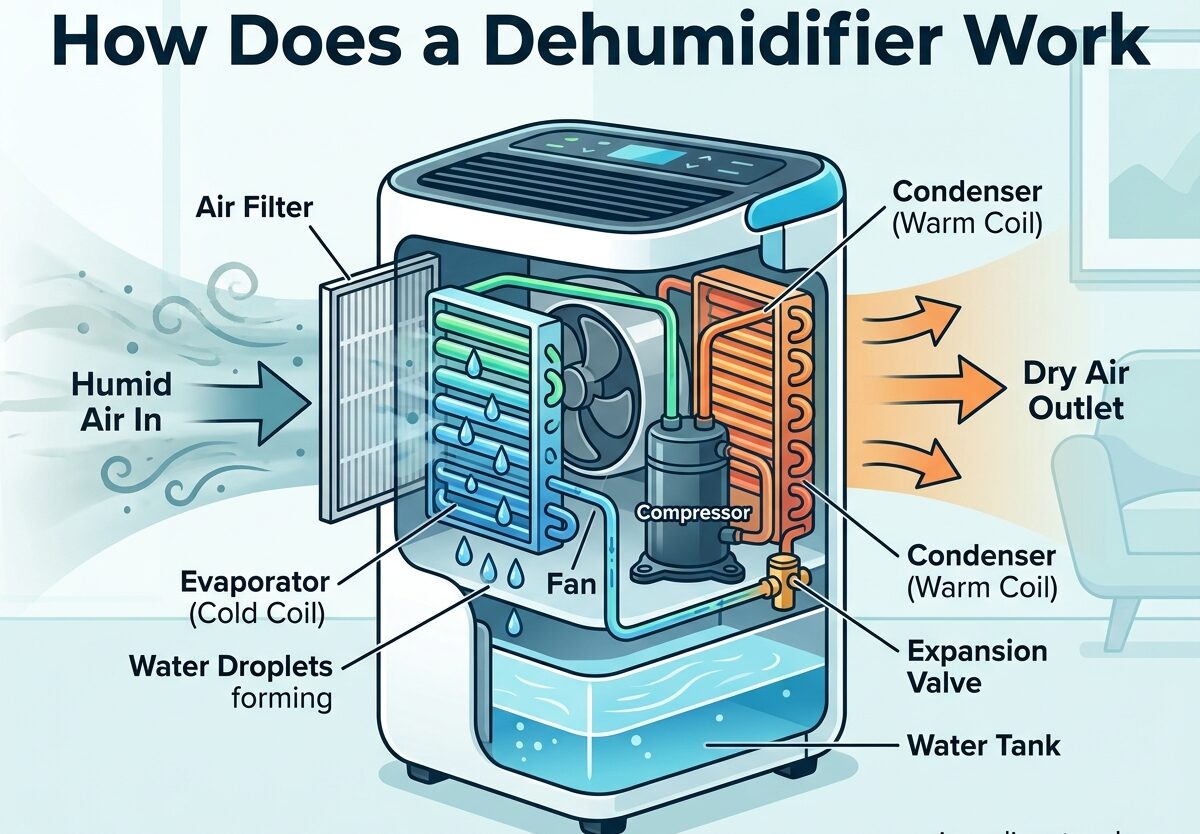
Have you ever noticed water droplets forming on the outside of a cold soda can on a hot day? That same principle is exactly how a dehumidifier works. It pulls moisture out of the air by cooling it down, collecting the water, and releasing dry air back into your room.
Understanding how does a dehumidifier work can help you decide if you need one, which type to choose, and what to expect from it. In this guide, I’ll break down the entire process in simple terms, explain the science behind it, and share real-world insights from homeowners who actually use these devices.
What Is a Dehumidifier?
A dehumidifier is an electrical appliance designed to reduce and maintain healthy humidity levels in indoor spaces. It works by drawing in moist air, removing the excess water vapor, and circulating drier air back into the room.
The ideal indoor humidity level is between 30% and 50%. When humidity rises above this range, you might notice sticky floors, condensation on windows, musty odors, or even mold growth. A dehumidifier helps prevent these problems by actively removing moisture from the air.
Relative humidity refers to the amount of moisture in the air compared to the maximum amount the air can hold at that temperature. Warm air can hold more moisture than cold air, which is why humidity often feels more oppressive in summer. This physical property is what makes dehumidification possible.
How Does a Dehumidifier Work?
The process is surprisingly simple once you understand the basic components. Most residential dehumidifiers use a refrigeration-based system that works like a miniature air conditioner. Here’s the step-by-step process:
Step 1: Air Intake
A fan inside the dehumidifier pulls warm, humid air from your room into the unit. This is the same type of fan you might hear running when the dehumidifier is operating.
Step 2: Cooling the Coils
The moist air passes over cold metal coils filled with refrigerant. These coils are kept cold by a compressor, similar to how your refrigerator keeps its interior cold. The refrigerant circulates through the system, absorbing heat from the air.
Step 3: Condensation
As the warm air hits the cold coils, it cools down rapidly. Remember that cold air can’t hold as much moisture as warm air. When the air temperature drops below its dew point, the water vapor condenses into liquid droplets on the coils—just like those droplets on your cold soda can.
Step 4: Water Collection
The condensed water droplets drip off the coils and fall into a collection bucket or reservoir beneath the unit. Depending on your humidity levels, a dehumidifier can collect anywhere from a few ounces to several pints of water per day. Many users report collecting around 2.4 liters (about 2.5 quarts) in 24 hours during particularly humid conditions.
Step 5: Air Reheating
After the moisture has been removed, the now-dry air passes over warm coils before being released back into your room. This reheating process brings the air temperature closer to room temperature, so the dehumidifier doesn’t significantly cool your space like an air conditioner would.
Step 6: Air Release
The dry, slightly warmed air is circulated back into your room. This air has much less moisture than when it entered the dehumidifier, which gradually lowers the overall humidity level in your space.
The entire process runs continuously as long as the dehumidifier is powered on and the humidity level exceeds your set target. Most models have a built-in humidistat that measures the current humidity and automatically cycles the unit on and off to maintain your desired level.
The Refrigeration Cycle Explained
The refrigeration cycle is the heart of how most dehumidifiers work. It’s the same technology used in air conditioners, refrigerators, and heat pumps. Here’s what’s happening inside your dehumidifier:
The compressor pumps refrigerant through the system, creating a continuous cycle of evaporation and condensation. When refrigerant evaporates in the evaporator coils, it absorbs heat from the surrounding air, making those coils cold. This is what causes the moisture in your air to condense.
After absorbing heat, the refrigerant travels to the condenser coils where it releases that heat. This is why the air coming out of your dehumidifier feels slightly warm. The refrigerant, now cooled again, cycles back to the evaporator coils to repeat the process.
This heat exchange process is incredibly efficient. It’s why dehumidifiers can remove pounds of water from the air while consuming relatively little electricity. The refrigeration cycle is a closed system—no refrigerant is consumed or released during normal operation.
What makes dehumidifiers different from air conditioners is what happens to the heat. Air conditioners exhaust the heat outdoors through an external unit. Dehumidifiers release that heat back into your room, which is why they don’t significantly cool your space despite using similar technology.
Types of Dehumidifiers
While most residential dehumidifiers use the refrigeration method I described above, there’s another type you should know about. Understanding the differences can help you choose the right option for your situation.
Refrigerant (Compressor) Dehumidifiers
These are the most common type found in homes. They work best in temperatures above 65°F (18°C). In colder environments, the coils can become too cold and ice over, which triggers an automatic defrost cycle that temporarily stops dehumidification. If you’re using a refrigerant dehumidifier in a cool basement, you might notice it cycles on and off more frequently or works less effectively.
Refrigerant dehumidifiers are excellent for most residential applications, especially in warm, humid climates. They’re relatively energy-efficient for the amount of water they can remove and work quickly when conditions are right.
Desiccant Dehumidifiers
Instead of using cold coils to condense moisture, desiccant dehumidifiers use a water-absorbing material like silica gel (the same stuff in those little do-not-eat packets). The moist air passes through a wheel coated with this material, which absorbs the water vapor like a sponge.
Once the material is saturated, a heating element warms it to release the collected water into a reservoir. The wheel then rotates back into position to absorb more moisture. Desiccant dehumidifiers work well in colder temperatures because they don’t rely on cooling the air to extract moisture.
The tradeoff is that desiccant models typically consume more electricity and release warmer air into your space. They’re also often noisier than refrigerant models. However, if you need to dehumidify a cold garage, crawlspace, or unheated basement, a desiccant model might be your best option.
Choosing the Right Type
For most homeowners in typical living spaces, a refrigerant dehumidifier is the practical choice. They’re widely available, energy-efficient, and effective in the temperature ranges where most people live and work. Consider a desiccant model only if you need to dehumidify a space that consistently stays below 65°F.
Real-World Water Collection: What to Expect
One of the most common questions from new dehumidifier owners is how much water they should expect to collect. The answer varies widely based on several factors, but real-world experiences can help set realistic expectations.
In moderately humid conditions (50-60% humidity), a typical residential dehumidifier might collect 1-2 pints (0.5-1 liter) per day. In very humid conditions (70%+ humidity) or in especially damp spaces like basements, that number can jump to 4-6 pints (2-3 liters) or more daily.
Forum users frequently express surprise at how much water their dehumidifiers collect. One homeowner reported collecting 2.4 liters (about 2.5 quarts) in just 24 hours during a particularly humid stretch. Another mentioned filling their 2-liter tank twice daily in a damp basement.
Several factors affect how much water your dehumidifier will collect. The humidity level is obviously the biggest factor—more humid air means more water to extract. Room size matters too, as larger spaces contain more total moisture. Temperature plays a role because warm air holds more moisture than cold air. Air circulation affects how efficiently the dehumidifier can process all the air in a room.
If your dehumidifier is collecting very little water, check that it’s sized appropriately for your space, the humidity setting isn’t already reached, and there’s adequate airflow around the unit. Conversely, if it’s collecting more water than expected, you might have a moisture problem that needs attention, like a water leak or poor ventilation.
Benefits of Using a Dehumidifier
Now that you understand how does a dehumidifier work, you might wonder why you’d need one. The benefits extend far beyond just comfort. Here’s what controlling indoor humidity can do for your home and health:
Mold and Mildew Prevention
Mold thrives in humidity above 60%. By maintaining levels between 30-50%, you create an environment where mold struggles to grow. This protects your home from structural damage and prevents the musty odors that often accompany hidden mold growth.
Allergen Reduction
Dust mites, one of the most common indoor allergens, need humidity to survive. When you reduce moisture, dust mite populations decline dramatically. This can mean fewer allergy symptoms and better respiratory health for sensitive individuals.
Improved Comfort
High humidity makes air feel warmer and stickier. By reducing moisture, the air feels cooler and more comfortable even at the same temperature. Many people find they can set their thermostat a degree or two higher in summer when using a dehumidifier, potentially saving on cooling costs.
Home Protection
Excess moisture can warp wood flooring, damage drywall, and cause paint to peel. It can also cause electronics to corrode and create rust on metal surfaces. By controlling humidity, you protect your home’s structure and your belongings from moisture-related damage.
Better Sleep
Many people sleep better in drier air. High humidity can make breathing feel heavy and worsen snoring. Using a dehumidifier in your bedroom can create a more comfortable sleep environment and may help reduce nighttime congestion.
Faster Drying
If you dry clothes indoors or have damp spaces after cleaning, a dehumidifier can accelerate the drying process significantly. It pulls moisture from wet items much faster than air drying alone.
Where Should You Use a Dehumidifier?
Dehumidifiers can benefit various spaces throughout your home, but some locations need them more than others. Here’s where to consider placing yours:
Basements
Basements are the most common location for dehumidifiers because they’re naturally prone to excess moisture. Cool underground temperatures combined with limited airflow create ideal conditions for condensation. If you notice a musty smell or see damp spots on walls, your basement likely needs a dehumidifier.
Crawlspaces
Like basements, crawlspaces often have humidity issues that can affect the entire home. Moisture here can migrate upward, causing problems throughout your living space. Special crawlspace dehumidifiers are designed to operate in tight spaces with lower clearance.
Bathrooms
If your bathroom lacks adequate ventilation or you notice persistent moisture problems after showers, a small dehumidifier can help. However, improving ventilation with an exhaust fan is usually the better first step for bathrooms.
Bedrooms
Using a dehumidifier in your bedroom can improve sleep quality, especially if you live in a humid climate or notice congestion when you wake up. Look for models with lower noise ratings if you plan to run one while sleeping.
Laundry Rooms
Indoor clothes drying releases significant moisture into the air. A dehumidifier in or near your laundry area can prevent the excess humidity from spreading to the rest of your home.
Whole-House Systems
For comprehensive humidity control, you can install a whole-house dehumidifier that works with your existing HVAC system. These are more expensive upfront but provide consistent humidity control throughout your entire home without the need to empty water tanks manually.
How a Dehumidifier Compares to an Air Conditioner
Since dehumidifiers and air conditioners use similar technology, it’s natural to wonder about the differences. Both use refrigeration to remove moisture from air, but their primary purposes differ.
An air conditioner’s main job is to cool your space, with dehumidification as a secondary benefit. As AC cools the air, it removes some moisture, but it’s not optimized for maximum water extraction. The cooled air is exhausted into your room, lowering the temperature significantly.
A dehumidifier focuses specifically on moisture removal. While it does use the same refrigeration principles, the extracted heat is released back into your space rather than exhausted outdoors. This means a dehumidifier won’t significantly cool your room, despite using similar technology to an air conditioner.
Can they work together? Absolutely. In fact, using a dehumidifier alongside your air conditioner can improve comfort and efficiency. The dehumidifier handles moisture removal, allowing the AC to focus more on cooling. This can help you feel comfortable at slightly warmer thermostat settings, potentially reducing energy consumption.
However, in very humid climates, you might find that running both simultaneously is unnecessary. Start with one device and monitor how it affects your comfort and humidity levels before adding the other.
Things to Consider Before Running a Dehumidifier
While dehumidifiers offer many benefits, there are some practical considerations to keep in mind before making a purchase or running one continuously:
Electricity Costs
Dehumidifiers consume electricity, and running one 24/7 can add to your energy bill. The exact cost depends on the model’s efficiency, how often it runs, and your local electricity rates. Look for ENERGY STAR certified models, which are more efficient than standard options.
Noise Level
All dehumidifiers make some noise due to the fan and compressor. Noise levels typically range from 20-50 decibels, with quieter models suitable for bedroom use. If noise is a concern, look for models specifically marketed as quiet or consider placing the unit in a less frequently used space.
Maintenance Requirements
Dehumidifiers need regular maintenance to work efficiently. You’ll need to empty the water tank regularly (unless you set up continuous drainage), clean or replace filters, and occasionally clean the coils to prevent mold and bacteria growth. Some models also require periodic defrosting in cold conditions.
Temperature Limitations
Standard refrigerant dehumidifiers work best in temperatures above 65°F. In colder spaces, they become less effective and may ice up. If you need to dehumidify a cool space, consider a desiccant model designed for lower temperatures.
Water Tank Emptying
The frequency of emptying depends on your humidity levels and the tank size. In very humid conditions, you might need to empty the tank daily or more often. Many models offer continuous drainage options, which allow you to connect a hose for automatic water removal.
Frequently Asked Questions About How Dehumidifiers Work
How long does it take for a dehumidifier to dry a room?
The time varies based on room size, initial humidity level, and the dehumidifier’s capacity. In a typical bedroom with moderately high humidity (60-70%), you might notice improvement within 2-4 hours. However, reaching your target humidity level could take 12-24 hours of continuous operation in larger spaces or more severe humidity problems.
What are the downsides of a dehumidifier?
The main downsides include electricity consumption, noise from the fan and compressor, and maintenance requirements like emptying the water tank and cleaning filters. Some models also release warm air back into the room, which can be undesirable in already-warm weather. Dehumidifiers can also dry out the air too much if not monitored, potentially causing dry skin or respiratory irritation.
Is it healthy to sleep in a room with a dehumidifier?
Yes, sleeping with a dehumidifier running can be healthy, especially if you live in a humid climate or notice congestion when waking up. Proper humidity control can reduce allergens like dust mites and create a more comfortable sleep environment. Just ensure humidity doesn’t drop below 30%, as overly dry air can irritate nasal passages and throat. Look for models with low noise ratings if you plan to run one while sleeping.
Can a dehumidifier help with snoring?
Dehumidifiers may help reduce snoring for some people, particularly if humidity contributes to nasal congestion or swelling. High humidity can make breathing feel heavier and worsen allergies that might contribute to snoring. By maintaining optimal humidity levels (30-50%), a dehumidifier can create a more comfortable breathing environment. However, snoring has many causes, so results vary and a dehumidifier isn’t a guaranteed solution.
At what temperature does a dehumidifier stop working?
Standard refrigerant dehumidifiers become less effective below 65°F (18°C) and may stop working efficiently below 41°F (5°C) as the coils can ice over. If you need to dehumidify a cold space like an unheated garage or crawlspace, consider a desiccant dehumidifier designed to work in lower temperatures. Some refrigerant models include defrost features that allow limited operation in cooler conditions.
Conclusion
Understanding how does a dehumidifier work demystifies these helpful appliances. They use a simple refrigeration process to pull moisture from your air, collect it in a tank, and release drier air back into your space. The same principle that causes water to condense on a cold soda can is harnessed to control humidity in your home.
Whether you’re dealing with a damp basement, allergy concerns, or just want more comfortable indoor air, a dehumidifier can make a significant difference. By maintaining humidity between 30-50%, you create an environment where mold struggles to grow, allergens are reduced, and your home stays protected from moisture damage.
If you’re considering a dehumidifier, start by measuring your current humidity levels with a hygrometer. This will help you determine if you actually need one and allow you to track its effectiveness over time. With the right dehumidifier for your space and proper maintenance, you can enjoy healthier, more comfortable indoor air year-round.




Leave a Comment