
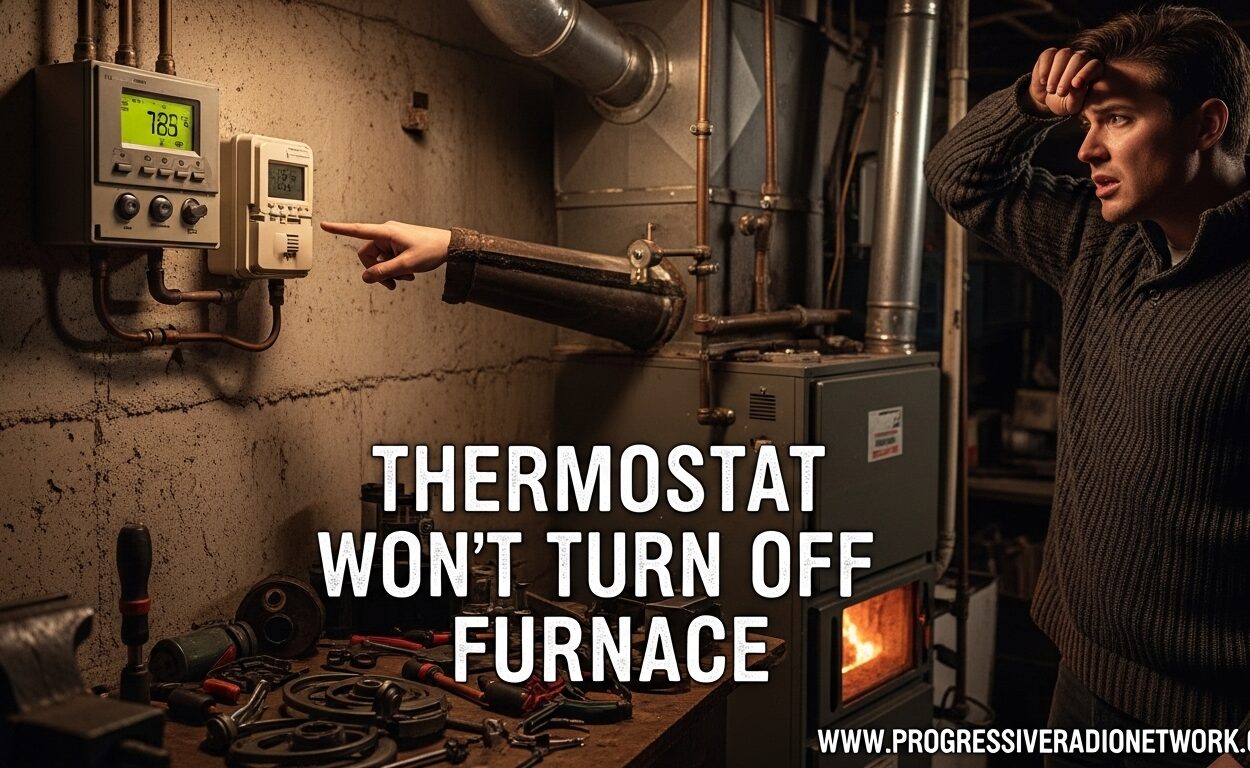
You set your thermostat to a comfortable 70 degrees, but your furnace keeps blasting heat. The house feels like a sauna, your energy bill is climbing, and nothing you do seems to stop the continuous heating. This frustrating problem – when your thermostat wont turn off furnace – happens more often than you’d think.
Based on HVAC industry data, a furnace that won’t shut off is typically caused by one of five common issues: incorrect thermostat settings, a dirty air filter, a faulty thermostat, a stuck relay switch, or blower motor problems. The good news is that most of these problems have straightforward solutions you can try yourself before calling a professional.
In this guide, I’ll walk you through exactly why your furnace runs continuously and how to fix it safely. Let’s start with the most important step.
How to Turn Off Your Furnace Manually (Emergency)
Before we dive into troubleshooting, you need to know how to stop your furnace immediately if it’s causing unsafe conditions. Here’s the fastest way to shut down your heating system:
Step 1: Turn off your thermostat completely by switching it to the “OFF” position.
Step 2: If the furnace keeps running, locate your furnace’s power switch. It looks like a standard light switch and is usually mounted on or near your furnace unit. Flip it OFF.
Step 3: If that doesn’t work, go to your electrical panel and find the circuit breaker labeled “furnace” or “HVAC.” Flip it to the OFF position.
Safety warning for gas furnaces: If you suspect your gas valve is stuck open (you smell gas or the burners won’t extinguish), evacuate your home immediately and call your gas company’s emergency line from outside. Do not attempt to manually close a gas valve if you’re not trained to do so.
Now that you know how to shut things down safely, let’s identify what’s causing the problem.
Wrong Thermostat Settings (Most Common Cause)
The number one reason your furnace won’t turn off is surprisingly simple: incorrect thermostat settings. I’ve seen this issue countless times, and it’s often the first thing an HVAC technician will check.
The Fan ON vs. AUTO setting issue: This is the most common culprit. Many people accidentally set their fan to “ON” instead of “AUTO.” Here’s the difference:
- AUTO: The fan only runs when your furnace is actively heating. Once your home reaches the set temperature, both the burners and the fan shut off.
- ON: The fan runs continuously, 24/7, regardless of whether your furnace is heating. Your burners will cycle off, but the blower keeps pushing air.
How to check your fan setting:
Look at your thermostat display. You should see a fan setting with options for “AUTO” and “ON.” If it’s set to “ON,” switch it to “AUTO” and wait 10-15 minutes. The fan should stop running once your home reaches the set temperature.
Temperature differential check: Make sure your thermostat’s set temperature is actually higher than the current room temperature. If your thermostat is set to 72 degrees but your room is already at 74 degrees, your furnace shouldn’t be running at all. Try setting the temperature 5 degrees below the current room temperature to see if the furnace responds.
If adjusting these settings doesn’t solve the problem, move on to the next potential cause.
Dirty or Clogged Air Filter
A dirty air filter is the second most common reason your furnace won’t turn off. Here’s why: when your air filter is clogged with dust and debris, your furnace can’t circulate air properly. This restricted airflow causes your furnace to overheat internally.
When this happens, your furnace’s limit switch (a safety device designed to prevent overheating) triggers and keeps your blower fan running to cool down the system. Even though the burners cycle off, the fan continues running as a safety measure.
How to check your air filter:
Locate your air filter (usually between your return air duct and your furnace, or inside the blower compartment). Hold it up to a light source. If you can’t see light through the filter, it’s time to replace it.
The fix: Replace your filter with a new one of the same size. Most homeowners should change their filters every 1-3 months, depending on factors like pets, allergies, and household dust levels.
After replacing the filter, your furnace should return to normal operation within an hour or so. The blower fan will stop running once the system cools down and the limit switch resets.
Faulty or Malfunctioning Thermostat
If your thermostat settings are correct and your air filter is clean, the problem might be the thermostat itself. A malfunctioning thermostat can fail to send the “off” signal to your furnace, causing continuous heating.
Signs of a failing thermostat include:
- The display is blank, flickering, or showing error codes
- The thermostat doesn’t respond when you adjust settings
- The temperature reading is inaccurate compared to actual room temperature
- The furnace continues running even with thermostat removed from the wall
Quick thermostat test:
Remove your thermostat from its wall plate. Most models pull straight off or have a release tab. Once removed, your furnace should stop running within a few minutes. If it does, the thermostat is likely faulty and needs replacement.
Common wiring mistake: If you recently installed a new thermostat yourself, check your wiring connections. A common error is placing the white wire on the wrong terminal. The white wire should be connected to the “W” terminal (for heating), not “O/B” (for cooling reversing valve on heat pumps). This simple mistake can cause your furnace to run continuously.
Thermostat replacement typically costs between $15 and $250 depending on the model, making this a relatively affordable fix if you’re comfortable with basic electrical work.
Stuck Relay Switch on Control Board
Your furnace’s control board contains relay switches that act like traffic lights for your heating system. These switches tell your furnace when to start and stop heating. When a relay switch gets stuck in the “closed” position, it continuously sends power to your furnace components.
Symptoms of a stuck relay include:
- Furnace runs even with thermostat completely removed
- Changing thermostat settings has no effect
- You hear clicking sounds from the control board
- The only way to stop the furnace is flipping the circuit breaker
What causes relays to stick?
Relay switches can fail due to electrical surges, normal wear over time, or exposure to moisture and dust. In areas with power fluctuations, surge protectors can help extend relay life.
The fix: Unfortunately, a stuck relay usually means replacing the entire control board. This typically costs between $200 and $600 for parts plus labor, depending on your furnace model. While some DIY enthusiasts tackle this repair, it involves working with high-voltage electrical components and is often best left to trained HVAC technicians.
Blower Motor and Limit Switch Problems
Blower motor issues can cause your furnace fan to run continuously, even when heating isn’t needed. Two main components are involved: the blower motor itself and the fan limit switch.
Faulty limit switch: The limit switch monitors the temperature inside your furnace and tells the blower when to turn on and off. If this switch fails or miscalibrates, it might keep the fan running constantly. Some limit switches are adjustable, while others require replacement.
Blower motor issues: If the blower motor’s capacitor fails, the motor might run continuously without properly cycling. A capacitor is a small cylindrical component that helps start the motor. Replacing a capacitor typically costs less than $50 and is a straightforward repair.
For electric furnaces: Electric systems use heat sequencers instead of gas valves. A faulty heat sequencer can cause your electric furnace to keep heating. If you have an electric furnace and hear a clicking sound that won’t stop, a stuck sequencer is likely the culprit.
Reddit users have shared experiences where their furnace displayed error codes like “2 amber flashes” when the blower wasn’t responding properly. If your furnace has a diagnostic window, note any flash patterns – these codes can help technicians pinpoint the problem faster.
Gas Valve Stuck Open (Gas Furnaces Only – Safety Warning)
This is a serious safety issue that requires immediate attention. If your gas furnace’s valve is stuck open, gas continues flowing to the burners even when the thermostat sends an “off” signal. This is rare but dangerous.
Signs of a stuck gas valve include:
- Burners remain lit even with thermostat off
- Strong gas smell near your furnace
- Excessive heat coming from furnace unit
- Carbon monoxide detector activating
Immediate action required:
- Do NOT try to manually close the gas valve unless you know exactly what you’re doing
- Turn off the furnace using the circuit breaker
- If you smell gas, evacuate your home immediately
- Call your gas company’s emergency line or a licensed HVAC technician
This is not a DIY repair situation. Gas valve problems require professional service for your safety.
When to Call an HVAC Professional
While many furnace issues are DIY-friendly, some problems require professional expertise. Here’s when you should call a licensed HVAC technician:
Call a professional if:
- Your furnace won’t shut off even after flipping the circuit breaker (indicates serious electrical issue)
- You smell gas or suspect a gas valve problem
- Your carbon monoxide detector has activated
- You’re uncomfortable working with electrical wiring
- The problem persists after trying all troubleshooting steps above
- Your furnace is over 15 years old and this is a recurring issue
What to expect from a professional service call:
A licensed technician will typically charge $75-150 for a diagnostic fee, which may be applied toward repairs if you proceed. They have specialized tools to test electrical components, check gas pressure, and identify issues that aren’t visible to the naked eye.
Look for NATE-certified technicians (North American Technician Excellence) – this certification indicates thorough training and testing in HVAC systems. Many companies like Williams Comfort Air and Santoro Oil emphasize certification as a trust signal.
Cost considerations:
Simple thermostat replacement: $15-250 for parts
Control board replacement: $200-600 parts plus labor
Blower motor repair: $150-500 depending on motor type
Gas valve replacement: $300-700 parts plus labor
Frequently Asked Questions
Why wont my furnace turn off even with the thermostat off?
Your furnace may not turn off due to incorrect fan settings (set to ON instead of AUTO), a stuck relay switch on the control board, a faulty thermostat, or a malfunctioning limit switch. The most common cause is the fan setting being set to continuous run mode rather than auto.
Why is my furnace still running when the thermostat is off?
If your furnace runs with the thermostat off, check if the fan setting is ON instead of AUTO. If that’s not the issue, you may have a stuck relay switch, faulty control board, or wiring problem. These electrical issues keep sending power to your furnace even without thermostat input.
What are signs of a failing thermostat?
Signs include blank or flickering display, unresponsive temperature adjustments, inaccurate temperature readings, error codes on screen, and the furnace continuing to run even after removing the thermostat from the wall plate. If adjusting settings has no effect, your thermostat likely needs replacement.
What to do if your thermostat heat wont turn off?
First, set the fan to AUTO and lower the temperature setting below room temperature. If that fails, replace a dirty air filter that might be causing overheating. As a temporary fix, turn off the furnace at the circuit breaker. If problems persist after checking these basics, call an HVAC professional to inspect the control board and relay switches.
Conclusion
When your thermostat wont turn off furnace, it’s usually due to one of five common causes: incorrect fan settings, a dirty air filter, a faulty thermostat, a stuck relay switch, or blower motor problems. Start with the simple fixes first – check your fan setting and replace your air filter. These two steps solve most problems.
If you’ve tried all the troubleshooting steps and your furnace still runs continuously, don’t ignore it. A constantly running furnace wastes energy and can indicate serious safety issues, especially with gas systems. Contact a licensed HVAC technician to diagnose and repair the problem safely.
Regular maintenance – including annual professional inspections and monthly filter changes – can prevent many of these issues from occurring in the first place. Stay warm and stay safe.

Leave a Comment