
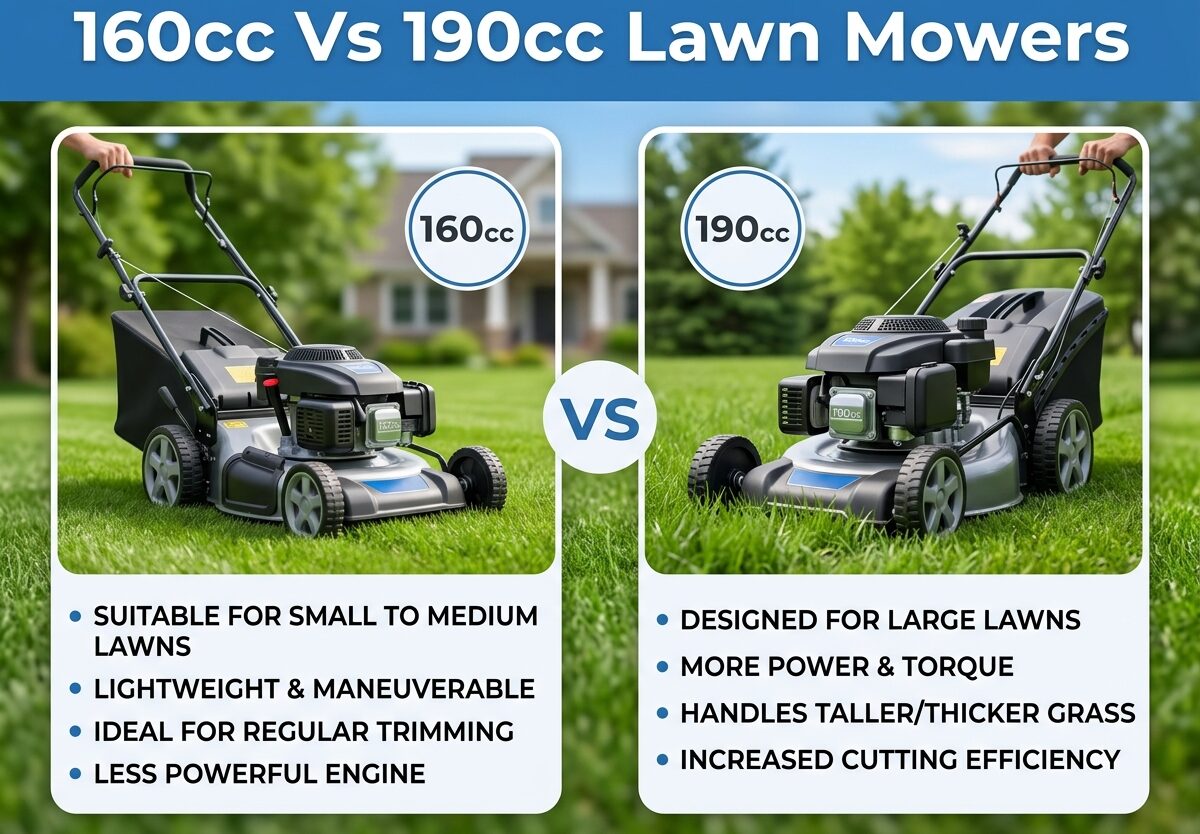
When shopping for a new walk-behind mower, you’ll notice engine sizes ranging from 140cc to over 200cc. The 160cc vs 190cc lawn mowers debate is one of the most common decisions homeowners face. These two engine sizes represent the sweet spot for residential lawn care, but understanding the real difference can save you money and frustration.
CC stands for cubic centimeters and measures engine displacement (the volume of fuel and air the piston can move in one stroke). A 190cc engine has 30cc more displacement than a 160cc, which translates to more power and torque. But does that extra power matter for your lawn?
After analyzing real user experiences and technical specifications, I’ll break down exactly when the upgrade makes sense and when you’re better off saving your money.
What Does CC Mean in Lawn Mowers?
CC refers to the engine’s displacement, measured in cubic centimeters. It represents the total volume of all cylinders in the engine. A larger cc means the engine can burn more fuel and air per combustion cycle, potentially generating more power.
Think of it like comparing a 4-cylinder car engine to a 6-cylinder. Both do the same job, but the larger engine has more capacity for work. However, bigger isn’t always better—it depends on what you need it to do.
Most residential lawn mowers range from 140cc to 190cc. Commercial models can exceed 200cc, but those are overkill for typical home lawns. The 160cc and 190cc engines are the most common sizes you’ll find at hardware stores and big-box retailers.
Power and Horsepower Comparison
The primary difference between these engines is power output. A typical 160cc lawn mower engine produces approximately 4.5-5.0 horsepower, while a 190cc engine usually delivers 5.5-6.5 horsepower. That might not sound like much, but it represents a 15-20% increase in power.
More importantly, the 190cc engine generates more torque—the twisting force that actually cuts through grass. Where a 160cc engine might produce around 6.5-7.0 ft-lbs of torque, a 190cc can deliver 8.0-8.5 ft-lbs or more.
This torque difference is what you feel when mowing. A 190cc engine maintains blade speed better when the going gets tough, whether that’s thick spring growth, wet grass, or bagging heavy clippings. The 160cc will bog down more easily under load.
Popular engines in this range include the Honda GCV160 and GCV190, as well as Briggs & Stratton’s 190cc series (often labeled as 8.50 ft-lbs gross torque). Interestingly, many users report that Honda’s 160cc engine performs comparably to Briggs’ 190cc in real-world conditions—brand quality matters as much as cc.
Torque Differences and What They Mean for Your Lawn
Torque is the real hero in lawn mower performance. Horsepower gets all the attention, but torque is what keeps the blade spinning through resistance.
When you hit a patch of thick grass or accidentally let your lawn get too tall between cuts, the engine faces resistance. A high-torque engine (190cc) powers through without slowing down. A lower-torque engine (160cc) will lose RPM, resulting in a ragged, uneven cut.
This is especially noticeable when mulching or bagging. Mulching requires extra power to recut clippings multiple times, while bagging adds the weight of collected grass. The 190cc engine handles both tasks with less strain.
Forum users on The Lawn Forum consistently report that the torque difference becomes apparent in challenging conditions. One user with both a 160cc and 190cc Toro Super Recycler noted that while both handle normal weekly mowing fine, the 190cc “doesn’t complain” when tackling overgrown areas.
Fuel Efficiency: Which Engine Uses Less Gas?
Here’s where the 160cc has an advantage. Smaller displacement means less fuel consumption per hour of operation. A 160cc engine will typically run 15-20% longer on the same amount of gas compared to a 190cc.
For a typical residential lawn (under 5,000 square feet), this difference might not matter much—you’re talking about a few cents per mow. But if you have a larger property or mow professionally, those savings add up over a season.
However, fuel efficiency isn’t just about engine size. A well-tuned 160cc can outperform a poorly maintained 190cc. Carburetor condition, air filter cleanliness, and fresh fuel all play significant roles in actual fuel consumption.
Weight, Maneuverability, and Handling
The 190cc engine is physically larger and heavier than its 160cc counterpart. We’re talking about 5-10 pounds difference, which affects push mowers more than self-propelled models.
If you’re pushing the mower yourself, that extra weight matters—especially on hills or during longer mowing sessions. A lighter 160cc mower can feel more nimble and easier to maneuver around obstacles.
Self-propelled mowers minimize this concern since the drive system does most of the work. In fact, the extra weight of a 190cc engine can provide better traction on slopes when combined with a good drive system.
Performance in Challenging Conditions
Wet grass is the ultimate test for any lawn mower. Moisture adds weight to the clippings and increases resistance on the blade. This is where the 190cc engine really shines.
Users consistently report that 160cc mowers struggle with wet spring grass, often requiring multiple passes or raking before mowing. The 190cc powers through with fewer clogs and better discharge.
Thick, tall grass presents a similar challenge. If you occasionally miss a week (or two) of mowing, the 190cc will handle the overgrowth more gracefully. The 160cc might bog down, leaving uncut strips or requiring you to raise the cutting height and make multiple passes.
For bagging leaves in autumn, the 190cc’s extra power helps maintain suction in the discharge chute, reducing clogs and improving collection efficiency.
Price Range and Value Comparison
Expect to pay $50-150 more for a 190cc model compared to an equivalent 160cc mower from the same brand. That premium covers the larger engine and often includes better features like electric start, enhanced deck design, or superior drive systems.
The question is whether that premium is worth it for your situation. If you have a small, flat lawn and mow regularly in dry conditions, the 160cc will serve you well for years. But if you face challenging mowing conditions regularly, the 190cc can be a worthwhile investment.
Consider your lawn size, terrain, grass type, and mowing frequency. These factors matter more than the engine size alone.
Lawn Size Recommendations
Matching your engine size to your lawn size is the key to satisfaction:
Under 3,000 square feet: A 160cc engine is plenty. Your lawn is small enough that even a lower-powered mower will finish the job quickly. Focus more on mower width and features than engine size.
3,000-8,000 square feet: This is the gray zone where either engine can work. If your lawn is flat and you mow weekly, 160cc is fine. If you have hills or thick grass, consider stepping up to 190cc.
Over 8,000 square feet: The 190cc becomes more attractive. The extra power reduces mowing time and handles the larger area without strain. You’ll appreciate the torque when bagging clippings from a big lawn.
Remember that lawn size isn’t the only factor. A small, hilly lawn with thick fescue might need more power than a large, flat lawn with fine Bermuda grass.
Signs You Need More Engine Power
How do you know if your current mower is underpowered? Watch for these symptoms:
• The engine bogs down and almost stalls when hitting thick patches
• You’re making multiple passes to get an even cut
• The discharge chute clogs frequently, especially when bagging
• You have to mow at the highest setting just to keep the engine running
• Wet grass forces you to stop and clear the deck constantly
If you experience any of these regularly, upgrading to a more powerful engine (or a better quality engine) could make your mowing routine much more enjoyable.
Brand Considerations: Honda Vs Briggs & Stratton
Engine brand matters as much as cc rating. Honda’s GCV series engines have a reputation for smooth operation and reliability, while Briggs & Stratton engines are known for raw torque and durability.
Many lawn care enthusiasts consider a Honda 160cc equivalent to a Briggs 190cc in terms of real-world performance. The Honda engine’s superior carburetion and compression efficiency make up for the smaller displacement.
When comparing, look beyond just the cc number. Check torque ratings (in ft-lbs), warranty terms, and service accessibility in your area. A well-supported 160cc from a reputable brand often outperforms a discount 190cc model.
Maintenance and Longevity
Both 160cc and 190cc engines require similar maintenance: regular oil changes, air filter replacement, spark plug service, and carburetor cleaning. Neither is inherently more maintenance-intensive than the other.
Some users report that Honda’s 160cc carburetor can be finicky coming out of winter storage, requiring patience to get started initially. Briggs engines tend to be more forgiving in this regard.
With proper maintenance, both engine sizes can last 8-12 years or more in residential use. The difference in longevity usually comes down to how well the mower is cared for, not the engine size.
Making Your Decision
The choice between 160cc and 190cc comes down to your specific situation:
Choose 160cc if:
• Your lawn is under 5,000 square feet
• Your terrain is relatively flat
• You mow regularly (weekly) in dry conditions
• You want lower fuel consumption and easier pushing
• Budget is a primary concern
Choose 190cc if:
• Your lawn exceeds 5,000 square feet
• You have hills or uneven terrain
• You frequently mow wet or thick grass
• You bag clippings or mulch heavily
• You want faster mowing with fewer passes
• You plan to keep the mower 8+ years
Frequently Asked Questions
What is the difference between 160cc and 190cc lawn mower engine?
The main difference is engine displacement. A 190cc engine has 30cc more displacement than a 160cc, resulting in approximately 15-20% more power and torque. This translates to better performance in challenging conditions like wet grass, thick growth, or when bagging clippings.
How many cc is good for a lawn mower?
For residential use, 140-160cc works well for lawns under 3,000 square feet. Medium lawns (3,000-8,000 sq ft) benefit from 160-190cc. Large lawns over 8,000 square feet or properties with hills are best served by 190cc or larger engines.
How many HP is a 190cc lawn mower?
A typical 190cc lawn mower engine produces 5.5-6.5 horsepower. However, horsepower isn’t the most important spec—torque matters more for cutting performance. Most 190cc engines deliver 8.0-8.5 ft-lbs of torque.
How many horsepower is a 160cc lawn mower?
A standard 160cc lawn mower engine generates approximately 4.5-5.0 horsepower and 6.5-7.0 ft-lbs of torque. This is sufficient for most residential lawns under 5,000 square feet with normal mowing conditions.
Is a 190cc lawn mower worth the extra money?
The 190cc is worth the extra $50-150 if you have a large lawn, hilly terrain, or frequently mow wet or thick grass. For small, flat lawns with regular mowing schedules, a 160cc will perform just as well and save you money upfront and on fuel.
Conclusion
When comparing 160cc vs 190cc lawn mowers, there’s no universal winner—only the right choice for your situation. The 190cc offers more power and better performance in challenging conditions, but the 160cc provides adequate performance for most residential lawns at a lower upfront and operating cost.
Focus on your lawn size, terrain, grass type, and mowing habits rather than just the cc number. A well-matched 160cc mower will outperform an overkill 190cc in the wrong conditions. Consider brand reputation and torque ratings alongside engine displacement.
For most homeowners with typical suburban lawns, the 160cc engine hits the sweet spot of power, efficiency, and value. Step up to 190cc if you regularly face challenging mowing conditions or simply want the peace of mind that comes with extra power on reserve.


Leave a Comment