
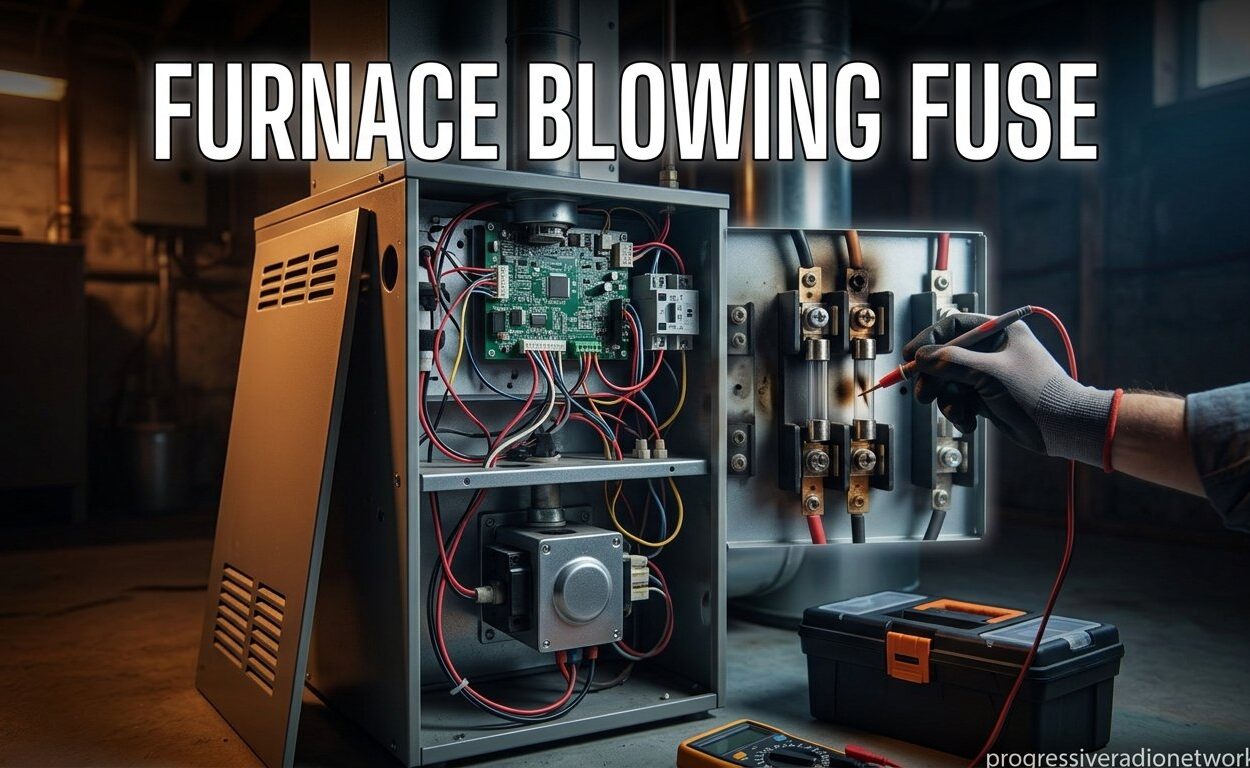
A furnace blowing fuse repeatedly means an electrical short circuit, overloaded component, or wiring fault is drawing too much current through the low-voltage 24V control circuit on your furnace control board. The fuse is a protective device. It blows to prevent fire and component damage. Replacing it without finding the root cause is dangerous and will not fix the problem.
The most common causes of a furnace blowing fuses, in order of frequency, are:
- Thermostat wiring short – Damaged or pinched 24V thermostat wires touching the furnace frame
- Contactor coil failure – The outdoor AC contactor coil shorting out and pulling excess current
- Loose wire connections – Vibrations over time cause wires to ground against the metal cabinet
- Failing blower motor or capacitor – An overworked motor drawing too much amperage
- Wrong fuse size – Using a 3 amp fuse where a 5 amp is specified, or vice versa
- Dirty air filter – Restricted airflow causing overheating and electrical strain on the blower
- Faulty transformer – The 24V transformer internally shorting
- Water leaks – Condensation or humidifier leaks dripping onto the control board or wiring
If your furnace fuse keeps blowing, stop replacing fuses and start diagnosing. Every time a fuse blows, an electrical fault is active somewhere in the system. I have helped homeowners trace dozens of these issues, and the root cause is almost always traceable with a systematic approach. This guide covers every common cause, a step-by-step wire isolation method no competitor mentions, fuse sizing confusion (3 amp vs 5 amp), and exactly when to stop and call a professional.
For related HVAC electrical issues, our team also put together a guide on what to do when your furnace is not blowing hot air, which covers overlapping electrical problems including control board failures.
Why Does My Furnace Keep Blowing Fuses?
Your furnace keeps blowing fuses because an electrical fault in the low-voltage 24V control circuit is allowing too much current to flow. The fuse is rated for a specific amperage (usually 3 or 5 amps), and when that limit is exceeded, the fuse intentionally breaks the circuit to protect the control board, transformer, and other expensive components from burning out.
Think of the fuse as a messenger. It is telling you something is wrong. The fuse itself is never the problem. The problem is whatever caused the current spike that blew it. I see homeowners buy packs of 10 fuses and keep swapping them in, hoping the issue resolves itself. It never does. Each blown fuse points to the same active fault that needs to be located and repaired.
The frustration is real. I have talked to homeowners who have had three different HVAC technicians visit their home without resolving a persistent fuse issue. The Reddit HVAC forums are full of these stories. One user described having 10 technicians from 3 different companies visit before someone finally traced the problem to a shorted contactor coil in the outdoor condenser unit. That is why understanding the diagnostic process yourself is so valuable, even if you ultimately hire a professional to do the repair.
Quick Answer: Top Causes and Immediate Steps
If your furnace blows a fuse, here is the immediate action sequence:
- Turn off power to the furnace at the breaker before touching anything
- Replace the fuse with the correct amperage (3 amp or 5 amp, matching the original)
- Disconnect all thermostat wires from the control board terminal block
- Restore power – if the fuse holds with wires disconnected, the short is in the wiring or a connected component
- Reconnect wires one at a time until the fuse blows again to isolate the problem circuit
- Check the outdoor condenser contactor if the fuse only blows when AC is running
- Inspect the air filter – a clogged filter can cause overheating and electrical strain
- Call a licensed HVAC technician if the short cannot be located or involves high-voltage components
This wire isolation method is the single most recommended diagnostic technique in professional HVAC forums. It systematically narrows down the problem without guessing.
What Does the Furnace Fuse Do?
The furnace control board fuse protects the low-voltage 24V control circuit. This circuit includes the thermostat wiring, gas valve, pressure switches, flame sensor circuit, inducer motor relay, blower motor relay, and the outdoor AC contactor. The fuse sits directly on the control board, usually a small automotive-style blade fuse (ATO or ATC type), colored orange for 5 amp or violet for 3 amp.
When the thermostat calls for heat or cooling, it sends 24V signals through these wires to activate various components. If any of those wires short to ground (touch the metal furnace cabinet), or if a component like a contactor coil fails internally and creates a low-resistance path, current spikes through the circuit. The fuse detects this excess current and melts its internal element, breaking the circuit before the transformer burns out or a fire starts.
Without the fuse, a short circuit would dump the full transformer output directly into the control board. The board would fry. The transformer would burn. Wires could melt and potentially start a fire. That small fuse is doing a lot of protective work.
Where to Find the Furnace Fuse
The fuse is located on the furnace control board inside the blower compartment. To access it:
- Turn off the power switch next to the furnace (looks like a light switch)
- Turn off the breaker at the main electrical panel
- Remove the lower front panel of the furnace (the blower compartment door)
- Locate the control board – a flat circuit board usually mounted at the bottom of the cabinet
- Look for a small blade fuse plugged into a socket on the board, often labeled F1 or FUSE
Most modern furnaces use a single 3 amp or 5 amp blade fuse. Some older models may use a glass tube fuse. Check your furnace manual or the label on the inside of the blower door panel for the correct specification.
What the Fuse Protects
The fuse protects everything on the 24V side of the system. This includes the control board itself (which can cost $300 to $700 to replace), the transformer ($50 to $150), the thermostat wiring run throughout your house, the gas valve ($100 to $300), and the relays that control the blower and inducer motors. A $2 fuse is protecting over $1,000 worth of components.
This is why you should never install a larger fuse to stop it from blowing. If your furnace has a 3 amp fuse and you install a 5 amp or 10 amp fuse, you are allowing more current through the circuit than the components are designed to handle. The fuse will not blow, but the control board or transformer will burn out instead. In the worst case, the wiring overheats and starts a fire.
Common Causes of a Furnace Blowing Fuses
The most likely cause of a furnace fuse blowing repeatedly is an electrical short circuit in the low-voltage 24V thermostat wiring, followed by contactor coil failure, loose wire connections, and failing blower motor components. Each cause has distinct symptoms that help with diagnosis. Below I break down every common cause, what symptoms accompany it, and how to identify it.
1. Thermostat Wiring Short (Most Common Cause)
Damaged thermostat wiring is the number one cause of a furnace blowing fuses. The thermostat wires run from the furnace control board, through the walls or basement, to the thermostat on the wall. Along that path, wires can be damaged by pest chewing, lawnmower strikes near the outdoor unit, drywall screws, aging insulation that cracks and exposes bare copper, or installation errors where wires were pinched during assembly.
When a bare wire touches the metal furnace cabinet, ductwork, or another wire, it creates a short circuit. The 24V current bypasses its intended path and flows directly to ground. Current spikes instantly, and the fuse blows.
The telltale symptom of a thermostat wiring short is that the fuse blows immediately when the thermostat calls for heat or cooling. You turn the thermostat up, hear a click at the furnace, and the system goes dead. The fuse has already blown. This immediate blow pattern almost always points to a wiring short.
Common damage locations include where wires pass through the furnace cabinet (rubbed against sharp metal edges), where wires exit the wall behind the thermostat, and where thermostat wires run alongside the copper lineset to the outdoor condenser. If your thermostat wires run outside to the condenser unit, inspect the entire length for damage. UV degradation and physical impact are common problems on exposed runs.
2. Contactor Coil Failure (AC-Specific Cause)
If your furnace fuse only blows when the air conditioning turns on, the contactor coil in the outdoor condenser is the prime suspect. The contactor is an electromagnetic switch in the outdoor unit that engages the compressor and condenser fan when the thermostat calls for cooling. It is controlled by the 24V circuit from the furnace control board.
Over time, the copper coil inside the contactor can degrade. The insulation on the wire thins or melts, causing the coil windings to short together. When energized, the shorted coil draws excessive current. The fuse on the furnace control board blows because the contactor is on the same low-voltage circuit.
This is one of the most frequently missed diagnoses. Homeowners assume the problem is the furnace because the fuse is on the furnace board. They may have multiple HVAC technicians inspect the indoor unit without finding the issue. Meanwhile, the problem is sitting outside in the condenser unit the whole time.
The diagnostic clue is timing. If the fuse blows within a few seconds of the AC kicking on but never blows when running heat-only mode, the contactor coil is almost certainly the culprit. A multimeter continuity test across the contactor coil terminals can confirm it. A good coil reads between 10 and 30 ohms. A shorted coil reads near zero ohms.
3. Loose Wire Connections Grounding to the Frame
Vibration from the blower motor and draft inducer can loosen wire connections over years of operation. When a wire nut backs off or a spade connector works loose, the bare wire end can contact the metal furnace cabinet. This immediately shorts the circuit to ground and blows the fuse.
This cause is particularly common in furnaces that are 5 to 15 years old. The connections were tight at installation, but thermal cycling (heating and cooling) causes expansion and contraction that gradually loosens mechanical connections. The first place HVAC techs check is where wires pass through the furnace cabinet, as the sharp metal edges are the most likely grounding points.
The symptom is often intermittent. The furnace may work fine for days or weeks, then suddenly blow a fuse. This happens because the loose wire only contacts the frame under specific vibration conditions. A thorough visual inspection of all wire connections, especially at the control board terminal block, gas valve, pressure switches, and limit switches, can reveal the problem.
4. Dirty Air Filter and Overheating
A severely clogged air filter restricts airflow through the furnace. Without adequate airflow, the heat exchanger overheats. The high limit switch trips to shut down the burners, but the blower motor also works harder to push air through the restriction. An overworked blower motor draws more amperage than normal.
In some cases, this excess amperage draw on the blower circuit is enough to overstress the control board and contribute to fuse failure. More commonly, the overheating damages the blower motor itself over time, leading to a shorted winding that eventually blows the fuse. The relationship is indirect but real.
The symptom pattern is a fuse that blows after the furnace has been running for several minutes or hours, not immediately on startup. This delayed blow pattern indicates thermal stress rather than an immediate short circuit. If you pull the blower compartment panel and see a thick layer of dust on the blower wheel or a completely blocked filter, this is likely contributing to the problem.
5. Failing Blower Motor or Capacitor
A blower motor that is failing internally can short out and blow the furnace fuse. Motors fail for several reasons: bearings wear out causing the motor to draw locked-rotor amperage, winding insulation breaks down causing internal shorts, or the run capacitor fails and the motor cannot start efficiently, drawing excess current.
The blower motor run capacitor is a particularly common failure point. When a capacitor weakens, the motor struggles to start. It hums, draws high current, and may not reach full speed. This excess current flows through the control board and can blow the fuse. A capacitor that is visibly bulging or leaking oil at the top needs immediate replacement.
Symptoms of a failing blower motor include a humming sound when the motor should be running, the furnace short cycling (turning on and off rapidly), or a motor that is hot to the touch. If the fuse blows specifically when the blower is supposed to start, the motor or capacitor is the likely culprit. Testing the capacitor with a multimeter (should read within 10 percent of its rated microfarad value) can confirm the diagnosis.
6. Faulty Transformer
The transformer steps down 120V or 240V line voltage to the 24V control voltage. It is the heart of the low-voltage circuit. When a transformer fails internally, the primary and secondary windings can short together or short to the transformer frame. This causes excessive current flow on the 24V side, blowing the control board fuse.
Transformer failure is less common than wiring shorts or contactor failure, but it does happen. The symptom is often a fuse that blows immediately on power-up regardless of what the thermostat is calling for. Even with the thermostat completely disconnected, the fuse blows the moment power is applied to the furnace. This pattern points to either the transformer or the control board itself.
To test a transformer, use a multimeter to measure the secondary (low voltage) output. You should read approximately 24 to 28V AC between the two low-voltage terminals. If the reading is zero or significantly low, the transformer is likely bad. If the reading is normal but the transformer gets extremely hot quickly, the internal windings may be partially shorted. Either way, replacement is necessary.
7. Wrong Fuse Size (3 Amp vs 5 Amp Confusion)
Using the wrong amperage fuse is a surprisingly common cause of repeated fuse blowing. Many furnaces are designed for a 3 amp fuse on the control board. If someone installed a 3 amp fuse where the furnace actually requires a 5 amp fuse, the fuse will blow under normal operating loads because certain components (like the gas valve or multiple relays energizing simultaneously) momentarily draw more than 3 amps.
The reverse situation is more dangerous. Installing a 5 amp fuse in a furnace designed for a 3 amp fuse allows more current through the circuit than the control board was designed to handle. The fuse may stop blowing, but the excess current will eventually damage the control board traces, the transformer, or the wiring insulation.
How do you know which fuse your furnace needs? Check three places:
- The furnace rating plate on the inside of the blower compartment door, usually near the wiring diagram
- The control board itself – the fuse socket is often labeled with the correct amperage (F1 3A or F1 5A)
- The installation manual – the fuse specification is listed in the electrical data section
Most Goodman, Amana, and Janitrol furnaces use a 3 amp fuse. Many Carrier, Bryant, and Payne furnaces use a 5 amp fuse. Trane and American Standard vary by model. Never assume. Always verify the correct specification for your specific furnace model. If the furnace has worked fine for years with a 3 amp fuse and suddenly starts blowing them, the fuse size is not the problem. Something changed in the circuit.
8. Water Leaks and Moisture Damage
Water and electricity do not mix. Several furnace components can leak water onto the control board or wiring, causing shorts that blow fuses. The most common sources are a clogged condensate drain line (on high-efficiency furnaces), a cracked condensate trap, a humidifier leak, or an evaporator coil drain pan overflow.
High-efficiency (condensing) furnaces produce significant condensation as a byproduct of their combustion process. This water drains through a PVC pipe to a floor drain or condensate pump. If the drain line clogs with algae, dirt, or debris, water backs up into the furnace cabinet. It can pool on the control board or drip onto wire connections, creating a short circuit.
The symptom of a water-related short is often seasonal. The furnace works fine in dry conditions but starts blowing fuses during humid weather or after heavy use when condensation production is highest. If you open the blower compartment and see water pooling, rust stains on the cabinet floor, or corrosion on the control board, water infiltration is the likely cause.
9. Power Surges and Electrical Spikes
Lightning strikes, utility grid switching, and large appliance cycling in your home can cause voltage surges on the electrical supply. These surges can travel through the furnace transformer and spike the 24V control circuit. While the fuse is designed to handle brief current fluctuations, a large enough surge can blow the fuse.
Power surge damage is typically a one-time event. The fuse blows once, you replace it, and the problem does not recur. If the fuse keeps blowing after a surge, the surge likely damaged the transformer or control board, and that damage is now causing the ongoing short. A whole-house surge protector installed at the electrical panel can prevent this type of damage.
If your furnace started blowing fuses immediately after a thunderstorm or power outage, surge damage is a strong possibility. Have the transformer and control board inspected for signs of voltage damage (burn marks, bulging capacitors on the board, charred transformer windings).
10. Failing Gas Valve or Draft Inducer
Less commonly, the gas valve or draft inducer motor can develop an internal short that blows the fuse. The gas valve is a 24V electromagnetic coil that opens to allow gas to flow to the burners. Like any coil, its windings can deteriorate over time and short out. The draft inducer is a small motor that pushes combustion gases out through the flue. Its internal windings can also fail.
A failing gas valve typically causes the fuse to blow specifically when the furnace attempts to ignite. The sequence is: thermostat calls for heat, the inducer starts, the pressure switch closes, the igniter glows, the gas valve is energized, and the fuse blows. If this happens consistently at the gas valve stage, the valve coil is shorted.
The draft inducer can cause a similar pattern if its internal motor windings short. However, the inducer is powered by line voltage (120V) through a relay on the control board. The fuse blows if the relay coil on the control board shorts, not directly from the inducer motor. A multimeter test of the gas valve coil (should read around 40 to 80 ohms for a good valve) can confirm the diagnosis.
Timing-Based Diagnosis: What the Blow Pattern Tells You
No competitor covers this, but the timing of when the fuse blows is one of your strongest diagnostic clues. Here is what different blow patterns indicate:
- Fuse blows immediately on power-up (before any thermostat call): Points to a dead short in the transformer primary, the control board itself, or wiring between the breaker and the furnace. This is the most serious pattern and requires immediate professional attention.
- Fuse blows when thermostat calls for heat (within 1 to 2 seconds of the click): Almost always a thermostat wiring short or a shorted gas valve coil. Use the wire isolation method to differentiate.
- Fuse blows when thermostat calls for cooling (within seconds of AC starting): Contactor coil in the outdoor condenser is the prime suspect. Test the coil resistance with a multimeter.
- Fuse blows after 30 to 40 seconds of operation: Often indicates thermal stress on a component. The blower motor is working hard, drawing excess current, and eventually exceeding the fuse rating. Check the capacitor and motor bearings.
- Fuse blows after several minutes to hours: Points to overheating from a dirty air filter, blower motor degradation, or intermittent connections that only ground under specific vibration and temperature conditions.
- Fuse blows intermittently with no clear pattern: Usually a loose wire connection that contacts the frame only under certain conditions. Requires a thorough physical inspection of every wire in the furnace cabinet.
This timing diagnostic narrows down the possible causes before you even open the furnace panel. Combine it with the wire isolation method below for maximum diagnostic efficiency.
How to Diagnose a Blown Furnace Fuse: The Wire Isolation Method
The wire isolation method is the single most effective diagnostic technique for a furnace blowing fuses. It is universally recommended by HVAC technicians on Reddit, and no competitor article covers it. The method works by systematically disconnecting and reconnecting components until the fuse blows, pinpointing the exact circuit at fault.
Before starting, gather the following tools: replacement fuses of the correct amperage (buy a pack of 5 to 10), a multimeter with ohms and continuity settings, a screwdriver set, wire strippers, and electrical tape. A resettable 3 amp circuit breaker fuse (available at any auto parts store) is extremely helpful for diagnostics because it saves you from burning through a pile of disposable fuses.
Step-by-Step Wire Isolation Procedure
Step 1: Turn off all power. Flip the furnace power switch to OFF. Turn off the breaker at the main electrical panel. Verify power is off using your multimeter set to AC voltage. Measure between the line voltage terminals on the furnace junction box and ground. You should read zero volts.
Step 2: Locate and inspect the fuse. Remove the blower compartment door. Find the blade fuse on the control board. Remove it and inspect it visually. A blown fuse has a dark or cloudy appearance inside the plastic body, and the metal element will be broken. Confirm with your multimeter set to continuity: place one probe on each blade. No beep means the fuse is blown.
Step 3: Disconnect all low-voltage wires from the control board. At the control board terminal block, you will see a row of screw terminals labeled R, W, Y, G, C, and possibly others. Note where each wire goes (take a photo with your phone for reference later). Disconnect all the thermostat wires from these terminals. Also disconnect any wires that run to the outdoor AC condenser unit (usually the Y and C terminals).
Step 4: Install a new fuse and restore power. With all low-voltage wires disconnected, install a new fuse of the correct amperage. Turn the breaker on and the furnace power switch on. If the fuse holds with all wires disconnected, the short is in the wiring or a connected component, not the control board or transformer itself.
Step 5: Reconnect wires one at a time. Turn power off before each reconnection. Start with the R (power) wire. Install, power on, and wait 30 seconds. If the fuse holds, turn off power and reconnect the next wire (G for fan). Continue this process with each wire one by one. When you reconnect the wire that causes the fuse to blow, you have found the problem circuit.
Step 6: Trace the problem wire. If the fuse blows when you reconnect the W (heat) wire, the short is somewhere along the thermostat wire path, at the gas valve, or at the limit switch circuit. If it blows on the Y (cooling) wire, the short is in the wire going to the outdoor condenser or in the contactor coil itself. If it blows on the G (fan) wire, the issue is the fan relay or the wire between the board and the thermostat.
Step 7: Test components with a multimeter. Once you have isolated the circuit, use your multimeter to test the components on that circuit. For the contactor coil, disconnect the wires at the outdoor unit and measure resistance across the coil terminals. For the gas valve, disconnect its wires and measure coil resistance. For thermostat wires, measure continuity between each wire and ground (furnace cabinet metal). Any wire reading near zero ohms to ground is shorted.
Step 8: Repair and verify. Replace the shorted wire, failed component, or damaged connection. Reconnect all wires to their correct terminals (use your reference photo). Install a new fuse, restore power, and test the furnace through a full heating and cooling cycle.
What If the Fuse Blows With All Wires Disconnected?
If the fuse blows even with all low-voltage thermostat wires removed from the control board, the problem is internal to the furnace. The three suspects are the control board itself, the transformer, or an internal wiring harness. This situation requires component-level testing:
- Test the transformer: Disconnect the secondary (low voltage) wires from the transformer. Power on the furnace. If the fuse holds with the transformer secondary disconnected, the transformer is likely shorted internally. Replace it.
- Inspect the control board: Look for visible burn marks, bulging or leaking capacitors, cracked traces, or areas of discoloration. A visibly damaged control board must be replaced.
- Check internal harness wiring: Trace every wire inside the furnace cabinet for signs of chafing, melting, or contact with sharp metal edges. Pay special attention to wires that pass through cabinet knockouts or alongside sheet metal edges.
At this point, if you have not found the issue, calling a professional is the right move. Internal furnace electrical problems require specialized knowledge and test equipment to diagnose safely.
Troubleshooting Steps You Can Try Safely
Not every diagnostic step requires a professional. Homeowners can safely perform several checks that may resolve the issue or at least narrow down the cause before calling an HVAC technician. Here is what you can do:
1. Replace the air filter. A dirty filter is the easiest thing to fix and can contribute to fuse-blowing through blower motor strain. Check the filter by holding it up to a light. If you cannot see light through it, replace it. Use the correct size (printed on the side of the old filter) and direction of airflow (arrow pointing toward the furnace blower).
2. Check the thermostat batteries and display. A malfunctioning thermostat can cause erratic behavior. Replace the batteries if it is battery-powered. Check that the display is functioning normally. If the thermostat acts erratically (blank screen, flashing display, incorrect temperature reading), it could be sending corrupted signals down the wiring that contribute to shorts. Our guide on what to do when your thermostat keeps turning off covers this in detail.
3. Visually inspect the control board and wiring. With the power OFF, remove the blower door and look at the control board. Check for the following: water marks or corrosion, burn spots on the board, bulging capacitors (small cylindrical components that are domed at the top instead of flat), loose wire connections, and wires with cracked or missing insulation. Take photos of anything suspicious to show an HVAC technician.
4. Check the condensate drain line. If your furnace has a clear vinyl tube coming out of it, that is the condensate drain. Check that it is not clogged by pouring a small amount of water into the drain pan and seeing if it flows freely out the other end. A clogged drain causes water backup and potential electrical shorts.
5. Inspect the outdoor condenser unit. If the fuse only blows when AC is running, look at the outdoor unit. Make sure nothing is blocking airflow (overgrown bushes, debris, or a blocked coil). With power OFF, remove the top panel and visually inspect the contactor (a black component with heavy wires going to the compressor and smaller control wires from the furnace). Look for pitted contacts, a burned coil, or insect damage inside the unit. Wasps and ants are known to build nests in contactor housings, causing shorts.
6. Reset the system properly. After replacing a fuse, turn the thermostat to OFF. Turn off the furnace power switch and breaker. Wait 30 seconds. Turn the breaker and power switch back on. Wait one minute. Turn the thermostat to HEAT or COOL and set it 5 degrees above or below room temperature. This full reset sequence gives the control board time to initialize properly.
If these steps do not resolve the issue, or if the fuse blows again immediately after replacement, the problem requires deeper electrical diagnosis. At that point, calling a professional is safer and more cost-effective than continued troubleshooting. If your system is completely unresponsive after fuse replacement, our guide on what to do when your thermostat will not turn on can help you determine if the issue is the thermostat or the furnace itself.
Electrical Safety: What Not to Do
Working with furnace electrical systems carries real risks. A 120V or 240V supply enters the furnace junction box. The control circuit is only 24V, but the transformer primary and blower motor wiring carry full line voltage. Here is what you must never do:
Never install a larger fuse. If your furnace calls for a 3 amp fuse and you install a 5 amp or 10 amp, you remove the protective element. The circuit will not blow, but the excess current will burn out the control board, melt wire insulation, and potentially start a fire. This is the single most dangerous mistake homeowners make.
Never bypass the fuse. Some homeowners wrap a wire or foil around the fuse to keep the furnace running. This is essentially the same as having no fuse at all. It is a fire hazard and can destroy every electronic component in the furnace. Do not do this under any circumstances.
Never work inside the furnace with the power on. Even when measuring voltage for diagnostic purposes, you must be trained in electrical safety procedures. The risk of shock from the line voltage side is lethal. Always turn off the breaker, verify with a multimeter that power is off, and follow lockout procedures if others have access to the breaker panel.
Never ignore a burning smell. If you smell burning plastic or ozone near the furnace, shut off power immediately at the breaker. A burning smell means wire insulation, transformer windings, or circuit board components are actively overheating. Continuing to run the furnace in this condition is a fire hazard.
Never attempt to repair the control board. Control boards contain delicate surface-mount components and firmware programming. You cannot repair a bad board, only replace it. And replacement requires correct dip switch settings, proper wire reconnection, and sometimes configuration through the furnace interface.
Know your limits. The wire isolation method, visual inspections, filter replacement, and condensate clearing are all homeowner-safe tasks. Anything involving line voltage measurement, control board replacement, transformer replacement, or gas valve testing should be left to a licensed HVAC technician.
How to Prevent Furnace Fuse Problems
Most furnace fuse problems are preventable with regular maintenance. Here is a preventive maintenance schedule that addresses the root causes of fuse blowing:
Monthly: Check and replace the air filter as needed. A clean filter reduces blower motor strain, prevents overheating, and extends component life. During peak heating season, check the filter every 2 to 4 weeks.
Quarterly: Inspect the area around the furnace for water leaks, dust buildup, and pest activity. Clear the condensate drain line with a wet vac or by pouring a cup of bleach and water down the drain pan. Check that nothing is stored against the furnace that could block airflow or damage wiring.
Annually (before heating season): Schedule a professional furnace tune-up. A licensed HVAC technician will inspect and clean the burners, check electrical connections for tightness, test the gas valve operation, measure blower motor amperage, inspect the heat exchanger for cracks, and verify safety switches are functioning correctly. This annual inspection catches the loose wires, failing capacitors, and worn components that cause fuse problems before they become failures.
Annually (before cooling season): Have the outdoor condenser unit inspected and cleaned. The technician will check the contactor coil resistance, clean the condenser coil, verify refrigerant charge, and inspect the low-voltage wiring between the furnace and the outdoor unit. This catches contactor coil failures before they start blowing fuses.
Install a whole-house surge protector. This device mounts in your main electrical panel and protects all appliances, including the furnace, from voltage spikes. Surge damage is a common cause of transformer and control board failure. A whole-house protector costs $200 to $400 installed and protects thousands of dollars in electronics.
If you have been dealing with ongoing furnace issues beyond fuses, our team has written about what to do when your furnace is not turning on when the thermostat is set, which covers a broader range of electrical and control board failures.
FAQs
How do I stop my heater from blowing fuses?
To stop your heater from blowing fuses, first turn off power and replace the blown fuse with the correct amperage. Then disconnect all thermostat wires from the control board, restore power, and reconnect wires one at a time. When the fuse blows on a specific wire, you have found the shorted circuit. Common fixes include replacing damaged thermostat wire, a failed contactor coil, or a failing blower motor capacitor. If the fuse continues to blow after this diagnostic, call a licensed HVAC technician.
What is the most likely cause of a fuse blowing repeatedly?
The most likely cause is an electrical short circuit in the low-voltage 24V thermostat wiring. Damaged wires touching the furnace metal cabinet, a failed contactor coil in the outdoor condenser, or loose wire connections grounding to the frame are the top three specific causes. A furnace fuse blowing repeatedly always indicates an active electrical fault that must be located and repaired, not just replaced.
How to fix a fuse that keeps blowing?
To fix a fuse that keeps blowing, locate and repair the root cause. Use the wire isolation method: disconnect all low-voltage wires at the furnace control board, install a new fuse, restore power, and reconnect each wire one at a time until the fuse blows. Test the components on the shorted circuit with a multimeter to identify the specific failure. Replace the damaged wire or failed component, then verify the fix with a working fuse before restoring normal operation.
How to trace a fuse that keeps blowing?
To trace a fuse that keeps blowing, disconnect all low-voltage thermostat wires from the furnace control board terminal block. Install a new fuse and restore power. If the fuse holds, reconnect each wire one at a time, turning power off before each reconnection. When the fuse blows after reconnecting a specific wire, trace that wire from the furnace to its endpoint, looking for physical damage, exposed copper, or contact with metal. Use a multimeter set to ohms to test continuity between each wire and the furnace cabinet ground to pinpoint the short location.
Conclusion
A furnace blowing fuse is never just a fuse problem. It is a warning that an electrical short, failing component, or wiring fault is drawing too much current through the 24V control circuit. The fuse is doing its job by protecting your control board, transformer, and wiring from damage. Your job is to find and fix the root cause, not to keep swapping fuses.
The most important takeaway from this guide is the wire isolation method. This systematic approach, recommended unanimously by professional HVAC technicians, lets you pinpoint the exact circuit causing the short without guessing. Combined with timing-based diagnosis (immediate blow versus delayed blow), you can narrow down the cause before opening the furnace panel.
Remember these key points: never install a larger fuse than specified, never bypass the fuse entirely, and always turn off power at the breaker before any electrical work. If your furnace keeps blowing fuses after the wire isolation method and basic component testing, it is time to call a licensed HVAC professional. Continuing to swap fuses risks fire, component damage, and leaving your home without heat when you need it most.
For more furnace and heating system troubleshooting, our team has put together additional resources. If your oil heater is not working, or if you need to troubleshoot a furnace that will not turn on, those guides walk through related electrical and mechanical issues step by step.


Leave a Comment