
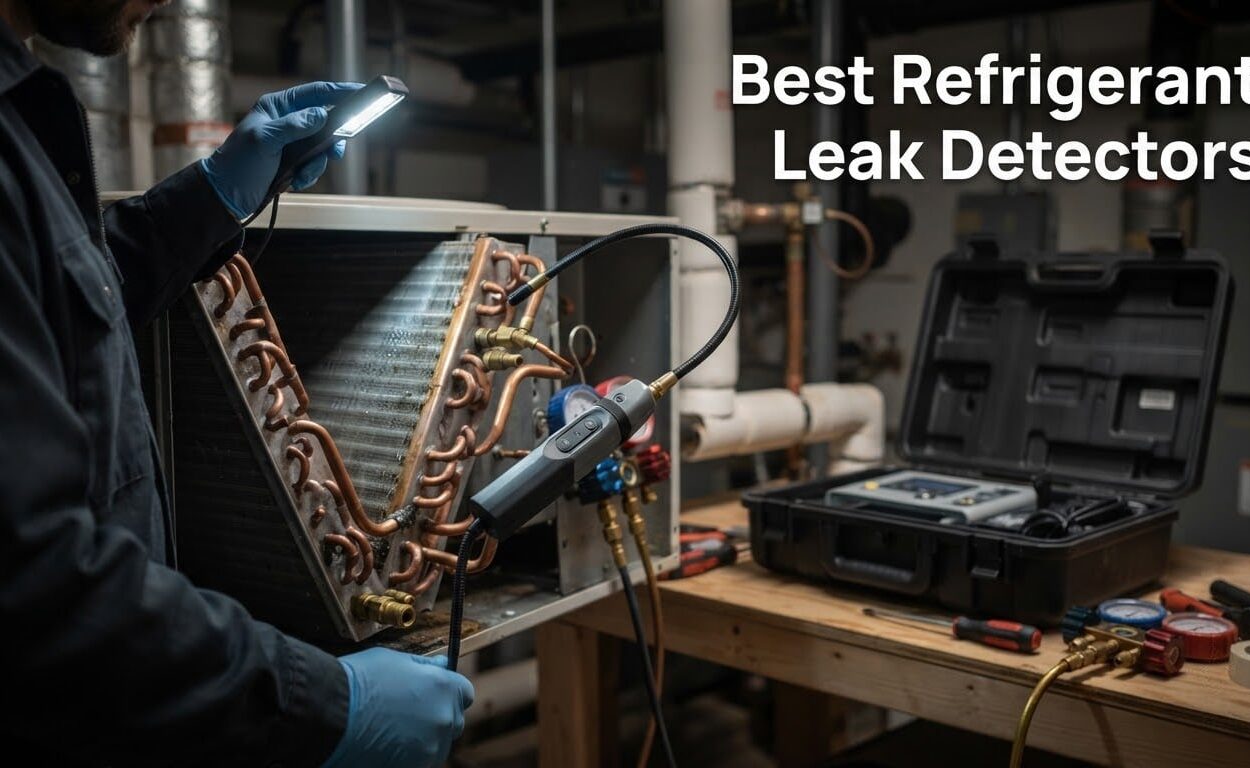
Choosing a refrigerant leak detector used to mean picking a heated diode or infrared model from a short list of trade names. That list is much wider now, and the differences that matter most are the ones nobody puts on the box: how the sensor behaves around oil and moisture, how long the sensing element actually lasts, and whether the probe can reach the coil you need to check. We spent weeks putting these eight handheld units through real leak searches on R-410A, R-22 and R-134a systems to separate the ones that earn a permanent spot in the truck from the ones that frustrate you on a Tuesday night call.
The short version: the best refrigerant leak detector is the one whose sensor technology matches your working conditions, not the one with the biggest number on the spec sheet. If you chase microleaks in attics, crawl spaces and condenser coils, an infrared sensor will outlast you. If you work around oil, PVC cement fumes and drain solvents all day, a heated diode still earns its keep. This guide covers both, plus the budget units that genuinely do the job on a first-time purchase.
Before the picks, two definitions worth having straight. Sensitivity is stated in ounces of refrigerant lost per year, and a lower number is better: a detector rated at 0.03 oz/yr can find leaks roughly 20 times smaller than the thinnest soap bubble you can hold together. Sensor life is the service life of the sensing element itself, which is where the big cost differences hide.
How Accurate Are Refrigerant Leak Detectors?
Yes, up to their rated threshold. Modern electronic detectors routinely register leaks well below 0.03 oz/yr, far smaller than soap-bubble testing can find, and most land within their published figure on a clean system. Accuracy depends far more on sensor technology, probe technique and a clean sensing element than on the brand name, which is why the same model can feel brilliant to one tech and useless to another.
That last point matters more than buyers expect. An electronic detector tells you where refrigerant is concentrated in the air right now, not whether a fitting is weeping. Technicians on r/HVAC and hvac-talk consistently make the same point: confirm every electronic hit with bubbles before you start cutting pipe.
Our Top 3 Refrigerant Leak Detectors for 2026
These three cover the widest range of real jobs: a first detector that almost anyone can afford, a mid-tier infrared workhorse, and a professional heated diode unit that shrugs off soap residue. Every pick here has a large enough base of verified owners to trust the rating.

Elitech WJL-6000S
- ✓Halogen heated diode
- ✓7 sensitivity levels to 0.21 oz/yr
- ✓7.9-inch flexible probe
- ✓6-second warm-up
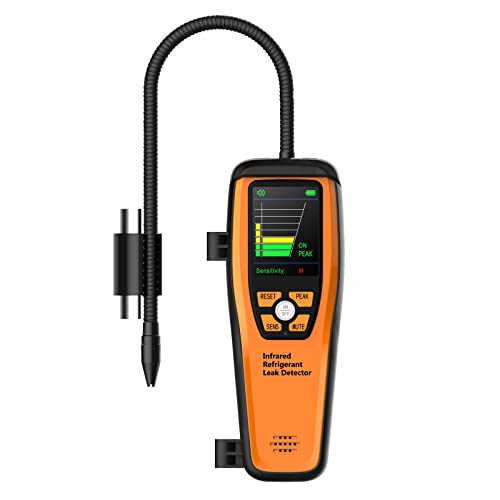
Elitech ILD-200
- ✓Infrared sensor with 10-year life
- ✓Sensitivity to 0.14 oz/yr
- ✓Peak-mode 2.8-inch display
- ✓Detects R1234yf and HFO blends
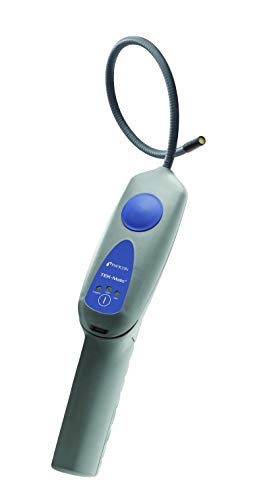
Inficon 705-202-G1
- ✓Heated diode with 100-hour sensor
- ✓0.25 oz/yr sensitivity
- ✓A2L certified
- ✓Immune to soap-solution false alarms
Comparing the Best Refrigerant Leak Detectors in 2026
All eight units below are single-piece handheld sniffers. Where a product’s data lists a maximum sensitivity figure, that is the number quoted here, and lower is better.
| Product | Features | Action |
|---|---|---|
| Elitech WJL-6000S |
|
Check Latest Price |
| Elitech ILD-200 |
|
Check Latest Price |
| Inficon 705-202-G1 |
|
Check Latest Price |
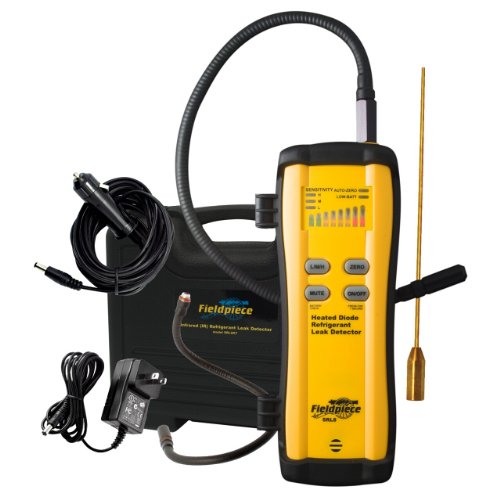 Fieldpiece SRL8 Fieldpiece SRL8 |
|
Check Latest Price |
 Fieldpiece DR58 Fieldpiece DR58 |
|
Check Latest Price |
 Elitech ILD-100H Elitech ILD-100H |
|
Check Latest Price |
 Fieldpiece DR82 Fieldpiece DR82 |
|
Check Latest Price |
 Aprvtio WJL-6000PRO Aprvtio WJL-6000PRO |
|
Check Latest Price |
Heated Diode vs Infrared vs Halogen: Which Sensor Technology Should You Buy?
Three technologies cover almost everything you will find in a truck today, and each one fails in a different way. Picking the wrong one is why some techs think all electronic sniffers are unreliable.
Heated diode: the pro workhorse that ignores soap residue
A heated diode sits inside a small heated cell. Halogen refrigerant breaks down in that heat and changes the current through the cell, which the instrument reads as a leak. Because the reading is chemical rather than optical, a coated soapy bubble or a film of compressor oil does not move the number. The Fieldpiece SRL8, the Fieldpiece DR58 and the Inficon 705-202-G1 all use this approach, and the Inficon is specifically listed as immune to false alarms from soap solutions.
The cost is consumable life. Heated diode sensors are rated in hours: 100 hours for the Inficon, 300 hours for the Fieldpiece DR58. That number is the single most important fact about any heated diode purchase, because it is a service part you will replace.
Infrared: near-zero consumables, stricter technique
An infrared sensor reads the absorption of a specific wavelength by refrigerant in the air. Nothing burns and nothing fouls, so manufacturers rate the sensor life in years: ten years for the Fieldpiece DR82 and for the Elitech ILD-200. There is no replacement sensor to budget for.
The tradeoff is technique. Infrared units react to a change in concentration, so the probe must be kept moving. Walk into a room too quickly and the concentration jump reads as a leak. This is the single most common source of false alarms on infrared units, and it disappears once you sweep slowly at a consistent pace.
Halogen sniffers: cheap, simple, still useful
Budget halogen units use a simplified heated diode with fewer controls and a coarser sensitivity ceiling. The Elitech WJL-6000S tops out at 0.21 oz/yr, which is roughly seven times less sensitive than the 0.03 oz/yr pro units. That gap decides what you find: a weeping service valve or a gurgling coil, not a slow pinhole weep at a braze joint.
The difference that is not on any spec sheet
Humidity and contamination decide real-world accuracy more than brand. Heated diode sensors foul from oil, condensation and PVC cement fumes; a technician on r/refrigeration described leak checking while drain solvents and cement fumes were in the air and warned that this type of exposure wrecks a detector’s sensor. IP54 enclosures, tip-mounted filters and field-replaceable filter tips exist for that reason, and they are worth more than any extra digit of claimed sensitivity.
How to Use a Refrigerant Leak Detector in 7 Steps
Most failed leak searches come down to a rushed first pass. Follow this order and even a modest detector will find what a soap bubble cannot.
- Start in clean air. Stand well away from the equipment, let the unit warm up, and let it zero itself before you approach anything. Calibrating next to a running condenser is the most common cause of a detector that alarms everywhere.
- Verify the unit. Confirm it responds to a known release or reference before you trust a negative result. An unresponsive detector and a tight system look identical from the outside.
- Load the probe. Move the probe into the suspected area first, then enable the sensor. Walking the tip through fresh air en route to the coil produces a false hit on infrared units.
- Sweep at a constant pace. Keep the probe moving steadily at roughly an inch per second. With an infrared unit, a stationary probe over a leak will stop reading within seconds.
- Use the meter, not the meter alone. Peak mode, bar graph and sensitivity level all exist to let you walk a concentration gradient back to the source. Dial sensitivity down when you are close rather than trusting a screaming alarm at arm’s length.
- Park a heated diode when you want. Heated diode units can sit motionless over a suspected leak, which makes them the better choice when you need both hands on a flashlight and a wrench.
- Confirm with bubbles. Every professional standard we found says the same thing: an electronic hit is a lead, bubbles are the proof.
If your detector alarms constantly and none of the above helps, the answer is usually cleaning rather than replacing. Move on to the section on false alarms below.
1. Elitech WJL-6000S – The Detection Start That Handles Most First Detectors
- ✓Largest verified owner base in this roundup
- ✓Over 5300 reviews and a 4.2 star average
- ✓Six-second warm-up with response inside three seconds
- ✓Covers R22 R410A R134a R1234yf plus HFCs CFCs HCFCs and blends
- ✓Audible and visual alerts with dual battery indicators
- ✕Coarse sensitivity ceiling misses slow microleaks
- ✕Some owners report repeatable false positives
- ✕No leak-rate reading beyond the alarm buzzer
Halogen heated diode
0.21 oz/yr max sensitivity
7.9-inch flexible probe
95 percent operating humidity
With more than 5300 verified reviews and a 4.2 star average, this is the most proven detector in the roundup, and that matters when you are talking about a tool that has to earn a place on a shelf. It is also the simplest: a halogen heated diode, seven sensitivity levels, audible and visual alarms and a 7.9-inch flexible probe.
In practice it is fast to deploy. The six-second warm-up and three-second electronic response mean you are not standing behind a coiled line waiting for the unit to settle, which is the difference between catching a leak and losing it. The probe reaches into evaporator areas and around service valves without you having to pull an evaporator out.
Sensitivity ceiling and what it misses
The 0.21 oz/yr maximum sensitivity is the honest limitation. It is roughly seven times less sensitive than the pro infrared units here, so a gurgling receiver or a weeping Schrader core is a straightforward catch while a slow pinhole weep at a braze joint is not. One reviewer also notes that refrigerant dissipates below detection inside a closed cabinet after about a minute, so work fast in an enclosed space.
Refrigerant coverage and automotive use
The coverage list is genuinely wide for a budget unit: R22, R134a, R404A, R410A and R1234yf, plus HFCs, CFCs, HCFCs and blends. Because R1234yf is explicitly listed, this is a workable first detector for automotive work rather than a home-only tool.
Where it frustrates people
The reviews split on consistency. Some owners get repeatable false positives on clean systems, others miss deliberately released refrigerant. The workaround is the same one forum technicians describe: calibrate in clean air, keep the probe off surfaces, sweep slowly and fit fresh batteries, because several failures in the reviews trace back to dead or reversed cells rather than a bad sensor.
Who should buy this
Buy it if this is your first detector, if you work mostly on residential splits and light automotive systems, or if you want a backup unit for the truck. Skip it if your work is commission testing on new installations where a 0.03 oz/yr threshold is the difference between passing and coming back.
2. Elitech ILD-200 – Ten Years of Sensor Life in a Mid-Tier Body
- ✓Infrared sensor removes the recurring sensor replacement cost
- ✓Sensitivity down to 0.14 oz/yr with high medium and low settings
- ✓Peak-mode display helps locate and re-check a leak point
- ✓Detects CFCs HFCs HCFCs HC HFOs and blends including R1234yf
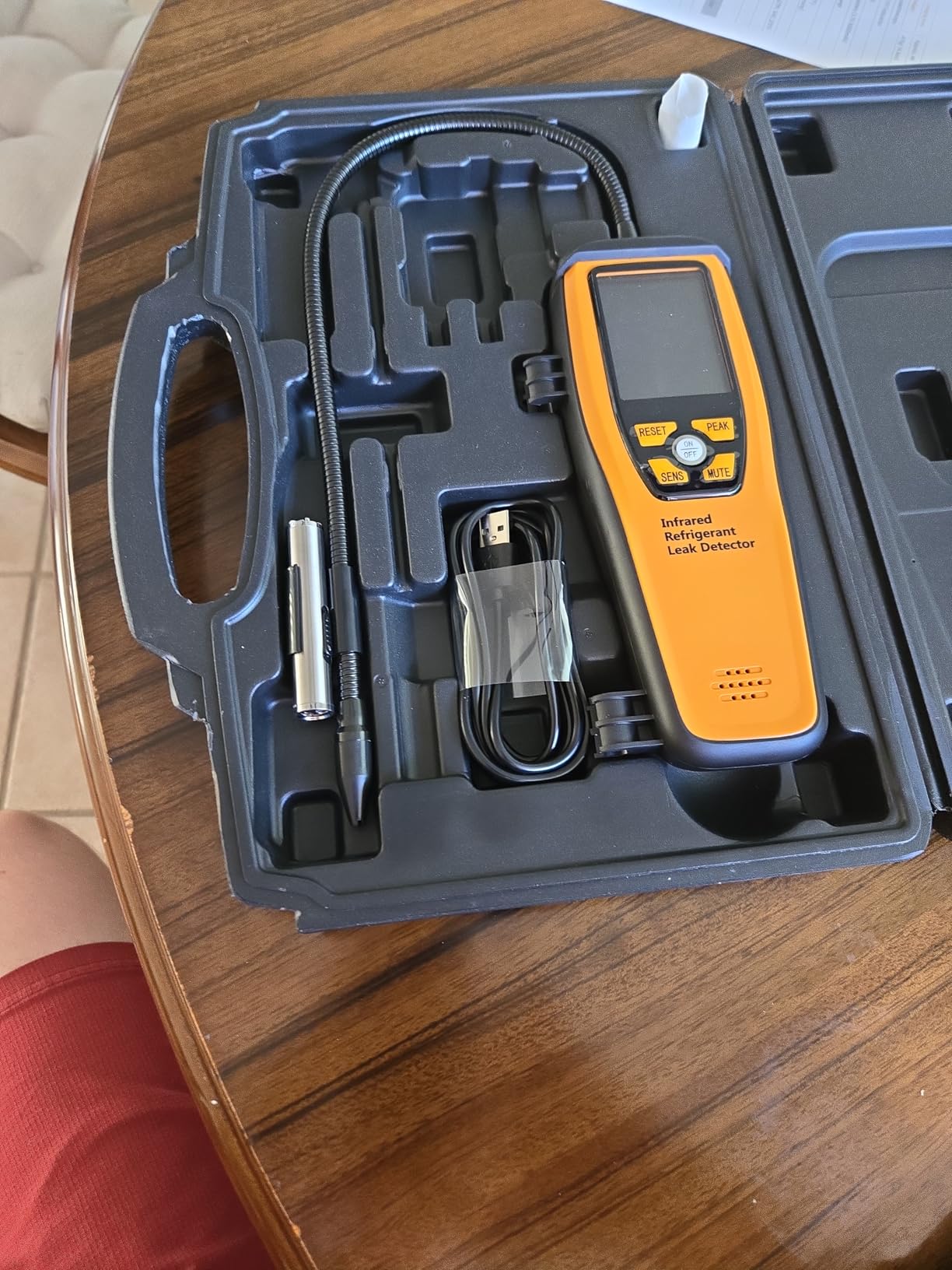
- ✓Ships with sensor module USB cable and carrying case
- ✕IR sweep technique is unforgiving if you bump the probe
- ✕Some owners report drifting readings near ambient gases
- ✕Rechargeable battery can discharge overnight
Infrared sensor
10-year rated sensor life
0.14 oz/yr max sensitivity
2.8-inch peak-mode display
The ILD-200 is the point where infrared detection becomes a rational purchase for a working technician. Seventy percent of its verified reviews are five star, and several owners running HVAC for a living describe it finding evaporator and automotive leaks in minutes.
Two owners report it located leaks that a higher-priced Fieldpiece unit had missed, which is exactly the kind of report that makes a mid-tier pick worth the switch. The infrared sensor carries a rated ten-year service life, so the ongoing consumable cost that defines heated diode ownership simply does not apply here.
Refrigerant coverage is the standout spec
The detection list covers CFCs, HFCs, HCFCs, HCs, HFOs and blends, specifically naming R11, R22, R404a, R410a, R600a and R1234yf along with AZ-50, HP62 and MP39. For a technician moving between residential, commercial and automotive work, that breadth removes the argument for carrying two detectors.
Why the technique catches people out
Because infrared reads concentration change rather than concentration, a bumped probe or a fast walk through outdoor air triggers an alarm. That is the recurring complaint in the reviews, and it is a technique problem rather than a fault. Slow down, keep the tip moving at a steady pace and the false positives largely disappear.
Peak mode and sensitivity settings
The 2.8-inch display shows a peak reading, which lets you move back to a spot and confirm the level rather than relying on memory. High, medium and low sensitivity settings cap detection at 0.14 oz/yr, so you dial down as you close in. A small 2.8-inch screen is also a small screen, and glare outdoors is a genuine annoyance.
Who should buy this
This is the detector for a residential or light commercial technician who wants infrared reliability without pro-tier spend, and for anyone who plans to keep the same unit for years. It is also the strongest value pick here. Buy it if you can live with sweep technique; skip it if you need a sensor you can park over a leak.
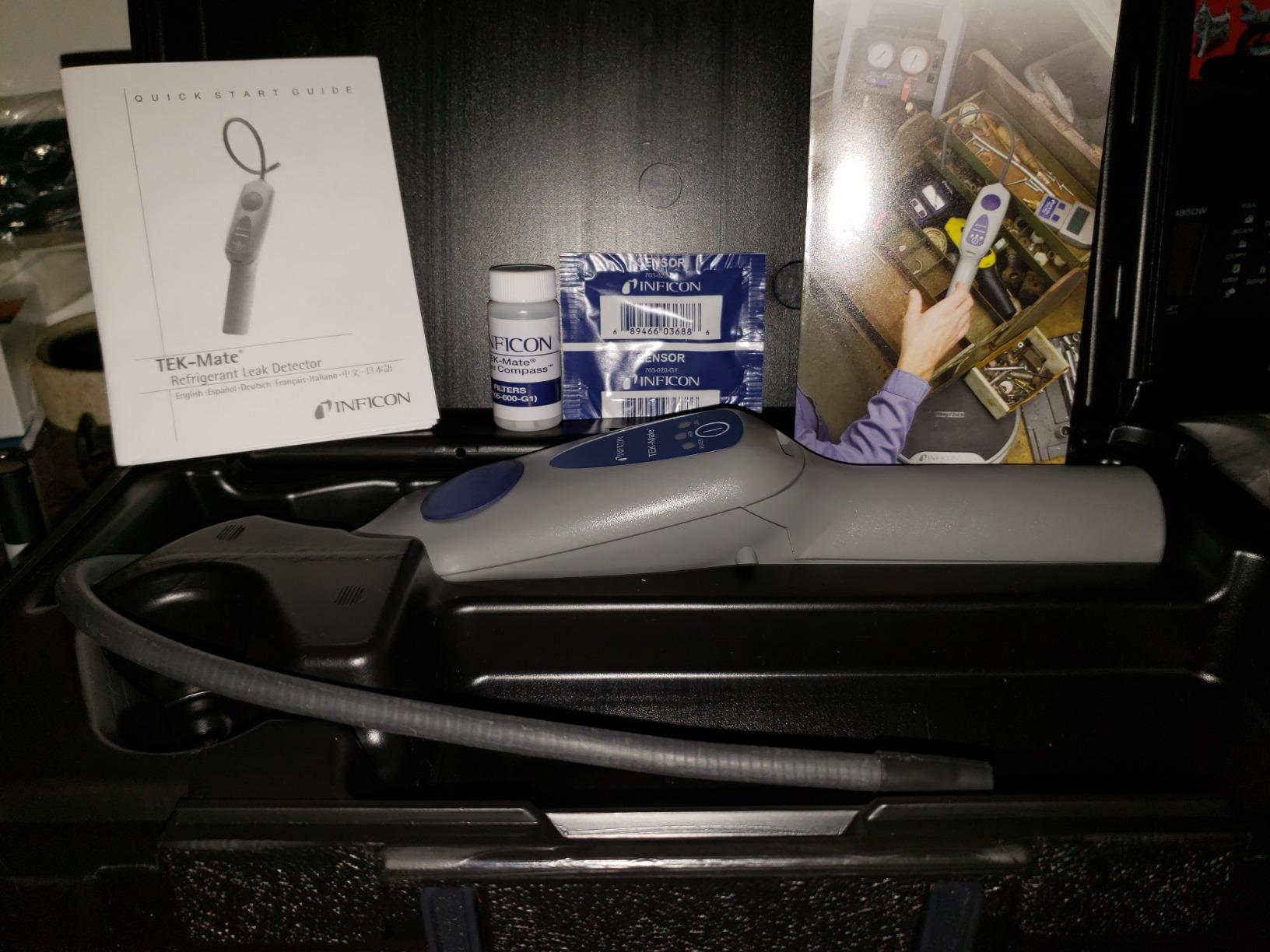
3. Inficon 705-202-G1 – The Classic Heated Diode That Starts Clean Every Morning
- ✓Immune to false alarms from soap and bubble solutions
- ✓Automatic background zeroing simplifies going from ambient to pinpoint
- ✓Rated for CFCs HCFCs HFCs and HFOs with A2L certification
- ✓Includes alkaline batteries filters and a rugged carrying case
- ✓Consistent repeatable detection across residential and commercial work
- ✕Very loud alarm fatigues during a long search
- ✕Large body at 12 inches tall and 3.1 pounds
- ✕100-hour sensor life means periodic replacement for daily use
Heated diode sensor
0.25 oz/yr sensitivity
100-hour sensor life
A2L certified
This is the detector that defined the professional heated diode category, and 72 percent of its verified reviews are five star. Seventy-two percent is a strong consistency signal for a tool that has been in service for years, and owners routinely report it paid for itself by finding condenser and compressor-seal leaks quickly.
Its defining strength is that soapy bubbles do not fool it. If you have just finished a bubble test, or you are working near a fresh soap residue, this is the detector that will not send you chasing a false positive.
What the 100-hour sensor life means for your costs
Advertised sensitivity is 0.25 oz/yr, or 7 g/yr, and the sensor is rated at 100 hours of service life. For a tech doing daily leak checks, that is a planned consumable cost rather than a surprise. Budget for a replacement sensor and treat the tip filter and the sensor as scheduled items, not as a fault when sensitivity starts to drift.
Zeroing, warm-up and the alarm you will hear everywhere
Automatic background adjustment lets the unit settle from ambient conditions before you start, which removes the mental load of manual zeroing. The complaint that comes up repeatedly is the alarm volume: owners describe it as loud enough to be fatiguing over a long hunt. Zeroing time also varies, with some owners reporting anywhere from under a minute to a couple of minutes before it settles.
A2L certification and refrigerant range
The unit is listed as A2L certified and detects all CFCs, HCFCs, HFCs and HFOs. That certification matters if you service R-32, R-1234yf or R-454B equipment, where a mildly flammable refrigerant changes how you approach the work area.
Who should buy this
Buy it if you want a detector that tolerates soap, works outdoors in any weather and runs on two D-cell alkaline batteries you can buy anywhere. It is also a sensible backup even if you own an infrared unit, because the two use different detection principles and disagreeing results between them are genuinely useful. Skip it if you need a light, quiet, all-day handheld.
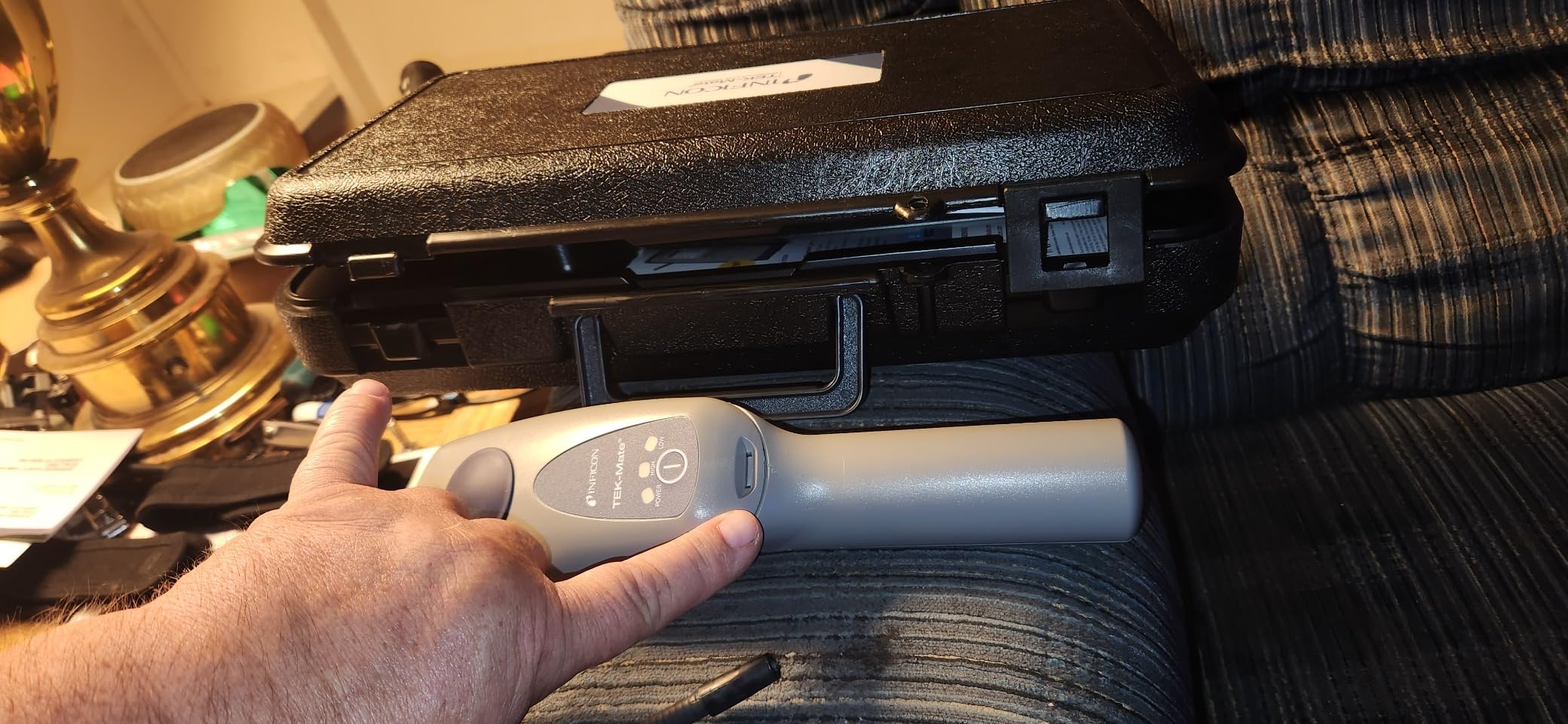
4. Fieldpiece SRL8 – Fifteen Hours of Rechargeable Heated Diode Work
- ✓Fifteen-hour rechargeable battery covers roughly two workdays
- ✓Runs while charging from a wall or vehicle outlet
- ✓Tip filter shields the sensor from moisture condensation and oil
- ✓Manual and automatic zeroing for precise pinpointing
- ✓Ready to run in 30 seconds
- ✕Heated diode sensor is a consumable many pros replace each season
- ✕Priced above the typical technician budget
- ✕Response can be slow on very slow leaks
Heated diode sensor
15-hour rechargeable battery
Tip-mounted filter system
Ready in 30 seconds
The SRL8 carries a 4.5 star average with 77 percent five star ratings, and it earns its place by removing the two things that annoy most about heated diode detectors: the battery swap and the multi-minute warm-up. Thirty seconds from box to searching is the fastest start in this roundup.
Owners who switched to it from infrared units specifically say they were tired of the sweep technique. That is worth repeating, because the heated diode can be held stationary over a leak, which is exactly what you want when you are tracing a line set in a dark attic with a headlamp on.
Battery life and charging in the truck
The lithium-ion pack is user-replaceable, runs for about 15 hours and keeps working while plugged into a wall or vehicle charger. Fifteen hours is roughly two full working days of calls, so the charging stops being a daily ritual. The battery is a standard replaceable item rather than a sealed unit, which matters for long-term ownership.
The filter system is the real longevity feature
Tip-mounted filters protect the heated diode from moisture, condensation and oil, the three things that shorten a sensor’s life. Replacement filters and a narrow long-reach tube ship in the case, and a magnet on the back lets you hang the unit somewhere it will not get knocked off a truck shelf. For shops that work near drain solvents and PVC cement fumes, this is the unit that keeps working.
What to watch for
Packaging is the weak point in the reviews: one owner received a unit without the sensor, and another reports friction getting warranty support through a third-party purchase. Check the box contents on arrival. Several owners also replace the sensor every season or two, and a few report slower response on very slow leaks than they expected.
Who should buy this
Buy it if you want heated diode detection with a full workweek of battery and the shortest warm-up available. It suits shops with dirty air, humid conditions and daily call volume. Skip it if a single sensor purchase and replacement cycle is not in your budget, since that recurring cost is real and unavoidable.
5. Fieldpiece DR58 – Sub-0.03 oz/yr Sensitivity With a 300-Hour Sensor
- ✓Best rated unit here at 4.7 stars with 84 percent five star
- ✓Below 0.03 oz/yr sensitivity roughly 20 times better than bubble testing
- ✓IP54 housing resists moisture and oil in field conditions
- ✓Eighteen-hour USB rechargeable battery with five filtered tips
- ✓Backlit screen shows leak size and intensity
- ✕Heated diode sensor still needs replacement around 300 hours
- ✕Command price for a heated diode detector
- ✕Heavier body at 3 pounds
Heated diode below 0.03 oz/yr
300-hour sensor life
IP54 rated enclosure
17-inch flexible probe
This is the highest-rated detector in the roundup at 4.7 stars with 84 percent five star and only 3 percent one star. Those distribution numbers describe a tool that behaves consistently, which is rarer and more valuable than a headline sensitivity figure.
Detection threshold sits below 0.03 oz/yr, roughly 20 times more sensitive than bubble methods, and it works with HFCs, CFCs, HCFCs, HFOs, H2N2 tracer gas and blends. Working with tracer gas matters if you ever pressure-test a system before evacuation.
Why shops with bad air should look here
The IP54 rated enclosure resists moisture and oil, and the probe uses replaceable filter tips to keep contaminants away from the diode. On diag.net, technicians comparing infrared and heated diode models routinely raise the DR58 as the answer for humid and dirty working conditions. The heated diode reads a chemical change rather than a concentration change, so humidity does not produce the phantom alarms that infrared units can give in damp spaces.
The 17-inch probe is the practical winner
That flexible probe reaches coil geometry and line sets that a short tip cannot, and it is the feature owners cite most often on real service calls. You can work a serpentine evaporator or a back-side braze joint without dismantling anything to get at it. Five replacement filtered tips ship in the box with a blow-molded case.
Battery, screen and the 300-hour caveat
The 18-hour USB rechargeable battery outlasts a working week, and the backlit LCD showing leak size and intensity plus LED tip and beep indicators give you the feedback to close in on a hit. The 300-hour sensor life is the trade: twice the Inficon’s figure, but still a consumable. At 3 pounds the body is substantial, which is fine for a shop unit and tiring for an all-day handheld.
Who should buy this
Buy it if microleak accuracy is the whole job, you work in high humidity or around oily equipment, and you want one unit that handles braze joints and coil interiors. Skip it if you are equipping a technician who will carry it all day, or if a 300-hour sensor budget does not fit your numbers.
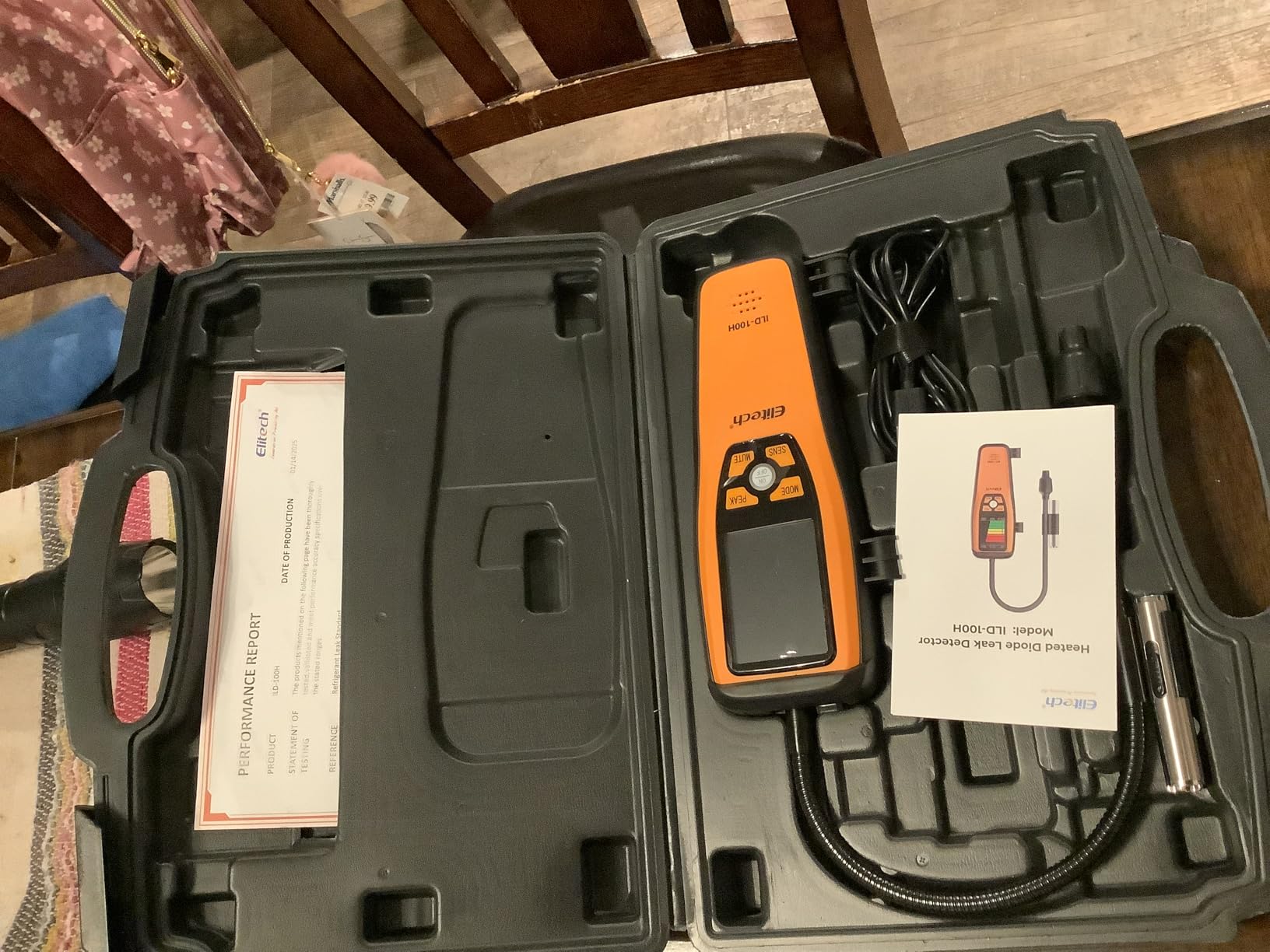
6. Elitech ILD-100H – A Heated Diode With a Screen, Under the Pro Tier
- ✓Only heated diode detector at the mid price band
- ✓Sensitivity to 0.1 oz/yr with high medium and low settings
- ✓Sub-one-second response across CFCs HFCs HCFCs HC HFOs and blends
- ✓TFT screen shows sensitivity setting and battery level
- ✓Front buttons for quick sensitivity adjustment and mute
- ✕Heated diode sensor is a consumable with finite service life
- ✕Buzzer cannot be fully disabled beyond mute
- ✕Written owner feedback is thinner than for the other picks
Heated diode sensor
Up to 0.1 oz/yr
TFT readout screen
Under 1-second response
Heated diode detection normally sits well above this tier, which is what makes the ILD-100H interesting. It undercuts the professional Fieldpiece heated diode units by a wide margin while adding a TFT screen that shows the current sensitivity setting, the leak alert and the battery level rather than just a buzzer.
Ratings skew strongly positive at 4.4 stars with 72 percent five star and only 1 percent three star, which suggests consistent satisfaction rather than occasional brilliance. The specification set positions it as a capable mid-tier sniffer with response inside one second.
Sensitivity and response
High, medium and low settings cap sensitivity at 0.1 oz/yr, roughly three times more sensitive than the budget halogen units and about 4.5 times less sensitive than the sub-0.03 oz/yr pro infrared units. Response arrives inside one second across CFCs, HFCs, HCFCs, HCs, HFOs and blends, including R11, R22, R404a, R410a, R600a, R1234yf, AZ-50, HP62 and MP39.
Controls you actually use on a call
Two front buttons handle sensitivity adjustment and buzzer mute directly, which keeps your attention on the probe rather than on a menu. The operating humidity rating is 85 percent, lower than the 95 percent figure on several picks here, so it is not the choice for a wash-down area or an unconditioned plant room in summer.
What we could not confirm
The product feed returned no written customer review text for this listing, so our read on long-term reliability rests on the rating distribution and the published specification rather than owner commentary. The heated diode element is a consumable regardless, and the buzzer cannot be fully disabled, only muted.
Who should buy this
Buy it if you want heated diode behaviour, a readable display and a quick response without moving up to a pro body. It is a good fit for maintenance staff running preventive checks rather than chasing commission-grade microleaks. Skip it if you need sub-0.03 oz/yr sensitivity or a ten-year sensor.
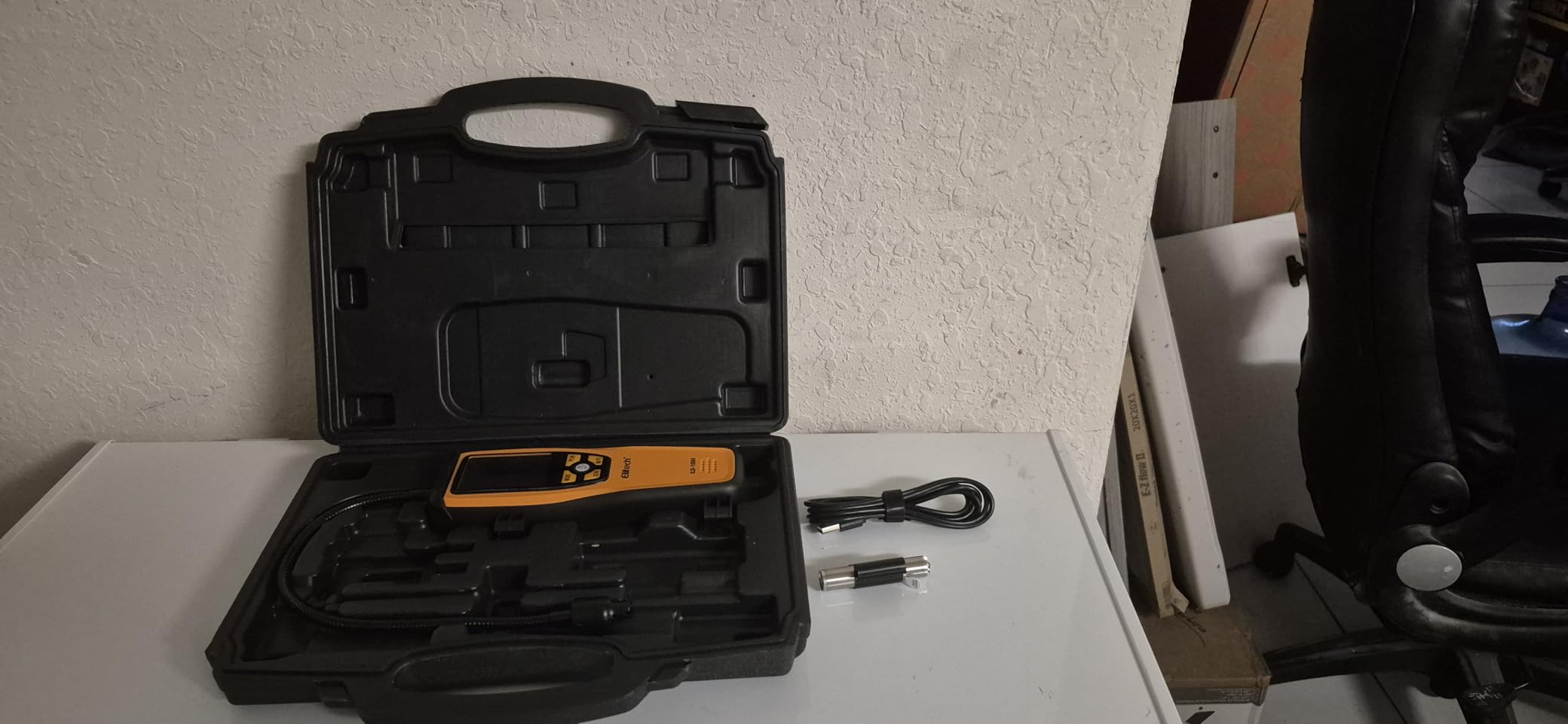
7. Fieldpiece DR82 – The Lightest Pro Detector With a Ten-Year Sensor
- ✓Ten-year infrared sensor life removes replacement cost
- ✓Finds microleaks across R410A R32 and R454B systems
- ✓Lightest pro unit here at 16 ounces with a 17-inch probe
- ✓IP54 rated against moisture and oil
- ✓Works down below 0.03 oz/yr with a backlit leak size readout
- ✕Tip filter is overly restrictive and some users modify it
- ✕Marginally slower response than cheaper heated diode meters
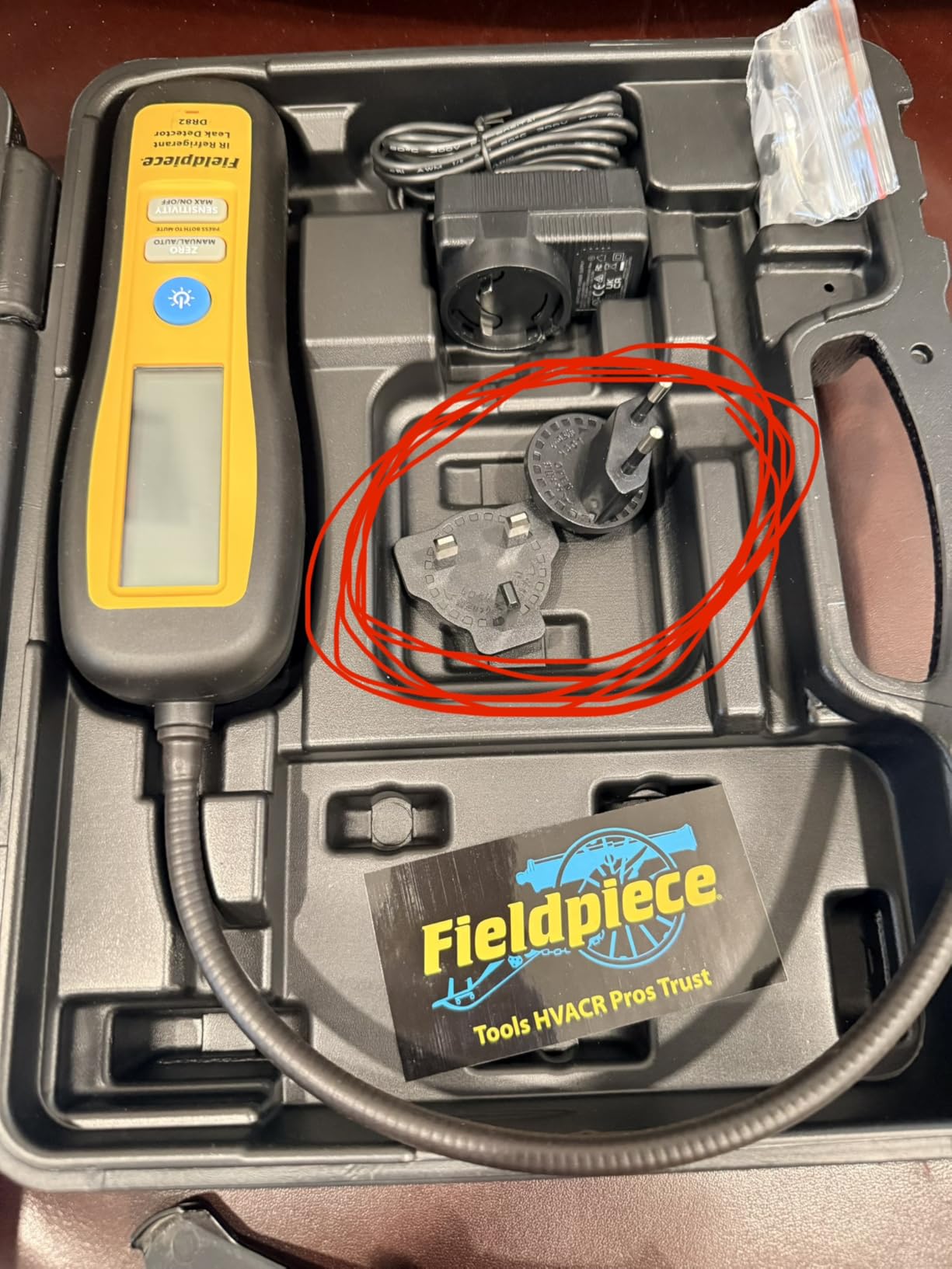
- ✕One owner received European power adapters with no US adapter
Non-dispersive infrared
Below 0.03 oz/yr
10-year sensor life
17-inch probe with USB-C
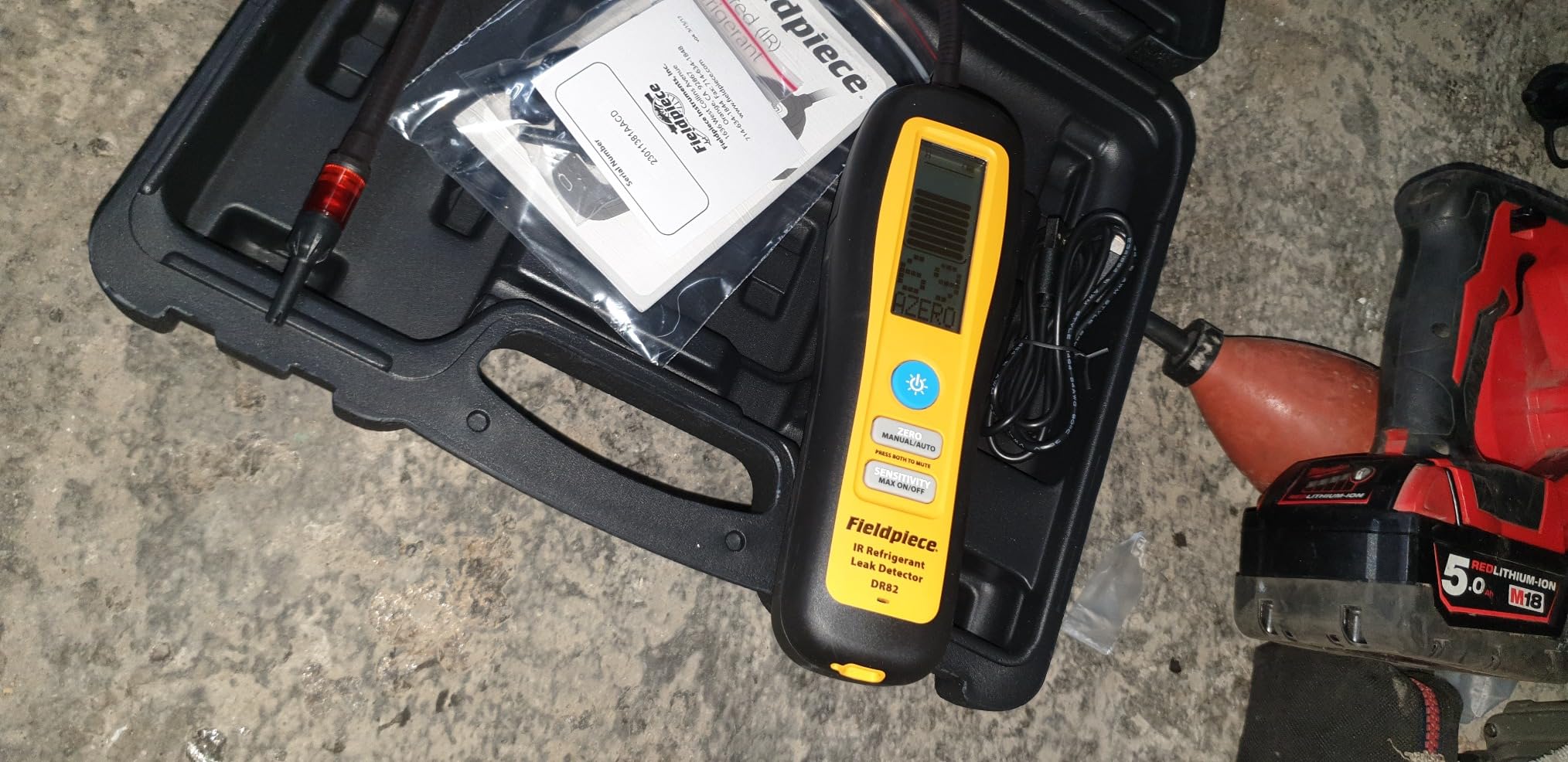
At 16 ounces with a 17-inch flexible probe, the DR82 is the only pro-grade detector in this roundup you can carry all day without noticing it. Its non-dispersive infrared sensor carries a rated ten-year service life, which removes the consumable cost that defines the heated diode units above it.
Detection goes below 0.03 oz/yr, about 20 times more sensitive than bubble methods, across CFC, HCFC, HFC, HFO and blends. Eighty percent of its verified reviews are five star, and several owners describe it as the best or most accurate detector they have used. On diag.net the DR82 is widely praised for exactly the reason the heated diode DR58 gets debated: a ten-year infrared sensor against roughly 300 hours.
How it performs on real systems
Owners describe consistent microleak finds across R-410A, R-32 and R-454B systems, mini splits, coils and braze joints. Dialling the sensitivity down lets a technician pinpoint the leak without immediately confirming with bubbles, which makes the search far faster on a system you already suspect.
Probe access and the filter tip
The 17-inch flexible probe with replaceable filter tips reaches the coil interiors and awkward geometry that short probes cannot. The IP54 rating and 95 percent operating humidity figure mean it tolerates the conditions that foul other sensors. The most common complaint is that the tip filter is overly restrictive, with some users opening it up with a pin hole, which trades contamination protection for airflow.
Battery, charging and small annoyances
The 10-plus hour USB-C battery covers a normal call day. It reacts marginally more slowly than cheaper heated diode meters in side-by-side use, and one owner received a unit with European power adapters and no US adapter. The backlit LCD showing leak size and intensity, plus LED tip and beep indicators, is the same display architecture that makes the DR58 easy to read.
Who should buy this
Buy it if you do residential or light commercial work and want the lowest long-run cost of ownership in this roundup with no replacement sensor to plan for. It also handles 95 percent humidity, so it suits hot, damp regions. Skip it if you need to park the probe over a leak or if your work is confined to a bench.
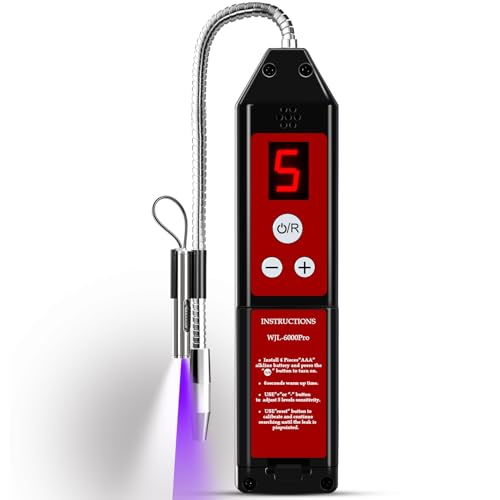
8. Aprvtio WJL-6000PRO – Built-In UV Lamp for Dye Cross-Checks
- ✓Built-in white LED flashlight and UV lamp for dye cross-checks
- ✓Upgraded 0.14 oz/yr sensitivity above the base halogen unit
- ✓LCD shows current sensitivity setting and leak level
- ✓Escalating beeps that intensify as you approach the leak
- ✓Light at 0.22 kg with a 7.9-inch flexible tip
- ✕Highest share of one and two star ratings in this roundup
- ✕Needs clean-air calibration and a slow sweep to avoid false alarms
- ✕Halogen sensors drift over time and are less sensitive than diode or infrared units
Halogen heated diode
Up to 0.14 oz/yr
LCD leak level display
UV lamp plus white LED
The distinguishing feature here is the light. A built-in white LED flashlight and UV lamp mean you can check fluorescent UV dye in the same pass as the electronic sniff, without carrying a separate UV torch. For automotive work in a dark engine bay, that is more useful than it sounds.
Sensitivity is upgraded to 0.14 oz/yr, better than the base halogen unit in this roundup, and the LCD shows both the current sensitivity setting and the gas leakage level rather than a bare buzzer.
Escalating alarms and a screen for beginners
The multi-alarm system increases beep frequency and visual alert intensity as the probe nears the source, which gives a new owner a gradient to follow instead of a single on-or-off signal. Buyers who calibrate in fresh air and sweep slowly report it works well for DIY and automotive checks, and 68 percent of its verified reviews are five star.
Where the complaints concentrate
This unit carries the widest spread of negative feedback here, with one and two star ratings combining at 12 percent. The recurring themes are false alarms when the technique is rushed and a sensitivity ceiling that will not find slow microleaks. Halogen-type sensors also drift over time, so a unit that performed well in its first year may not match that later.
Refrigerant coverage
The listed coverage runs across CFCs, HCFCs, HFCs, HFOs, blends and PFCs, naming R22, R410A, R134a and R1234yf explicitly, plus R1233zd(E). That makes it a legitimate choice for automotive and light commercial work rather than a home-only gadget.
Who should buy this
Buy it if you work on car air conditioning, use UV dye as a secondary check and want one device that covers both. Skip it if accuracy on microleaks is the deciding factor or if you cannot commit to calibrating in clean air every single time you turn it on.
Refrigerant Leak Detector Buying Guide: What Actually Matters
Sensitivity is the first number on the box and the least useful one to compare on its own. What matters is whether the threshold is below the leak size you are being asked to find, which depends on your work.
Match sensitivity to the job
Commissioning and warranty work on new residential systems demands sub-0.03 oz/yr. Routine service on an aging system is comfortably handled at 0.1 to 0.14 oz/yr, and automotive work sits somewhere in between. A 0.21 oz/yr ceiling, as on the budget halogen unit, will find weeping valves and gurgling coils and will miss slow weeps at braze joints.
Sensor life drives the real cost
Heated diode sensors are consumables rated in hours: 100 hours on the Inficon, 300 hours on the Fieldpiece DR58. Multiply that by how many detectors you run and how often you use them, then add the price of replacement sensors. Infrared sensors rated at ten years change that calculation completely, which is why they tend to be the cheaper option over a five-year ownership period despite a higher purchase cost.
Probe length decides whether you can see the leak at all
A 17-inch flexible probe, standard on the Fieldpiece DR58 and DR82, is what lets you reach coil interiors, back-side braze joints and line sets without dismantling the equipment. The 7.9-inch tips on the budget units are adequate around valves and service ports and inadequate inside equipment cabinets.
Power, protection and consumables
Rechargeable lithium-ion with USB or USB-C charging removes battery swaps, and 15 to 18 hours of runtime covers several call days. IP54 enclosures and tip-mounted filters are what keep moisture and oil off the sensing element, and field-replaceable filter tips matter because filters get used up. A one-year warranty is common; anything longer is worth paying for.
Refrigerant coverage you will actually meet
Check that R-410A, R-134a, R-1234yf and R-22 appear explicitly, plus HFO blends if you touch newer equipment. Budget units increasingly list R1234yf, but confirm it rather than assuming. Our broader guides to refrigerant recovery machines and leak down testers cover the rest of the service kit this detector plugs into.
A2L and R-1234yf Safety: What to Check Before You Buy
A2L is the mildly flammable refrigerants class, covering R-32, R-1234yf, R-454B and R-1233zd(E). As these replaced high-GWP refrigerants in residential splits and new vehicle air conditioning, detection safety became a real buying criterion rather than a footnote.
The good news is that current handheld heated diode and infrared detectors are non-igniting and A2L compatible, so an ordinary sniff will not start a fire. The INFICON 705-202-G1 is explicitly listed as A2L certified, and both Fieldpiece units are listed as A2L compatible devices. Older halogen sniffers from years back are where caution applies.
For industrial or plant work, the certification to look for is ATEX Zone 2 or Class I Division 2. Those markings are about the environment, not the sensor: they tell you the instrument is permitted where a flammable atmosphere may be present. If you maintain chillers in a machine room with a Class I Division 2 rating, buy the certified unit. For a residential service truck, any of the picks here will serve.
One caution from the safety side: a refrigerant release in an enclosed space displaces oxygen, and acute exposure causes dizziness, headache and throat irritation. Ventilate, and never deliberately vent refrigerant to locate a leak.
Why Your Refrigerant Leak Detector Keeps False-Alarming
If a detector sounds constantly on a system you believe is tight, the fault is almost always process or contamination rather than the electronics.
It was calibrated in the wrong air
Zeroing next to a running compressor or in a stairwell full of solvent vapour teaches the sensor a background it will fight you on every later job. Move to genuinely clean air, let it settle, and only then approach the equipment. The Inficon’s automatic background adjustment handles part of this for you.
The tip touched something
Refrigerant residue, oil and dust on a probe tip produce readings that have nothing to do with a leak. Cleaning the tip and replacing the filter is cheaper than arguing with the display.
The sensing element is fouled
This is the big one. Heated diode sensors degrade after exposure to oil, moisture, drain solvents and PVC cement fumes, and sensitivity drifts long before the unit stops alarming. A technician on r/refrigeration specifically warned about leak checking while drain and cement fumes were in the air. If a heated diode detector has been in service for a full season, replace the sensor before blaming the system.
You are using an infrared unit wrong
Infrared reads concentration change. Bumping the probe, stepping quickly through a doorway or parking the tip in still air all read as leaks. This accounts for most of the false alarms reported on infrared units in this roundup, and the fix is a slow, consistent sweep.
If you are adding to a maintenance routine rather than a single leak search, our guide to water leak detectors covers the fixed, always-on monitoring side of the job.
When You Do Not Need an Electronic Refrigerant Leak Detector
Electronic detection is the most sensitive option, but it is not always the right tool, and technicians working in the field say so consistently.
Soap bubbles remain the confirmation step
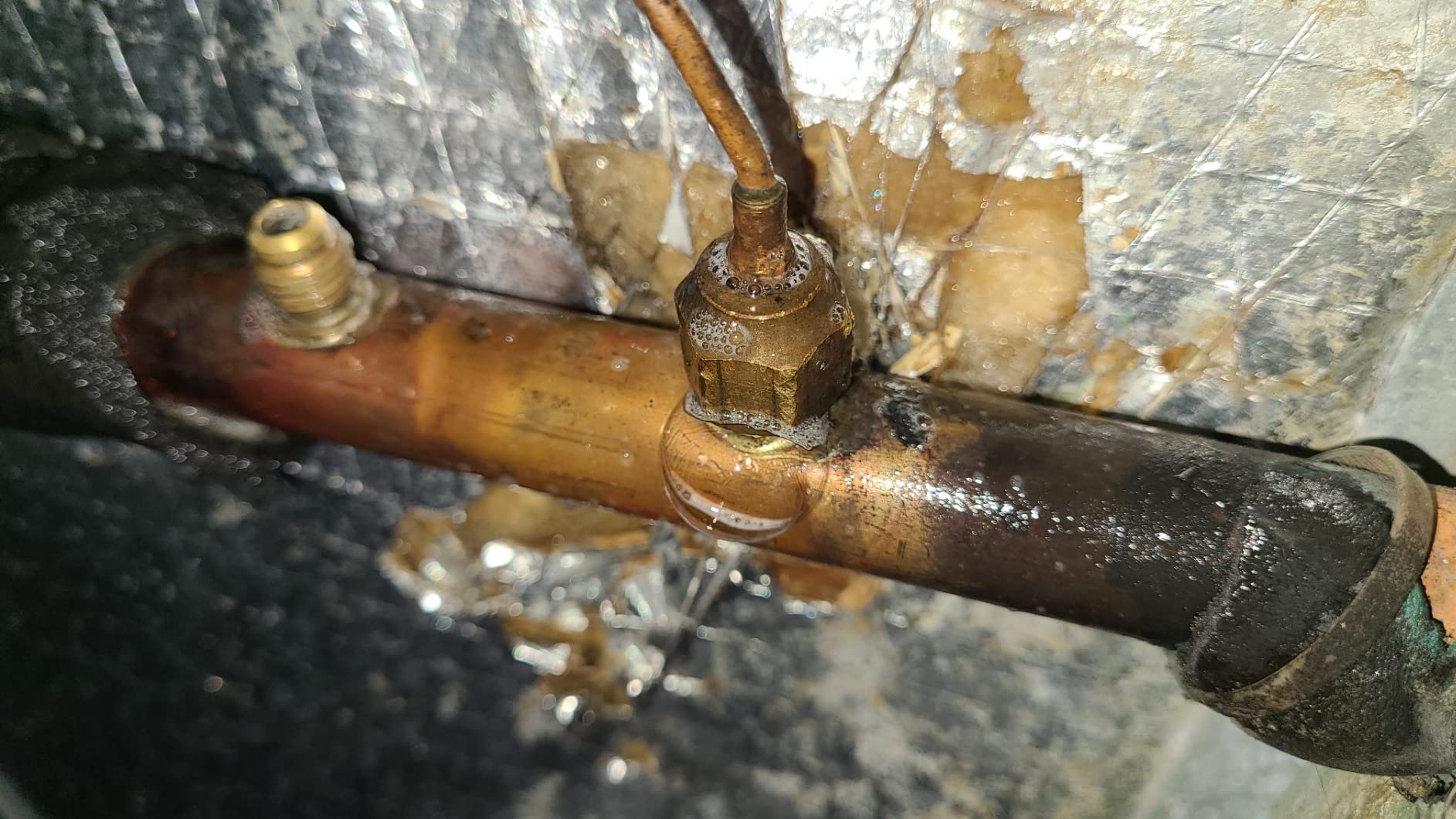
Bubbles cannot find what a calibrated electronic detector misses, which is why forum technicians treat bubbles as the proof rather than the search. Some DIY users also report bubble methods catching leaks that electronic detectors missed in cold ambient conditions, where refrigerant pools and flows rather than dispersing.
Nitrogen pressure testing pinpoints better than anything
On an isolated section, a pressure decay test with dry nitrogen tells you whether the leak exists and roughly how fast it is, without any interpretation of alarm pitch. It is slower, needs a gauge and a good seal, and it is the most reliable method for confirming a suspected joint.
UV dye gives you a visual mark
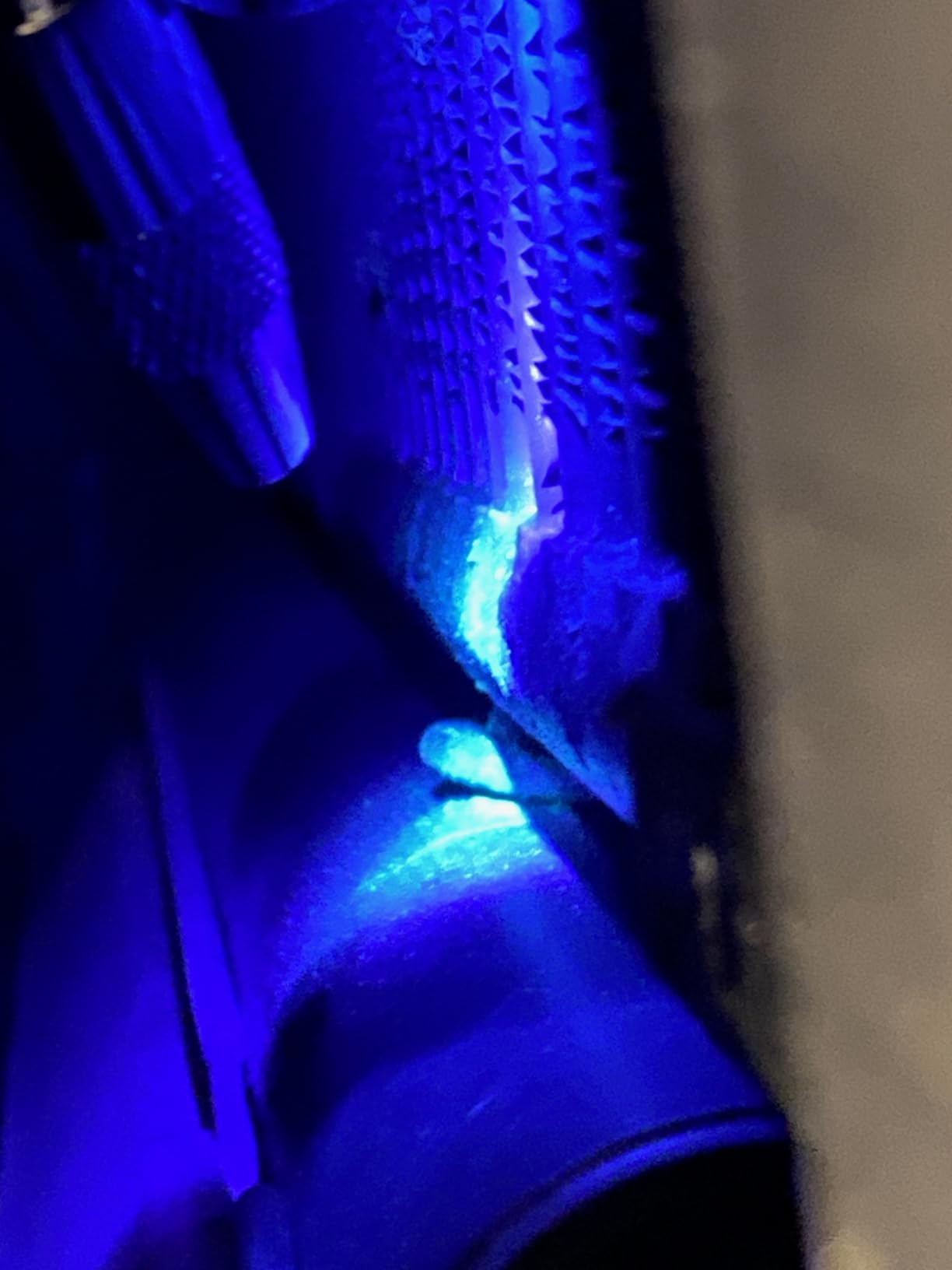
Ultraviolet dye puts dye at the escape point, which you can then see under a UV lamp. That is how the Aprvtio WJL-6000PRO earns its place. The ongoing professional debate over dye means many pros avoid injecting it into a system they will not drain, since the dye has to be recovered. Where leaks are slow, dye at the fitting plus a UV lamp can show you exactly where to cut.
Mini split interiors need a probe, not a technique
For hidden coil work, the practical answer is probe length rather than sensor type. Our guide to floor heating leak detection and repair covers the same principle for a different system: get the sensing tip to the suspect point, then use electronics to guide you there.
Frequently Asked Questions
Are refrigerant leak detectors accurate?
Yes, up to their rated threshold. Modern electronic detectors routinely register leaks well below 0.03 oz/yr, far smaller than soap-bubble testing can find, and most land within their published figure on a clean system. Accuracy depends more on sensor technology, probe technique and a clean sensing element than on the brand name.
Is a heated diode or infrared leak detector better?
Infrared wins on sensor life, typically ten years against 100 to 300 hours for a heated diode, and resists false positives from oil and chemicals. Heated diode holds advantages in high-humidity shops and can be parked over a leak. The practical trade-off is technique: an infrared probe must be kept moving, while a heated diode can be held still.
What is the most efficient way to detect refrigerant leaks?
Charge and self-calibrate in clean air, verify the unit responds to a known release, load the probe into the suspect area before enabling the sensor, sweep at a steady pace, use peak mode and sensitivity to trace the concentration gradient, and confirm every electronic hit with soap bubbles before cutting anything.
What is the best leak detector for A2L refrigerant?
All current heated diode and infrared handhelds are A2L compatible and non-igniting, so the real question is certification for your site. If you work industrial or plant areas, look for ATEX Zone 2 or Class I Division 2 marking, and confirm the unit lists R-1234yf explicitly alongside R-32 and R-454B.
What is the best refrigerant leak detector for R-134a?
Check that R-134a appears explicitly on the compatibility list, since some budget units are limited to older refrigerant families. For occasional garage work a universal halogen unit with a flexible probe is enough. For daily automotive work on R-134a and R-1234yf, choose a unit listing both with a longer probe and a leak-level readout.
Which leak detection method is considered the most accurate?
A calibrated electronic detector is the most sensitive for finding microleaks, nitrogen pressure testing is the most reliable for confirming a leak in an isolated section, and soap bubbles remain the universal confirmation step. Most professionals search with electronics and prove with bubbles, which is why we still recommend both.
What breaks first on a refrigerant leak detector?
On a heated diode unit, the sensing element is the first consumable to fail, rated at 100 to 300 hours of service life and degraded early by oil, moisture and solvent fumes. Filter tips are the next item, and on infrared units the tip filter usually restricts airflow before anything else goes wrong.
Which Refrigerant Leak Detector Should You Buy?
If you are buying your first refrigerant leak detector and want the least risk of wasting money on something that alarms constantly, start with the Elitech WJL-6000S. More than 5300 verified owners have tested it, it covers R-410A, R-134a and R-1234yf, and the six-second warm-up makes it the least annoying tool to own.
If you want one detector that covers infrared work without a recurring sensor bill, the Elitech ILD-200 is the value pick, and the Fieldpiece DR82 is the same idea built for all-day carrying with a ten-year sensor and a 17-inch probe. If your shop runs humid, oily or solvent-heavy, choose heated diode: the Inficon 705-202-G1 for soap immunity and A2L certification, the Fieldpiece SRL8 for battery life and a 30-second warm-up, or the Fieldpiece DR58 for sub-0.03 oz/yr sensitivity in bad air.
Whatever you choose, calibrate in clean air, sweep slowly, confirm with bubbles and treat the filter tips as consumables. That habit will do more for your leak searches than any spec on the box. Check the current pricing on any of these picks before you commit, and if you are building out a service kit, our [refrigerant leak detector roundup for HVAC technicians](https://progressiveradionetwork.com/best-refrigerant-leak-detectors-for-hvac-technicians/) sits alongside the rest of the tool list.






Leave a Comment