
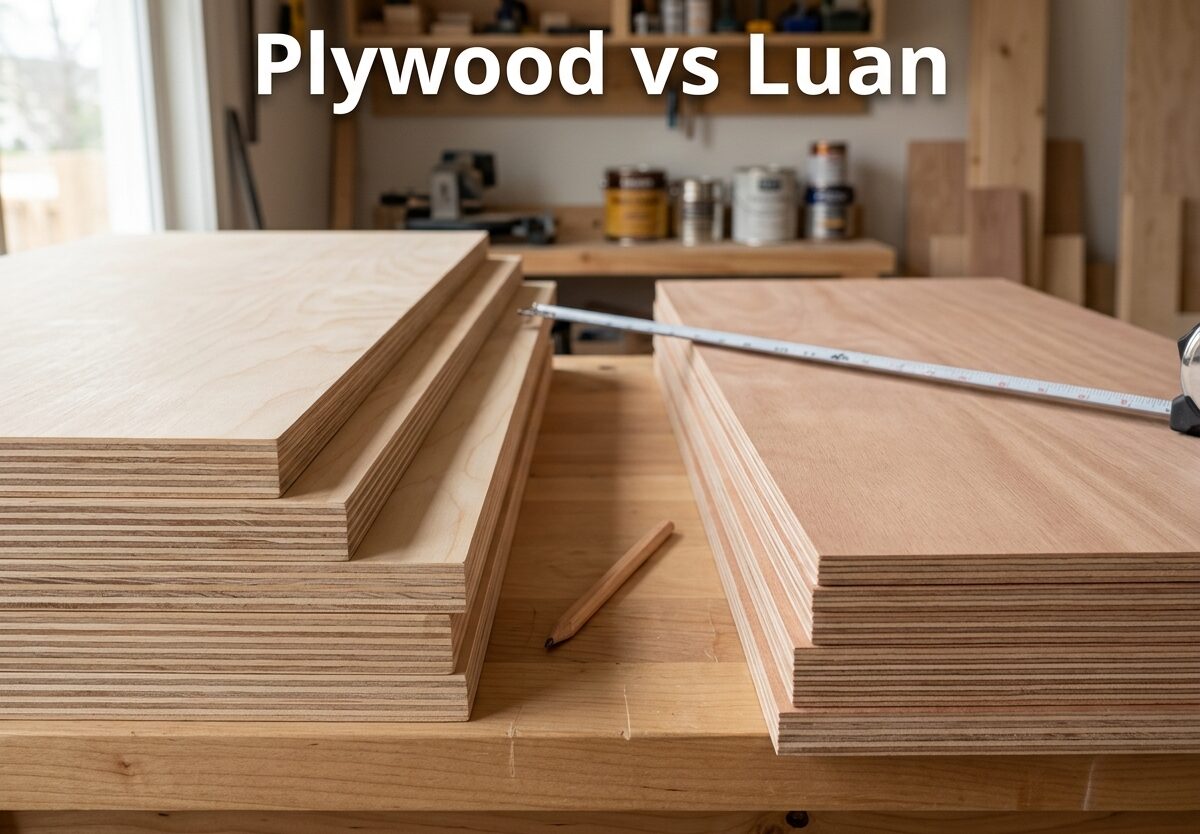
Plywood vs luan comes down to strength and application. Plywood is a engineered wood product made from multiple layers of wood veneer glued together with alternating grain directions, making it strong and dimensionally stable. Luan (also spelled lauan) is a thin tropical hardwood plywood, typically 1/8 to 1/4 inch thick, made from Southeast Asian trees like meranti. It’s lighter, more flexible, and less expensive than traditional plywood but not as structurally strong.
The main differences are clear: plywood offers superior strength and durability for structural applications, while luan excels in lightweight projects where flexibility and smooth surface matter more than load-bearing capacity. Choosing the wrong material leads to problems—luan under tile can telegraph through laminate flooring, and plywood used for curved applications may crack.
Plywood vs Luan: Quick Comparison
Before diving deep, here’s what you need to know about plywood vs luan:
- Composition: Plywood uses multiple layers of various wood species with cross-graining construction; luan is thinner tropical hardwood plywood with fewer layers
- Thickness: Plywood ranges from 1/4 inch to 3/4+ inches; luan typically comes in 1/8 to 1/4 inch sheets
- Strength: Plywood handles structural loads and heavy-duty applications; luan is designed for lightweight, non-structural uses
- Cost: Luan costs $24-$35 per 4×8 sheet; standard plywood runs $35-$40+ for similar dimensions
- Best Uses: Plywood for subflooring, sheathing, furniture; luan for underlayment, cabinet backs, crafts
What is Plywood?
Plywood is an engineered wood product constructed from thin layers of wood veneer called plies. These layers are glued together with adjacent layers having their wood grain rotated up to 90 degrees to each other—a process called cross-graining. This construction gives plywood its strength and dimensional stability, preventing the wood from splitting when nailed at the edges and reducing expansion and shrinkage.
The plywood manufacturing process starts with peeling logs into thin veneer sheets. These sheets are dried, graded, and then glued together under heat and pressure. The number of layers (plies) determines the plywood thickness and quality, with odd numbers of layers being standard for balanced construction.
Plywood comes in various grades ranging from A to D, with A-grade having the smoothest surface with few defects, and D-grade having more knots and defects allowed. The face grade and back grade are typically specified separately, such as A-C plywood meaning one A-quality face and one C-quality back.
Common plywood types include softwood plywood (made from cedar, fir, spruce, pine), hardwood plywood (using oak, maple, birch), marine plywood (water-resistant glue for boats), and aircraft plywood (high-strength birch for aviation). Each type serves specific applications based on the wood species and adhesive used.
What is Luan?
Luan, also spelled lauan, is a type of tropical hardwood plywood originating from Southeast Asia. The name comes from the lauan trees found in the Philippines and Indonesia, though most commercial luan today comes from various Shorea species including meranti trees. It’s one of the thinner plywood options available, typically sold in 1/8 inch or 1/4 inch thicknesses in 4×8 foot sheets.
The construction of luan plywood differs from standard plywood. It typically uses fewer plies (often just 3 layers) with the core layers made from softer tropical hardwoods. The face veneers are smooth and relatively consistent, making luan popular for applications where surface quality matters more than structural strength.
Luan’s characteristics make it distinctive—it’s lightweight compared to other plywood types, flexible enough to bend for curved applications, and has a smooth surface that accepts paint and finishes well. However, these same characteristics limit its use in structural applications.
The tropical hardwoods used in luan grow quickly in tropical climates, which keeps costs down. However, this has raised sustainability concerns about deforestation and harvesting practices in Southeast Asian rainforests. Some lumber yards now offer alternatives like RevolutionPly, which uses more sustainable wood sources while maintaining similar properties to traditional luan.
Plywood vs Luan Strength and Durability
Strength is where plywood vs luan shows the biggest difference. Standard plywood, especially thicker varieties with more plies, significantly outperforms luan in load-bearing applications. The cross-graining construction with more layers gives plywood superior screw-holding power, resistance to splitting, and overall structural integrity.
For structural applications like subflooring, roof sheathing, or wall construction, plywood is the clear choice. It can support heavy loads, resist impact damage, and maintain its shape under stress. Luan simply lacks the thickness and ply count to handle these demands—it will deflect under load, screws may pull out more easily, and it’s more prone to damage during installation.
That said, luan has adequate strength for its intended uses. As a cabinet back or drawer bottom, it provides plenty of support. For craft projects, door skins, or decorative paneling, luan’s strength is sufficient. The key is matching the material to the application—using luan where plywood is needed leads to failure, while using plywood where luan would suffice is wasteful.
Longevity also favors plywood in most applications. Quality plywood can last decades when properly installed and protected from moisture. Luan, especially in thinner grades, is more susceptible to damage over time and may show signs of wear faster in high-traffic applications.
Moisture Resistance Comparison
Neither plywood nor luan is inherently waterproof, but their response to moisture differs significantly. Standard plywood with exterior-grade glue can withstand occasional moisture exposure without delaminating. Marine plywood goes further, using waterproof glue and durable face veneers for boat building and other wet applications.
Luan presents more moisture-related challenges. The tropical hardwoods used in luan absorb and release moisture readily, causing the sheets to warp and cup if exposed to humidity changes or water damage. This is particularly problematic for flooring applications—luan installed over concrete slabs can absorb ground moisture and expand, creating bumps and telegraphing through vinyl or laminate flooring.
Forum discussions among flooring professionals consistently mention luan’s moisture sensitivity as a major drawback. Many report that modern luan quality has declined, with more voids, less wood content, and greater tendency to warp compared to luan from decades ago. This has led many contractors to abandon luan underlayment in favor of foam underlayment systems or other alternatives.
For bathrooms, kitchens, laundry rooms, or any area with moisture exposure, plywood with appropriate moisture-resistant rating is the safer choice. Luan should be limited to dry, climate-controlled environments where humidity remains relatively stable.
Appearance and Workability
Both plywood and luan offer workable surfaces, but with different characteristics. Luan typically provides a smoother, more consistent face veneer with fewer defects than lower-grade plywood. This smooth surface makes it ideal for painting projects where surface quality matters—cabinet backs, drawer bottoms, and craft projects all benefit from luan’s uniform appearance.
Plywood appearance varies dramatically by grade. A-grade plywood offers smooth surfaces suitable for staining and finishing, while lower grades have more knots, patches, and defects that may require covering. For visible applications, higher-grade hardwood plywood provides beautiful wood grain patterns that luan can’t match.
When it comes to cutting and machining, both materials work with standard woodworking tools. Luan’s thinner profile and fewer plies make it easier to cut with less tendency to splinter, though sharp blades are still recommended for clean edges. Plywood requires more care when cutting thicker sheets to prevent tearout, especially on the face veneer.
For curved or bent applications, luan’s flexibility gives it an advantage. The thinner sheets can bend around forms for curved furniture, architectural features, or boat building where flexibility is needed. Thicker plywood resists bending and may crack if forced into tight curves—bending plywood with more plies and thinner faces is specifically designed for curved applications.
Cost Comparison
Price is often the deciding factor in plywood vs luan decisions. Luan consistently costs less than standard plywood, with typical 4×8 sheets ranging from $24 to $35 depending on thickness and quality. Standard plywood in similar dimensions starts around $35 and can go significantly higher for marine-grade, hardwood, or specialty varieties.
The cost savings make luan attractive for budget-conscious projects, especially when the structural advantages of plywood aren’t necessary. For large surface areas like ceiling paneling, garage wall covering, or back-of-cabinet applications where appearance and strength aren’t critical, luan provides adequate performance at lower cost.
However, the cheapest option isn’t always the most economical. Using luan in applications where plywood is recommended leads to problems that cost more to fix than the initial material savings. A luan underlayment that warps and telegraphs through expensive laminate flooring creates a costly redo. A cabinet back that sags and pulls away from the frame requires replacement.
For structural applications, flooring underlayment in moisture-prone areas, or any project where failure would be expensive or dangerous, the higher cost of quality plywood is money well spent. For lightweight interior projects in dry environments, luan offers genuine cost savings without compromising performance.
Best Uses for Plywood
Plywood’s strength and versatility make it suitable for countless applications across construction, furniture making, and DIY projects. Here are the most common and appropriate uses:
Subflooring and Underlayment: Plywood provides the structural base for finished flooring in most residential construction. Typically 3/4 inch tongue-and-groove plywood creates a solid, stable surface that withstands foot traffic and supports heavy furniture. For tile flooring, exterior-grade plywood prevents moisture-related failures.
Wall and Roof Sheathing: Structural plywood sheathing provides strength to wall and roof assemblies while offering a nailing surface for siding and roofing materials. The cross-graining construction resists racking and helps buildings withstand wind and seismic forces.
Furniture and Cabinetry: Hardwood plywood with attractive face veneers creates beautiful furniture, cabinets, and built-ins. Cabinet boxes, shelving, table tops, and desk surfaces all benefit from plywood’s stability and strength. Higher grades provide surfaces suitable for staining and finishing.
Exterior Projects: Exterior-grade or marine plywood handles outdoor applications like sheds, playhouses, soffits, and exterior trim. The water-resistant glue prevents delamination when exposed to weather, making these plywood varieties suitable for intermittent moisture exposure.
Structural Applications: From beams to concrete forms, plywood’s strength makes it indispensable in construction. The material’s ability to span distances and support loads while remaining relatively lightweight gives it advantages over solid wood in many structural applications.
Best Uses for Luan
Luan excels in specific applications where its lightweight nature, flexibility, and smooth surface are advantages. Here are the most appropriate uses for luan plywood:
Flooring Underlayment: Luan has traditionally been used as underlayment for vinyl flooring, providing a smooth surface between the subfloor and the finished floor. However, this use has declined as foam underlayments and other alternatives have gained popularity, especially in areas with moisture concerns.
Cabinet Backs and Drawer Bottoms: The smooth surface and adequate strength make luan ideal for the back panels of cabinets and bottoms of drawers. These applications don’t require structural strength, but benefit from luan’s consistent surface and lighter weight.
Craft Projects and Hobbies: Model builders, diorama makers, and craft enthusiasts often choose luan for its workability and smooth painting surface. The thin sheets cut easily, accept paint well, and provide sufficient strength for small-scale projects.
Door Skins: Hollow-core doors typically use luan or similar thin plywood for the face skins. The material’s smooth surface takes paint and finishes well, while its light weight keeps doors from being excessively heavy.
Curved Applications: Luan’s flexibility allows it to bend for curved furniture, architectural features, and boat building where tighter curves are needed. The thin sheets can wrap around forms to create rounded shapes that thicker plywood couldn’t achieve without specialized bending techniques.
Garage and Workshop Paneling: For covering garage walls or creating workshop surfaces where appearance isn’t critical, luan provides an economical option. The light color brightens spaces, and the smooth surface is easy to clean.
Common Luan Problems and How to Avoid Them
Understanding luan’s limitations helps prevent common failures. Based on contractor experiences and forum discussions, here are the most frequent problems:
Telegraphing Through Flooring: One of the most common complaints is luan imperfections showing through laminate or vinyl flooring. Any gaps, voids, or rough patches in the luan will telegraph through as visible bumps or depressions in the finished floor. To prevent this, fill all voids and sand the surface thoroughly before installing flooring. Better yet, consider modern foam underlayment systems that eliminate this problem entirely.
Warping from Moisture: Luan readily absorbs moisture from concrete slabs, humid air, or water exposure, causing the sheets to warp and create uneven surfaces. Professional installers recommend testing concrete slabs for moisture emissions before installing luan underlayment, and allowing acclimation time in the installation space before fastening. In moisture-prone areas, plywood with appropriate moisture rating is the safer choice.
Quality Decline: Many long-time contractors report that luan quality has decreased over the years, with more voids, less actual wood content, and greater tendency to delaminate. This has led some professionals to abandon luan entirely in favor of more consistent alternatives. If using luan, inspect sheets carefully before purchase and avoid brands with visible quality issues.
Delamination: The adhesive bonds in lower-quality luan may fail over time, especially in humid environments or when exposed to temperature fluctuations. This causes the plies to separate, creating bubbles and weak spots. Choosing higher-quality luan from reputable manufacturers and keeping it in stable conditions helps prevent delamination.
Modern Alternatives to Traditional Luan
As sustainability concerns grow and quality issues persist with traditional luan, several alternatives have emerged. RevolutionPly has gained popularity as a replacement, using more sustainable wood sources while maintaining similar thin profile and smooth surface characteristics.
Other alternatives include birch plywood in thinner grades, which offers more consistent quality and better moisture resistance than tropical hardwood luan. For flooring underlayment specifically, foam products have largely replaced luan in many applications, eliminating telegraphing issues and providing better moisture barriers.
When choosing alternatives, consider the specific requirements of your project. For applications where luan’s smooth surface is the primary need, other thin plywood options may work well. For underlayment, modern foam systems often outperform both luan and plywood. For curved applications, specialty bending plywood may provide better results than traditional luan.
How to Choose: Decision Guide
Choosing between plywood vs luan comes down to three questions: What’s the application? What’s the environment? What’s the budget?
For Structural Applications: Always choose plywood. Subflooring, sheathing, roofing, load-bearing furniture, and any project requiring strength demand plywood’s superior construction. The cost difference is negligible compared to the cost of failure.
For Dry Interior Projects: Luan works well for cabinet backs, drawer bottoms, crafts, and paneling in climate-controlled, dry spaces. The cost savings are real, and the performance is adequate for these non-structural uses.
For Moisture-Prone Areas: Choose exterior-grade or marine plywood. Bathrooms, kitchens, laundry rooms, basements, and any area with moisture exposure require plywood’s better moisture resistance. Luan’s tendency to warp makes it unsuitable for these environments.
For Curved Projects: Luan or specialty bending plywood works best. The thin, flexible sheets bend around forms for curved furniture, architectural features, and other rounded applications. Standard plywood in thicknesses above 1/4 inch will crack when forced into tight curves.
For Budget-Conscious Projects: Luan provides genuine savings for large surface areas where strength isn’t critical. Garage walls, workshop surfaces, and back-of-cabinet applications can all use luan effectively. However, don’t sacrifice structural integrity to save money—skimping on materials for critical applications costs more in the long run.
Frequently Asked Questions
Is luan and plywood the same thing?
Luan is a type of plywood, but not all plywood is luan. Luan specifically refers to thin tropical hardwood plywood made from Southeast Asian trees like meranti, typically 1/8 to 1/4 inch thick. Standard plywood includes many varieties with different wood species, thicknesses, and constructions. Think of luan as one specific category within the broader plywood family.
Is luan or plywood better?
Neither is universally better—it depends on the application. Plywood is better for structural projects, flooring underlayment in moist areas, and any application requiring strength and durability. Luan is better for lightweight interior projects like cabinet backs, drawer bottoms, and crafts where its smooth surface and lower cost are advantages. The key is matching material properties to project requirements.
What are the disadvantages of using Luan?
Luan’s main disadvantages include lower strength compared to standard plywood, tendency to warp when exposed to moisture, quality inconsistency between brands, and risk of telegraphing imperfections through flooring. The tropical hardwoods used absorb moisture readily, causing warping in humid environments or over concrete slabs. Many professionals also note declining quality in modern luan products compared to older versions.
Is Luan real wood?
Yes, luan is real wood. It’s made from actual wood veneers from tropical hardwood trees, primarily species of Shorea including meranti trees native to Southeast Asia. The term luan refers to both the wood species and the plywood product made from these trees. Like all plywood, luan consists of thin layers of real wood bonded together with adhesive.
Can luan be used for exterior projects?
Luan is not recommended for exterior projects. The tropical hardwoods used in luan absorb moisture readily and will warp when exposed to humidity changes or rain. For exterior applications like sheds, soffits, or outdoor furniture, choose exterior-grade plywood designed to withstand weather exposure. Luan should be limited to dry, climate-controlled interior spaces.
Which is better for flooring underlayment?
For most flooring underlayment applications today, foam underlayment products outperform both plywood and luan. However, if choosing between the two, plywood is generally better—especially in moisture-prone areas or under heavy flooring like tile. Luan was commonly used under vinyl flooring for decades, but its tendency to warp and telegraph imperfections through finished floors has led many professionals to prefer alternatives. Consult your flooring manufacturer’s specific underlayment requirements.
Conclusion
Plywood vs luan isn’t about which material is universally better—it’s about choosing the right tool for the job. Plywood offers superior strength, moisture resistance, and structural integrity for demanding applications. Luan provides lightweight flexibility, smooth surfaces, and cost savings for appropriate interior projects.
The key is matching material properties to project requirements. Use plywood for subflooring, structural applications, and any project where failure would be costly or dangerous. Use luan for cabinet backs, drawer bottoms, crafts, and other lightweight projects in dry environments where its advantages matter more than its limitations.
When in doubt, err on the side of plywood—it’s better to overbuild slightly than to deal with failures down the road. But for the right applications, luan remains a useful and economical material that has earned its place in the woodworker’s arsenal.






Leave a Comment