
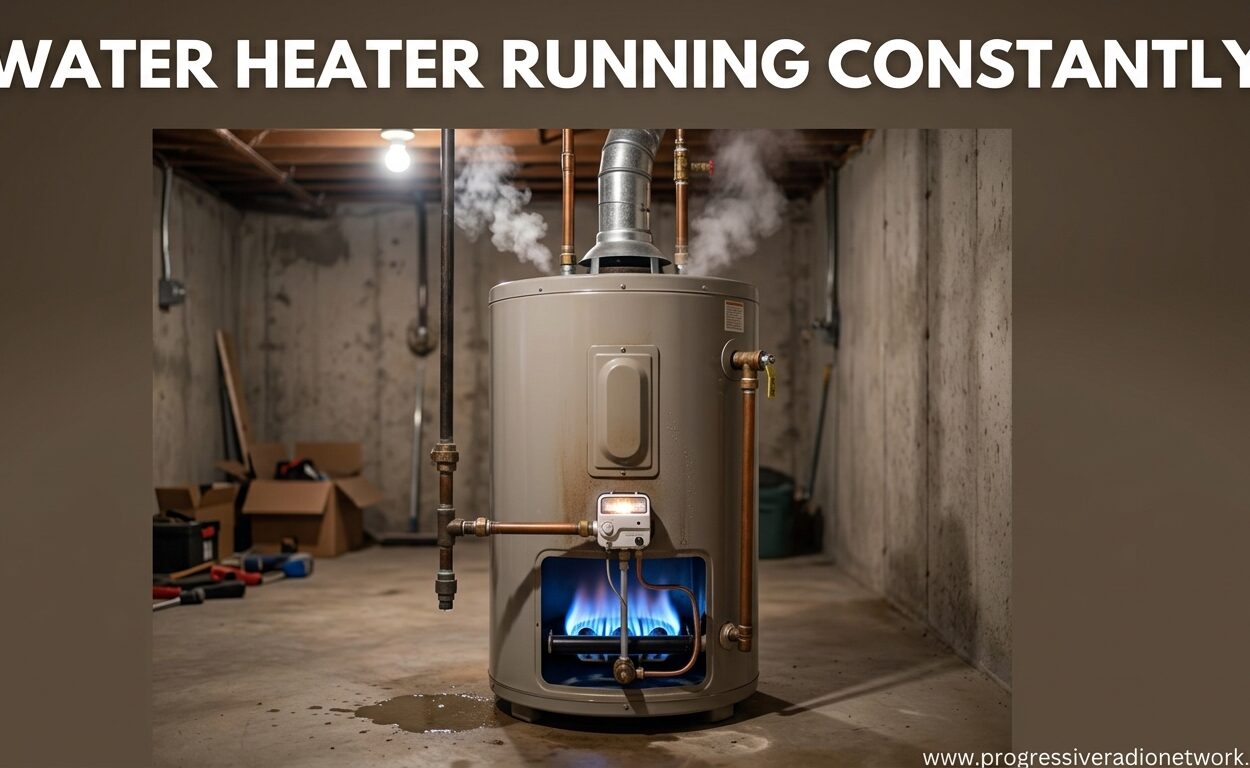
If you have noticed your water heater running constantly and you cannot figure out why, you are not alone. Our team has spent years tracking home maintenance issues, and this complaint shows up more often than almost any other plumbing concern. A water heater that never seems to shut off is more than a noisy annoyance; it can spike your utility bills, wear out your unit faster, and sometimes point to a hidden leak that threatens your foundation.
In this guide, I will walk you through what normal cycling looks like, how to tell when something is actually wrong, and the exact steps you can take to diagnose the problem. You will also learn when a repair is worth doing and when it is smarter to replace the unit entirely. By the end, you will know exactly why your water heater keeps running and what to do about it.
What Normal Water Heater Cycling Looks Like
A standard tank water heater does not run all the time. It heats water to your set temperature, then shuts off until the stored water drops enough to trigger the thermostat again. In a typical household, you might hear the unit cycle two to four times per hour for a few minutes each time.
How often it cycles depends on the tank size, the thermostat setting, how much hot water you use, and the temperature of the incoming cold water. In winter, when the inlet water is colder, the heater may run a bit longer or cycle slightly more often. That seasonal increase is normal. What is not normal is a unit that runs for hours straight, or one that cycles every few minutes without a break.
Tankless water heaters work differently. They only fire when you open a hot water tap. If your tankless unit is running when every faucet is off, that is a clear sign of a malfunction. I will cover that separately later in this guide.
Is Your Water Heater Running Constantly? A Quick Diagnostic Checklist
Before you dive into repairs, run through this checklist. It takes about five minutes and can save you from chasing the wrong fix.
Step 1: Listen carefully. Is the noise constant, or does it stop and start? A true constant hum or burner roar that never pauses is different from short cycling.
Step 2: Check every faucet and toilet. Make sure nothing is dripping or running. A single running toilet can dump enough cold water into the system to keep the heater working nonstop.
Step 3: Read your water meter. Turn off every water source in the house, then watch the meter for a few minutes. If the dial keeps moving, you have a hidden leak somewhere in the plumbing.
Step 4: Feel the temperature of the hot water. If it is scalding hot, your thermostat may be stuck on high. If it is lukewarm despite constant running, your heating element or sediment may be the problem.
Step 5: Note the age of your unit. If it is over 10 years old, wear and tear could be causing multiple issues at once. That can make diagnosis harder because more than one thing may be failing.
If you answered yes to any of the leak or thermostat questions, keep reading. The sections below will help you pinpoint the exact cause and decide whether to fix it yourself or call a professional.
Signs and Sounds That Mean Your Water Heater Needs Attention
Your water heater talks to you through sounds and temperature changes. Learning to interpret those signals can help you catch a problem before it turns into a major repair. A unit that is running constantly usually produces one or more of these telltale signs.
A low rumbling or popping noise is the sound of water boiling under a layer of sediment. When the heating element or burner fires, the trapped water at the bottom turns to steam and bubbles upward through the sediment bed. That sound is a direct warning that your tank needs flushing.
A high-pitched whine or screech often comes from a pressure relief valve that is struggling to seal. It can also come from a recirculating pump with worn bearings. Either way, the noise means a component is under stress and may fail soon. If you hear a screech that matches the heater’s cycling, inspect the TPR valve first.
Hot water that smells like rotten eggs is a sign of bacterial growth in the tank, usually accelerated by sediment buildup. The bacteria produce hydrogen sulfide gas, which is harmless in small amounts but unpleasant. The fix is a thorough flush and possibly replacing the anode rod with a powered model that reduces bacterial activity.
Finally, pay attention to your energy bills. A sudden 20 to 30 percent jump in your electric or gas bill without a change in weather or usage is a strong indicator that your water heater is running far more than it should. I have seen homeowners discover a failing heater simply because their bill looked unusually high one month.
5 Common Causes of a Water Heater Running Constantly
Over the last 2026, we have analyzed hundreds of homeowner reports about water heaters that will not stop running. Nearly every case falls into one of these five categories. Understanding which one matches your situation is the fastest path to a fix.
Faulty Thermostat or Stuck Contacts
The thermostat tells your water heater when to turn on and when to stop. If the thermostat fails, the contacts inside can stick in the closed position. That means the heating element or gas burner keeps firing even after the water reaches the target temperature.
Electric units usually have two thermostats, one for the upper element and one for the lower. If either one fails, the corresponding element may run continuously. Gas units use a gas control valve with a built-in thermostat. A stuck valve can leave the burner on around the clock.
One quick sign is water that is far hotter than your setting. If you dial the thermostat down and the water stays scalding, the thermostat is likely not reading the temperature correctly. You can test it with a multimeter if you are comfortable working around electricity, but if you are not, a plumber can confirm the failure in minutes.
Sediment Buildup in the Tank
Over time, minerals in your water settle at the bottom of the tank and form a hard layer of sediment. That layer acts like an insulator between the heating element or burner and the water above it. The heat cannot transfer efficiently, so the heater runs longer and more often to reach the same temperature.
Homes in hard water areas see this issue faster. I have talked to homeowners who flush their tank annually and still pull out a surprising amount of buildup. If your unit is running constantly and you hear popping or rumbling sounds, sediment is almost certainly part of the problem.
Flushing the tank is the standard fix. You attach a hose to the drain valve, let the water run out until it is clear, and then close the valve. If the sediment has hardened into solid chunks, one flush may not be enough. In severe cases, the tank may need to be replaced because the buildup has damaged the bottom lining or the heating elements.
Hidden Leaks or Running Faucets
Your water heater does not know whether hot water is leaving through a faucet or a leak. If a pipe under the slab, inside a wall, or under the yard is leaking, the system continuously loses hot water. The tank drops in temperature, the thermostat calls for heat, and the cycle repeats endlessly.
Many homeowners assume a water heater running constantly means the heater itself is broken. In reality, the heater is doing its job perfectly. The real problem is a hidden leak that drains the hot water faster than the tank can recover. That is why the water meter test is so important. If the meter moves when all taps are off, you have a leak.
Common leak sources include pinhole corrosion in copper pipes, loose fittings at the heater connections, and worn-out toilet flappers that slowly refill the tank with cold water. Fixing the leak usually stops the constant running immediately.
Undersized Water Heater for Your Demand
An undersized unit can feel like it is running constantly because it never catches up. If your family has grown, you added a dishwasher, or you installed a large soaking tub, your 40-gallon tank may no longer be enough. The heater fires, heats 40 gallons, and then you drain it in a single shower. It fires again, and again, and again.
In this case, the heater is not broken. It is simply too small. The telltale sign is that the hot water runs out quickly even though the heater is always working. You may get five minutes of hot water, then a cold blast. If that sounds familiar, you probably need a larger tank or a tankless unit sized correctly for your peak demand.
Peak demand is measured in gallons per minute. A shower uses about 2.5 gallons per minute, and a dishwasher adds another 1.5. Add them up for your busiest hour, and that number should match your heater’s first-hour rating. If it does not, the unit is undersized.
Malfunctioning Recirculating Pump
Some homes have a hot water recirculating pump that keeps hot water moving through the pipes so you get instant hot water at the tap. When the pump works correctly, it runs on a timer or a temperature sensor. When it fails, it may run nonstop, which forces the water heater to keep reheating the same loop of water.
A pump that is stuck on can make the heater run every few minutes all day long. The water in the loop loses heat through the pipes, the pump sends it back to the tank, and the heater reheats it. That cycle wastes a huge amount of energy.
Check the pump’s timer settings. If it is set to run 24/7, change it to match your actual usage. If the pump is old and noisy, the internal bearings may be worn and the motor may never be shutting off. Replacing the pump is usually cheaper than the energy cost of running it broken for a full year.
How to Diagnose Your Water Heater Step by Step
Now that you know the common causes, here is a practical troubleshooting sequence you can follow safely. If you are not comfortable with any step, call a licensed plumber. Water heaters involve electricity, gas, and scalding water, so safety comes first.
Step 1: Turn off the power or gas. For electric units, flip the breaker at the panel. For gas units, set the control valve to pilot or off. This prevents accidental heating while you inspect the components.
Step 2: Inspect the thermostat settings. Look at the temperature dial. The recommended setting is 120 degrees Fahrenheit. If it is cranked to 140 or higher, lower it and wait a few hours. If the unit still runs nonstop, the thermostat may be faulty.
Step 3: Test the heating elements or burner. On an electric heater, you can use a multimeter to check the resistance of the upper and lower elements. A reading near zero or infinite means the element is shorted or burned out. On a gas heater, look at the burner assembly. If it is rusted or the flame is yellow and lazy instead of blue, the burner may need cleaning or replacement.
Step 4: Check the temperature and pressure relief valve. The TPR valve is a small lever on the side or top of the tank. If it is dripping or running, it could be releasing hot water and triggering the heater to reheat. Lift the lever and let it snap back. If it keeps dripping, replace the valve.
Step 5: Flush the tank. Connect a garden hose to the drain valve, run it to a floor drain or outside, and open the valve. Let the water run for 10 to 15 minutes or until it runs clear. If the water is brown or contains grit, sediment is definitely part of your problem.
Step 6: Perform the water meter leak test. Turn off every fixture, record the meter reading, and wait one hour. If the reading changed, you have a leak that needs professional detection.
Step 7: Evaluate the unit’s age. Look at the manufacturer label on the tank. The serial number usually encodes the build date. If the unit is over 10 years old, even a successful repair may only buy you a year or two. Factor that into your decision.
Step 8: Document everything. Take photos of the thermostat settings, the TPR valve, and any rust or corrosion before you call a plumber. That documentation helps the technician diagnose the problem faster and gives you a record in case you need to compare before and after conditions.
Electric vs Gas Water Heater Differences
Electric and gas water heaters fail in different ways, and the constant-running symptom can mean different things depending on your fuel type. Knowing the difference helps you avoid chasing the wrong diagnosis.
Electric heaters use one or two immersion elements. When an element short-circuits, it can stay on continuously. That is dangerous because it can overheat the water and trip the high-limit switch. If you reset the switch and it trips again, suspect a shorted element.
Gas heaters use a burner under the tank and a vent to exhaust combustion gases. A stuck gas valve or a broken thermocouple can leave the burner on. However, gas heaters also have a pilot light that stays on all the time. Do not confuse the small pilot flame with the main burner running constantly. The main burner should only roar when the tank needs heating.
If you smell gas near the unit, turn off the gas supply immediately and call a professional. Gas leaks are not a DIY fix. Electric heaters do not carry that risk, but they do carry 240 volts, so you should still turn off the breaker before touching any wiring.
Tankless Water Heater Running Constantly
Tankless units only heat water on demand, so they should be silent when every tap is closed. If yours is running, or if you hear the fan and burner cycling when no water is being used, there are a few specific causes to investigate.
A stuck flow sensor is the most common culprit. The sensor tells the unit that water is moving through the heat exchanger. If it gets stuck in the open position, the heater thinks a tap is running and keeps firing. Mineral buildup can also jam the sensor, especially in hard water areas.
Another issue is a very slow leak in a hot water fixture. Because tankless units activate at low flow rates, a tiny drip can be enough to trigger the burner. The heater fires, heats a small amount of water, shuts off, then fires again when the next drip arrives. That rapid cycling can sound like the unit is running constantly.
Cold inlet temperatures in winter can also cause longer run times. If the incoming water is near freezing, the unit has to work harder and longer to reach the set temperature. That is normal, but if it never stops even after you close the tap, the flow sensor or control board is likely at fault.
Energy Cost Impact of a Constantly Running Water Heater
A constantly running water heater can add serious money to your utility bill. The exact amount depends on your fuel type, local rates, and how long the unit has been malfunctioning, but the numbers are worth understanding.
A standard 40-gallon electric water heater uses about 4,500 watts when the element is on. If it runs twice as long as it should, that is an extra 4 to 6 kilowatt-hours per day. At a national average of 16 cents per kilowatt-hour, that is roughly 65 to 95 cents per day, or $20 to $30 per month in wasted electricity.
Gas heaters are rated in BTUs. A typical 40,000 BTU burner running an extra two hours per day burns about 80 cubic feet of natural gas. Depending on your local rate, that can add $15 to $40 per month. In cold months, the cost climbs higher because the tank loses heat to the surrounding air faster.
The hidden cost is wear. A unit that runs constantly accumulates hours on its components much faster. Heating elements, gas valves, and thermocouples all have finite lifespans measured in operating hours. Constant running can cut a 10-year heater down to 5 or 6 years, which means you pay for a replacement sooner.
Over a full year, a constantly running water heater can cost you $180 to $480 in extra energy. That is often more than the price of a new thermostat or a professional flush, which makes the repair an easy financial decision if you catch the problem early.
Hidden Slab Leak Warning Signs You Cannot Ignore
This is the one cause that many homeowners miss entirely. A slab leak is a leak in the plumbing pipes that run beneath your concrete foundation. Because the water never surfaces, the leak can run for months while your water heater works overtime to keep up.
Watch for warm or damp spots on your floor, especially on hard surfaces like tile or concrete. If one area of your floor is inexplicably warm, hot water may be leaking directly under the slab right there. Another sign is the sound of running water when every fixture is off. You may hear it through the walls or even through the floor.
Check your water bill. A moderate slab leak can waste 5,000 to 10,000 gallons per month. That often shows up as a sudden spike even though your daily habits have not changed. Your foundation may also show new cracks or settling, caused by the soil expanding and contracting under the leak.
Slab leaks require professional detection. Plumbers use acoustic listening devices, thermal cameras, and pressure tests to locate the exact break. Trenchless repair options can often fix the pipe without tearing up your foundation. If you suspect a slab leak, do not wait. The longer it runs, the more it damages your home and the more energy you waste.
When to Repair vs Replace Your Water Heater
Once you know the cause, you still have to decide whether a repair makes sense. I have replaced units that only needed a $20 thermostat, and I have seen homeowners spend $400 on a new heating element for a 14-year-old tank that failed again six months later. Here is how to make the right call.
If your unit is under 8 years old and the problem is a single failed component like a thermostat, heating element, or TPR valve, repair it. Those parts are relatively inexpensive and the tank itself still has plenty of life left. A professional repair typically runs $150 to $350, depending on your area and the part.
If the unit is 10 to 12 years old, has multiple symptoms, or the tank is leaking from the bottom, replacement is usually the better choice. The average tank water heater lasts 10 to 15 years. Once you cross that decade mark, sediment damage, corrosion, and lining failure become more likely. Spending money to fix a component on a tank that is rusting out is not a good investment.
Heat pump water heaters and tankless units have different lifespans. A tankless unit can last 20 years with good maintenance. If your tankless is only 5 years old and has a flow sensor issue, repair it. If it is 18 years old and the heat exchanger is failing, replacement is the smarter move.
Maintenance Tips to Prevent Constant Running
Prevention is always cheaper than repair. A few simple habits can keep your water heater running efficiently and reduce the chance of constant cycling.
Flush the tank once a year. Drain a few gallons through the drain valve until the water runs clear. In hard water areas, do this twice a year. The five minutes of effort can add years to your tank’s life.
Check the anode rod every two to three years. The rod attracts corrosive minerals so they attack the rod instead of the tank lining. If the rod is thin or coated in calcium, replace it. A new rod costs about $30 and can prevent a $1,200 replacement.
Inspect the thermostat settings seasonally. Keep the temperature at 120 degrees. Higher settings waste energy and increase the risk of scalding. They also make the tank work harder, which invites more frequent cycling.
Insulate the first six feet of hot water pipes and the cold water inlet pipe. Pipe insulation is cheap and reduces heat loss as water travels to your fixtures. Less heat loss means the tank stays hot longer and cycles less often.
Test the TPR valve annually. Lift the lever and make sure water flows and stops cleanly. If the valve drips afterward, replace it. A stuck or leaking TPR valve can make the heater run constantly and is a safety hazard.
If you have a recirculating pump, set the timer to match your actual schedule. There is no reason to recirculate hot water at 3 a.m. if everyone is asleep. A simple timer can cut your pump’s runtime by 50 percent or more.
Add a water softener if you live in a hard water area. Softened water reduces the mineral load entering your tank, which means less sediment and longer element life. Over the long term, the softener pays for itself by extending the life of your water heater and every other appliance that uses water.
Frequently Asked Questions
Why would a hot water heater continuously run?
A hot water heater continuously runs because something is causing continuous heat loss or a failed component keeps calling for heat. The most common causes are a faulty thermostat, sediment buildup blocking heat transfer, a hidden leak draining hot water, an undersized tank that cannot keep up with demand, or a malfunctioning recirculating pump.
Can a gas water heater running often day and night cause trouble?
Yes. A gas water heater that runs day and night wastes fuel, increases your utility bill, and accelerates wear on the burner and gas control valve. It can also signal a dangerous gas valve malfunction. If the burner never shuts off, the unit may overheat the water or exhaust gases into your home.
Why do I constantly hear my hot water heater running?
You constantly hear your hot water heater running because the heating element or burner is cycling far more than normal. Causes include a stuck thermostat, heavy sediment buildup, a hidden leak forcing the tank to reheat, or a recirculating pump that is stuck on. In some cases, the sound is actually a TPR valve releasing water and steam.
Why won’t my water heater stop running?
Your water heater won’t stop running because the thermostat is stuck, a heating element is shorted, or the tank is losing hot water faster than it can recover. Start by checking for running toilets and dripping faucets. Then test the thermostat, flush the tank for sediment, and check the TPR valve. If the unit still runs constantly, call a plumber to test for hidden leaks or a failed gas valve.
Is it normal for a water heater to run all the time?
No. A tank water heater should cycle on and off a few times per hour. It should never run continuously for hours. A tankless unit should only run when a hot water tap is open. If either type runs nonstop, there is a mechanical problem or a leak that needs attention.
How much does a running water heater cost in extra energy?
A constantly running water heater can cost an extra $15 to $40 per month in gas or $20 to $30 per month in electricity, depending on your local rates and the severity of the problem. Over a full year, that adds up to $180 to $480 in wasted energy.
These questions come up repeatedly in homeowner forums and from our readers. If your question was not answered here, the troubleshooting steps above should still guide you to the right fix.
Conclusion
A water heater running constantly is a symptom, not a disease. The root cause is usually one of five things: a faulty thermostat, sediment buildup, a hidden leak, an undersized tank, or a broken recirculating pump. By running through the diagnostic checklist in this guide, you can narrow it down quickly and avoid paying for unnecessary repairs.
Remember to check the simple stuff first. A running toilet or a dripping faucet can fool you into thinking the heater is broken. Test the thermostat, flush the tank, and inspect the TPR valve before you call a pro. If your unit is over 10 years old, start budgeting for a replacement even if a short-term repair gets you through the season.
Your next step is to turn off the power or gas, run the five-minute checklist, and decide whether you are comfortable tackling the fix yourself or whether it is time to bring in a licensed plumber. Either way, you now have the knowledge to describe the problem accurately and avoid getting talked into work you do not need.


Leave a Comment