
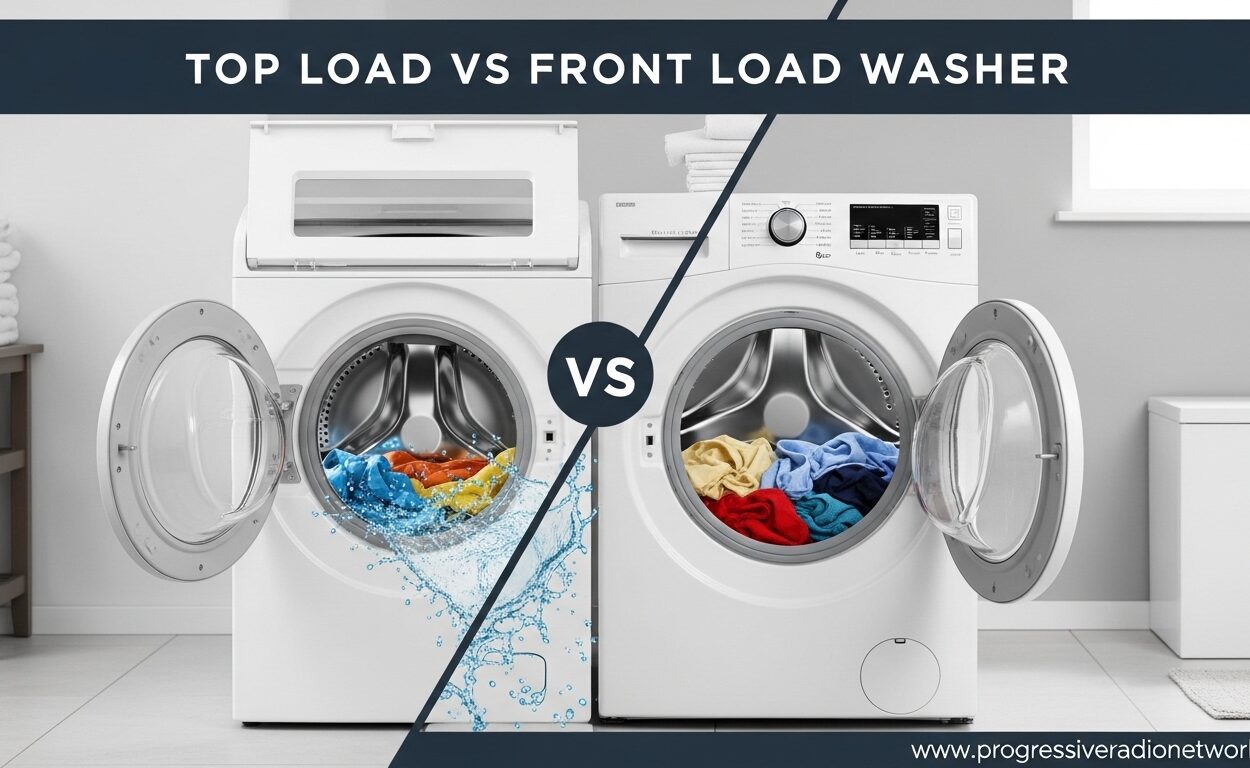
Choosing between a top load vs front load washer is one of the most important appliance decisions you’ll make for your home. This choice affects your water bill, energy costs, clothing longevity, and daily laundry routine for the next 10-15 years.
After researching both washer types extensively and analyzing real user experiences, I can tell you that neither is universally better. The right choice depends entirely on your priorities, physical needs, budget, and laundry habits. Front load washers generally clean better and use less resources, while top load washers offer more convenience and faster cycles.
This comparison guide breaks down every difference you need to know, from cleaning performance and water usage to maintenance requirements and total cost of ownership. Let’s dive into the details so you can make the right choice for your household.
How They Clean: Tumbling vs Agitator Action
The fundamental difference between these washer types lies in their cleaning mechanisms. This single difference drives most of the other contrasts in performance, efficiency, and clothing care.
Front load washers clean using a tumbling action. The drum rotates horizontally, lifting clothes up and then dropping them down through the wash water. Gravity does most of the work here. The tumbling motion creates friction between fabric fibers, which is highly effective at removing dirt and stains. This gentle action treats fabrics better than aggressive mechanical movement.
Top load washers use two different mechanisms depending on the model. Traditional top loaders feature a central agitator, a tall post with fins or vanes that twists back and forth, aggressively rubbing clothes against each other. Newer high-efficiency top load models use an impeller, a low-profile disc at the bottom of the drum that creates turbulence to move clothes through the water.
In terms of pure cleaning performance, front load washers have the advantage. The tumbling action combined with faster spin speeds (typically 1,000-1,400 RPM vs 600-800 RPM for top loaders) extracts more water and detergent from fabrics. Consumer Reports and Wirecutter testing consistently shows front loaders clean better, especially for heavily soiled items and stain removal.
However, top load washers with agitators excel at certain tasks. The vigorous mechanical action can be more effective at breaking loose stubborn dirt from work clothes, uniforms, or heavily soiled items. The trade-off is more wear on fabrics over time.
Water Usage: Front Load Washers Use 40-50% Less Water
Water efficiency is where front load washers dominate the competition. On average, a front load washer uses about 7 gallons of water per load. A standard top load washer uses between 13-19 gallons for the same load size. This represents a 40-50% reduction in water consumption.
The design difference explains this massive gap. Front load washers clean by tumbling clothes through a shallow pool of water at the bottom of the drum. Gravity and friction do the cleaning work, not water volume. Top load washers need enough water to fully submerge clothes for the agitator or impeller to move them effectively.
Over the course of a year, this difference adds up significantly. An average household doing 8 loads of laundry weekly would save approximately 2,500-4,000 gallons of water annually with a front load washer. For larger families doing 12-15 loads per week, annual savings can exceed 6,000 gallons.
Beyond the environmental benefits, this water efficiency translates to real cost savings. In areas with high water rates, the difference can amount to $100-200 per year on water bills alone. When combined with reduced water heating costs (since there’s less water to heat), the savings become even more substantial.
Some high-efficiency top load washers have improved their water usage, using 12-15 gallons per load instead of 19. However, they still can’t match the efficiency of front load designs, which fundamentally require less water to operate effectively.
Energy Efficiency: Lower Operating Costs with Front Load
Energy efficiency works hand-in-hand with water savings. Front load washers typically use 50-65% less energy than traditional top load washers. This advantage comes from three factors: less water to heat, more efficient motors, and faster spin speeds.
Less water means less energy required to heat that water. Since about 90% of washer energy consumption goes to water heating, reducing water volume dramatically cuts energy use. A front load washer using 7 gallons of water needs roughly half the energy to heat compared to a top loader using 15 gallons.
Front load washers also feature more efficient motors. Most use direct drive or inverter motors that operate at variable speeds, consuming only the power needed for each cycle phase. These motors generate less heat and waste less energy than the traditional induction motors found in many top load washers.
The third advantage comes from spin speed. Front load washers spin at 1,000-1,400 RPM, extracting significantly more water from clothes. Top load washers typically spin at 600-800 RPM. This difference means clothes from a front loader come out drier, reducing drying time and energy use by 15-30%. When you account for the dryer’s energy consumption, this compounds the overall efficiency advantage.
Most front load washers qualify for ENERGY STAR certification, meeting strict efficiency guidelines set by the EPA. While some high-efficiency top load washers also qualify, front load models generally achieve higher efficiency ratings and lower estimated annual energy consumption.
Cycle Times: Top Load Offers Faster Wash Cycles
Here’s where top load washers fight back: speed. Standard top load washers typically complete cycles in 35-50 minutes. Front load washers often take 45-90 minutes for comparable cycles. This difference matters if you do multiple loads per day or need clean clothes in a hurry.
The longer cycle time for front loaders results from their design. The tumbling action takes longer to achieve the same cleaning result because it’s gentler than the aggressive agitation of top loaders. Front load washers also use more soaking periods and lower water temperatures to enhance cleaning while protecting fabrics.
However, both washer types now offer quick wash cycles designed for lightly soiled items. Top load quick washes typically run 15-25 minutes, while front load quick washes take 20-35 minutes. These shorter cycles sacrifice some cleaning performance but work fine for daily wear that isn’t heavily stained.
Some modern front load washers have added speed features to address this disadvantage. Turbo wash or speed cycle options can complete a normal load in 30-40 minutes by using higher spin speeds, more detergent dispersion, and sometimes slightly more water. However, these options may reduce the efficiency advantages that make front loaders attractive.
Capacity: Similar Sizes, Different Loading
Both washer types offer similar capacity ranges, typically from 2.5 cubic feet (compact models) up to 5.8 cubic feet (largest residential models). However, the usable capacity differs due to loading mechanisms.
Front load washers often provide more usable space because they lack a central agitator post. This means you can load bulkier items like comforters, pillows, and large blankets more easily. The drum orientation also allows for more efficient packing of clothes.
Top load washers with agitators lose some usable space to the agitator post in the center. While the stated capacity might be 4.5 cubic feet, the agitator reduces the actual space available for clothes. Impeller models (without the central post) offer more usable space but still can’t match the efficient packing of front load drums.
Door opening size is another consideration. Front load washers typically have smaller door openings, which can make loading large or awkward items more challenging. Top load washers open from the top, providing full access to the drum. This makes adding heavy wet items or retrieving small socks that get stuck easier.
For most households, capacity differences matter less than loading convenience. If you frequently wash bulky items like comforters or sleeping bags, a front loader’s larger drum and tumbling action handles these items better. If you prefer the ease of dropping clothes in from above, a top loader might feel more convenient.
Maintenance and Mold Prevention
This is the single biggest disadvantage of front load washers: mold and odor problems. The rubber door gasket, detergent drawer, and drum design create environments where mold thrives if not properly maintained. This issue is so common that it’s the most frequent complaint in user reviews and forum discussions.
Why does this happen? Front load washers seal tightly during operation, trapping moisture inside. The door gasket remains damp after cycles end, and water can pool in folds of the rubber. Detergent residue builds up in hard-to-reach areas. Together, these factors create ideal conditions for mold growth.
Preventing mold requires consistent maintenance. You should wipe the door gasket dry after each use, leave the door ajar between cycles to allow air circulation, and clean the detergent drawer regularly. Monthly cleaning cycles with hot water and either vinegar or a washer cleaner are essential. Some models feature self-cleaning cycles that help but don’t eliminate the need for manual maintenance.
Top load washers don’t have these mold issues. The lid design allows for better air circulation, and there’s no rubber gasket to trap moisture. While any washer can develop odors if not maintained, top loaders are far more forgiving of irregular cleaning schedules.
Long-term maintenance considerations also differ. Front load washers have more complex mechanical systems with bearings and seals that can fail after 8-12 years. Top load washers, especially those with direct drive systems, often have simpler mechanisms that may last longer. Repair costs for front loaders tend to be higher when problems do occur.
Comfort and Accessibility: Loading Height Matters
The physical act of loading and unloading differs significantly between these washer types. This difference matters more than many people realize, especially if you have back issues, mobility concerns, or do laundry frequently.
Front load washers require bending to load and unload clothes. The door is typically 12-24 inches from the floor, depending on whether you place the washer on the floor or on a pedestal. This repeated bending can strain your back, especially when reaching into the drum to retrieve wet items.
However, front load washers can be installed on pedestals that raise them 12-15 inches. This brings the door to a more comfortable height but adds $200-400 to the purchase price. Pedestals also provide storage space, which some users find valuable.
Top load washers load from above, eliminating the need to bend. The lid is typically 36-42 inches from the floor, a comfortable standing height for most adults. You simply drop clothes in and lift them out, which many users find easier on their back and knees.
For elderly users, pregnant women, or anyone with mobility limitations, top load washers are generally more accessible. The vertical loading position requires less flexibility and puts less strain on joints. Some top load models also feature lids that stay open at various angles, making it easier to load with one hand while holding items with the other.
Another consideration is adding forgotten items. Once a front load cycle starts, the door locks and you cannot add items (unless the washer has a specific add wash feature). Top load washers allow you to pause the cycle, lift the lid, and add that sock you dropped anytime during the wash portion of the cycle.
Space and Installation Flexibility
Front load washers offer installation advantages that matter in certain spaces. The ability to stack a dryer on top of a front load washer is a game-changer for small laundry rooms, apartments, or closets. Stacking frees up floor space for other uses and creates a more compact laundry footprint.
Most front load washers are designed to work with matching dryers in stacked configurations. Stacking kits cost $50-150 and are required for safe installation. The stacked height typically reaches about 75-80 inches, so measure your space carefully before committing to this arrangement.
Top load washers cannot be stacked. The dryer must be placed beside the washer, requiring more floor space. This configuration makes sense in traditional laundry rooms with ample space but becomes problematic in smaller apartments or closet installations.
However, top load washers offer more flexibility in tight spaces because the lid opens upward. You can install them under countertops with enough clearance above, or in corners where a swinging front door might be obstructed. Front load washers require clearance in front for the door to swing open fully.
Depth is another consideration. Front load washers are typically deeper than top loaders (27-30 inches vs 25-28 inches) to accommodate the drum orientation and door mechanism. If your laundry space is shallow, a top load washer might fit more easily.
Cost Comparison: Purchase Price vs Total Ownership
The upfront cost difference between these washer types is substantial. Front load washers typically cost $800-2,000 for standard residential models. Top load washers range from $500-1,500. On average, front loaders cost 30-50% more than comparable top load models.
This price difference reflects the more complex construction of front load washers. The horizontal drum system requires stronger suspension, more sophisticated seals, and more precise engineering. Top load washers, especially traditional agitator models, use simpler, less expensive mechanisms.
However, purchase price is only part of the equation. Operating costs tell a different story. The water and energy savings from a front load washer amount to $50-150 per year for most households. Over a 10-year lifespan, this offsets much of the initial price difference.
Drying efficiency also factors into long-term costs. Because front load washers extract more water, drying time decreases by 15-30%. This reduces energy use for your dryer and extends the life of your clothing since they spend less time exposed to high heat.
Repair costs favor top load washers. When front load washers need repairs, parts and labor typically cost more due to the more complex mechanism. Common issues like bearing failure, seal leaks, or control board problems can cost $300-800 to fix. Top load washer repairs generally cost less, though this varies by specific problem.
When calculating total cost of ownership over 10-12 years, including purchase price, utilities, and expected repairs, the difference between front and top load washers narrows considerably. In some cases, high-efficiency front loaders can actually cost less overall despite the higher initial price.
Pros and Cons: Quick Reference Guide
Front load washers offer clear advantages in several key areas. They clean better, use significantly less water and energy, treat clothes more gently, and can be stacked to save space. The tumbling action and higher spin speeds provide superior stain removal and water extraction. These benefits make front loaders ideal for energy-conscious households and those who prioritize cleaning performance.
However, front load disadvantages are significant. Higher initial cost, longer cycle times, mold maintenance requirements, and the need to bend when loading are real drawbacks. The door lock during cycles prevents adding forgotten items, and mechanical repairs tend to be more expensive.
Top load washer advantages center on convenience and affordability. Faster cycles, easier loading without bending, the ability to add items mid-cycle, and lower purchase price make top loaders attractive. They’re more forgiving about maintenance and typically have lower repair costs.
Top load disadvantages include higher water and energy consumption, less effective cleaning (especially for impeller models), and potential fabric wear from agitators. They also cannot be stacked and may use more detergent to achieve comparable cleaning results.
Frequently Asked Questions
Which is better, top load or front load?
Front load washers are better for cleaning performance, water efficiency, and energy savings. They clean clothes more effectively using 40-50% less water and 50-65% less energy than top load washers. However, top load washers are better if you prioritize faster cycles, easier loading without bending, and lower initial cost.
What are the disadvantages of front loading washing machines?
Front load washers have several disadvantages: higher purchase price ($800-2,000 vs $500-1,500), longer cycle times (45-90 minutes vs 35-50), mold maintenance requirements, and the need to bend when loading. The door locks during cycles so you cannot add forgotten items, and repairs typically cost more due to the more complex mechanism.
Which lasts longer, top load or front load?
Top load washers generally have slightly better longevity, with many models lasting 12-15 years compared to 10-12 years for front load washers. The simpler mechanism of top loaders means fewer components that can fail. However, proper maintenance can extend the life of either type, and reliability varies more by brand than by washer type.
What is the disadvantage of a top load washing machine?
Top load washers use significantly more water (13-19 gallons vs 7 gallons) and energy than front load models. Agitator models can be rough on fabrics, causing more wear on clothes. They cannot be stacked to save space, and they generally don’t clean as well as front load washers according to Consumer Reports and Wirecutter testing.
Conclusion: Which Washer Type is Right for You?
After examining all aspects of the top load vs front load washer comparison, the decision becomes clearer based on your specific priorities. There’s no universal winner, but there is a right choice for your situation.
Choose a front load washer if you prioritize cleaning performance above all else, want to minimize water and energy consumption, plan to keep the washer for 10+ years (allowing efficiency savings to offset the higher price), have space for stacking or don’t mind the floor footprint, and are willing to commit to regular maintenance to prevent mold issues.
Choose a top load washer if you have mobility concerns that make bending difficult, need faster cycle times for multiple loads per day, prefer the convenience of adding forgotten items mid-cycle, have a limited upfront budget, and don’t want to worry about mold maintenance routines.
For most households, the decision comes down to this trade-off: front load washers cost more initially but deliver better cleaning and efficiency over time. Top load washers cost less upfront and offer more convenience, but use more resources and may not clean as well. Consider which factors matter most to your household, and you’ll find the right choice in the top load vs front load washer debate.




Leave a Comment