
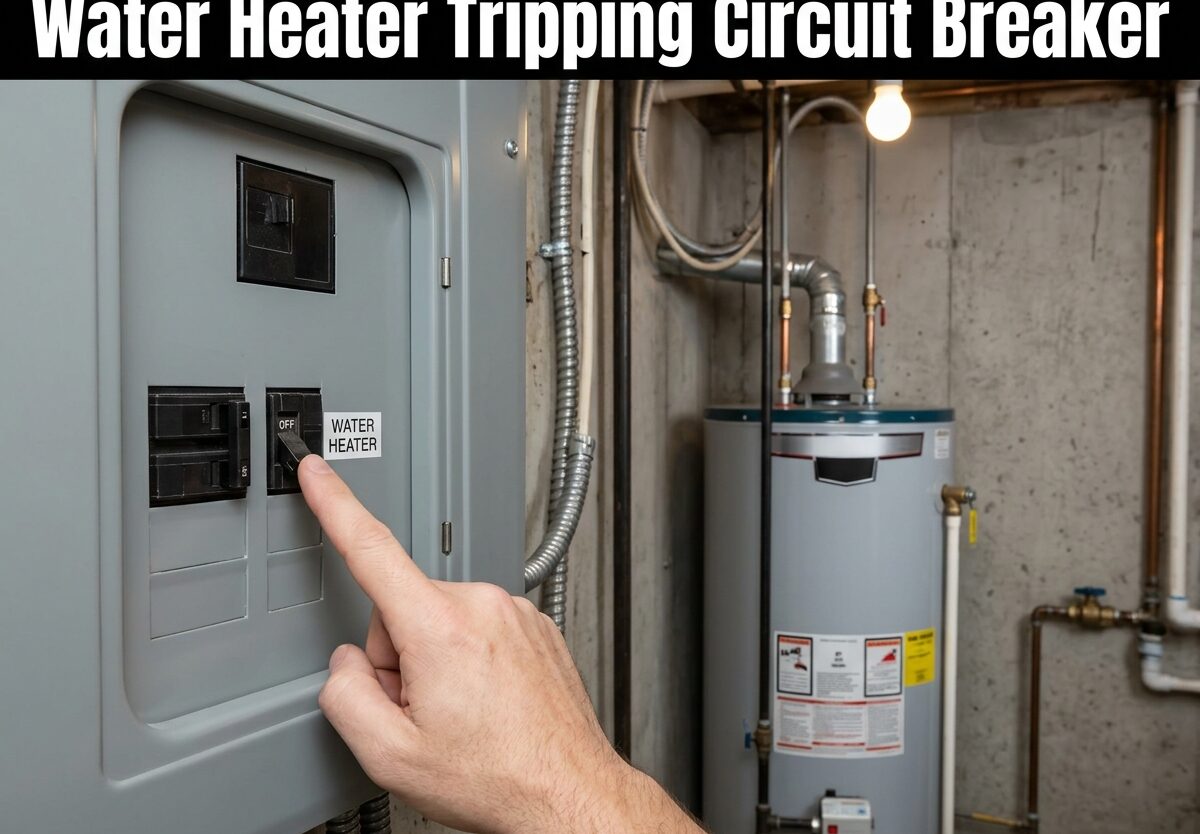
There’s nothing quite like the shock of stepping into a cold shower because your water heater stopped working again. If your circuit breaker keeps tripping, you’re dealing with more than just an inconvenience – this is a warning sign that something is wrong with your electric water heater.
Based on our research of hundreds of homeowner reports and professional diagnostics, heating element failure accounts for 60-70% of all water heater tripping circuit breaker issues. Understanding what’s causing your breaker to trip helps you decide whether this is a DIY fix or time to call in a professional.
⚠️ Important Safety Warning Before You Begin
Water and electricity are a deadly combination. Before attempting any troubleshooting, understand that a tripping breaker is your home’s safety system working correctly – it’s preventing a potential fire or electrocution hazard.
Never repeatedly reset a tripping breaker without investigating the cause. Each reset sends electrical current through a potentially dangerous fault condition, which can damage your water heater further or create a fire risk. If you’re not comfortable working with electricity, or if the breaker trips immediately upon resetting, call a licensed electrician or plumber.
Water Heater Tripping Circuit Breaker: 4 Most Common Causes
1. Shorted or Failed Heating Element (Most Common Cause)
The heating element is the component that actually heats the water in your tank. Electric water heaters typically have two elements – an upper element and a lower element. When these elements fail, the internal wiring can break and touch the metal sheath surrounding the element.
This creates a direct short circuit to ground, causing an immediate spike in current draw that trips your breaker. Unlike a gradual failure, a shorted element will typically trip the breaker within seconds to minutes of the water heater turning on.
Signs your heating element has failed:
- Breaker trips consistently after the same amount of time (like 5 minutes into a shower)
- You have less hot water than usual (if only one element failed)
- Visible burn marks or corrosion on the element when you inspect it
- The water heater trips the breaker immediately upon reset
A Reddit user from r/askanelectrician shared their experience: “My water heater worked fine for 8 months, then started tripping the breaker randomly. It turned out to be a failing upper element that had slowly degraded until the internal wiring shorted to the tank.”
2. Faulty Thermostat
Electric water heaters use thermostats to control when the heating elements turn on and off. Each element has its own thermostat (upper and lower), which monitors water temperature and activates the element as needed.
When a thermostat fails, it can get stuck in the “closed” position, causing the heating element to run continuously. This creates an electrical overload as the element draws more current than the circuit is designed to handle, eventually tripping the breaker.
Symptoms of a faulty thermostat:
- Water temperature fluctuates wildly (too hot then cold)
- The reset button on the thermostat keeps tripping
- Breaker trips only occasionally, not every time the heater runs
- Water comes out scalding hot (thermostat not shutting off)
The high limit switch is a safety feature built into the thermostat that trips when water temperature exceeds 170°F. If this keeps tripping, it indicates your thermostat is failing.
3. Loose or Damaged Wiring
Electrical connections at your water heater can degrade over time due to thermal expansion and contraction. Every time your water heater cycles on and off, the wires and connections heat up and cool down, gradually loosening terminals.
Loose wiring creates electrical resistance, which generates heat at the connection point. This heat can cause the connection to deteriorate further, creating a feedback loop that eventually causes the breaker to trip. In homes with aluminum wiring (common in homes built between 1965-1975), oxidation at the connections is particularly problematic.
Warning signs of wiring issues:
- Burning smell near the water heater access panels
- Visible scorch marks on the wiring or terminal connections
- Breaker trips when both heating elements are running (high current draw)
- You hear buzzing or sizzling sounds from the electrical panel
Forum discussions on DIY forums repeatedly mention aluminum wiring oxidation as a hidden culprit. One homeowner reported: “Both elements tested fine with a multimeter, but the breaker kept tripping. An electrician found the aluminum wire connections had oxidized, reducing conductivity. When both elements kicked in, the voltage drop caused the breaker to trip.”
4. Problem with the Circuit Breaker Itself
Sometimes the problem isn’t your water heater at all – it’s the circuit breaker. Circuit breakers can wear out over time, especially if they’ve tripped repeatedly. A weakened breaker may trip at lower current levels than its rated capacity.
Another common issue is an incorrectly sized breaker. Most electric water heaters require a dedicated 30-amp breaker and 10-gauge wiring. If a previous homeowner or handyman installed a 20-amp breaker to save money, it will trip whenever the water heater demands full power.
Signs the breaker itself is the problem:
- Breaker feels warm to the touch (normal operation should produce minimal heat)
- Breaker doesn’t stay firmly in the “on” position
- The breaker trips randomly, not correlated with water heater cycles
- Water heater components test fine but problem persists
How to Diagnose the Problem (Step-by-Step)
Before replacing any parts, proper diagnosis can save you hundreds of dollars. Here’s the systematic approach professional electricians use:
Step 1: Turn Off Power
Flip the water heater breaker to the OFF position at your electrical panel. Use a non-contact voltage tester to verify power is off before touching any wires. This is not optional – working on live water heater circuits can be fatal.
Step 2: Access the Components
Remove the access panels on the side of your water heater (usually two panels for upper and lower elements). You’ll need a screwdriver. Fold back the insulation to reveal the heating elements and thermostats.
Step 3: Visual Inspection
Look for obvious problems before testing anything. Check for burn marks, melted wires, corroded connections, or water leaks around the elements. Any of these visible issues give you a starting point for repairs.
Step 4: Test Heating Elements with a Multimeter
Set your multimeter to continuity mode (or the lowest ohms setting). Disconnect one wire from each element terminal to isolate it. Touch the multimeter probes to the two element terminals.
- Good element: Reading between 10-16 ohms (varies by element wattage)
- Bad element: Reading of infinity (open circuit) or zero ohms (shorted)
Also test for ground faults by touching one probe to an element terminal and the other to the metal tank. Any continuity reading means the element is shorted to the tank and must be replaced.
Step 5: Test Thermostats
With power still off, use your multimeter to test the thermostat. At room temperature, the thermostat should show continuity (closed circuit). If you gently heat the thermostat with a hair dryer and it opens (no continuity), it’s working correctly. If it stays closed or open regardless of temperature, replace it.
When to Call a Professional
DIY repairs can save money, but electrical work on water heaters carries real risks. Consider calling a professional if:
- The breaker trips immediately upon reset every single time (this indicates a dead short somewhere in the system)
- You’ve replaced heating elements and/or thermostats but the problem continues
- Your water heater is over 10 years old – replacement might be more cost-effective than repair
- Your home has aluminum wiring, which requires special expertise and safety precautions
- You’re uncomfortable working with electricity or don’t own a multimeter
- There’s evidence of water leakage near electrical components
A licensed plumber or electrician will charge $100-200 for diagnostic service, but this includes proper testing with professional-grade equipment and guaranteed repairs. For complex issues like aluminum wiring or repeated failures after parts replacement, professional diagnosis often saves money in the long run.
Frequently Asked Questions
Why would my hot water heater keep tripping the breaker?
A hot water heater keeps tripping the breaker due to electrical faults – most commonly a shorted heating element (60-70% of cases), faulty thermostat stuck in the on position, loose wiring connections creating resistance heat, or a failing circuit breaker itself. Each time the breaker trips, it’s preventing a potential fire hazard from excessive current flow or direct short circuits.
Why would my water heater kick the breaker?
Your water heater kicks the breaker when it draws more current than the circuit can safely handle. This happens when a heating element fails and shorts to ground, a thermostat malfunctions and keeps the element running continuously, or wiring connections degrade and create electrical resistance. The breaker is doing its job by protecting your home from electrical fires.
How to fix a tripping water heater?
First turn off power at the breaker panel. Remove access panels and inspect for visible damage like burn marks or loose wires. Test heating elements with a multimeter – replace any showing zero or infinite ohms. Check thermostat operation and replace if stuck. Ensure all wire connections are tight. If problems persist after these checks, the issue may be the breaker itself or require professional diagnosis.
Will your breaker trip if an electric hot water heater filament goes bad?
Yes, when a heating element filament goes bad, it typically creates a short circuit to ground. This causes a sudden surge in electrical current that exceeds the breaker’s rating, tripping it immediately. A completely burnt-out element (open circuit) won’t trip the breaker – you’ll just have no hot water. But most element failures create shorts rather than complete opens.
Is it dangerous if my water heater keeps tripping the breaker?
Yes, a repeatedly tripping breaker indicates a potentially dangerous electrical fault. The danger exists in two forms: fire hazard from the electrical fault itself, and the risk of further damage if you keep resetting the breaker without fixing the underlying problem. Each reset sends current through the fault, which can worsen the issue. This is not a situation to ignore or repeatedly reset.
Conclusion
A water heater tripping circuit breaker is more than an annoyance – it’s your home’s electrical protection system alerting you to a problem that needs attention. While failed heating elements are the most common culprit, proper diagnosis with a multimeter can prevent unnecessary part replacement and ensure you fix the actual issue.
Safety should always come first when dealing with water heater electrical problems. If you’re uncertain about any step in the diagnostic process, or if the problem persists after replacing components, don’t hesitate to call a licensed professional. The cost of professional service is far less than the risk of electrical fire or injury.

Leave a Comment