
If you’re shopping for an air cleaner, you’ve probably noticed the confusing choice between air purifiers and ionizers. Both promise cleaner air, but they work in completely different ways with very different results for your health.
Understanding the Air Purifier vs Ionizer difference matters because one technology actually removes pollutants from your home, while the other just makes them settle on your surfaces. Plus, some ionizers produce ozone, a lung irritant that can make breathing problems worse.
I’ve spent years researching indoor air quality, and I’ll break down exactly how each technology works, what the science says about effectiveness, and which one you should choose based on your specific needs.
How Air Purifiers Work
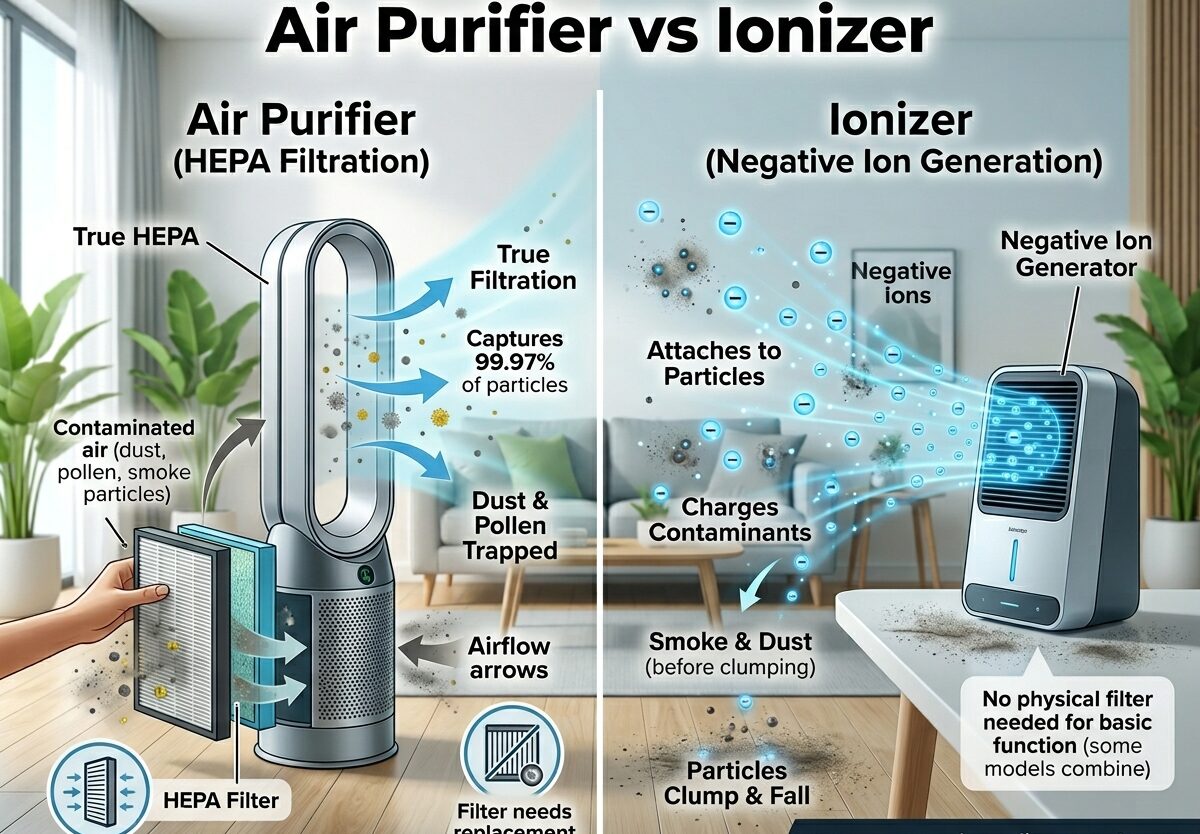
Air purifiers use physical filtration to capture and remove airborne particles from your indoor environment. The most effective models rely on HEPA (High-Efficiency Particulate Air) filters, which are designed to trap at least 99.97% of particles as small as 0.3 microns.
Here’s what happens inside a typical air purifier: A fan draws air through the unit, passing it through multiple filter stages. First, a pre-filter catches larger particles like pet hair and dust. Then the HEPA filter captures microscopic particles including pollen, mold spores, bacteria, and even some viruses. Many units also include an activated carbon layer that adsorbs gases, odors, and volatile organic compounds (VOCs).
The key advantage of filtration is that it physically removes pollutants from circulation. When you replace a dirty filter, you’re seeing exactly what was pulled from your air. This visible proof of effectiveness is why so many allergy and asthma sufferers prefer true HEPA filtration.
Most quality air purifiers use a multi-stage filtration system with a True HEPA filter as the final stage. This is different from “HEPA-type” filters, which don’t meet the strict 99.97% efficiency standard. When shopping, look for “True HEPA” or “HEPA H13” designations.
How Air Ionizers Work
Air ionizers take a completely different approach to cleaning air. Instead of filtering, they release negatively charged ions into your room. These ions attach to airborne particles, giving them a negative charge. The charged particles then become attracted to positively charged surfaces in your room, causing them to fall out of the air and settle on floors, walls, and furniture.
The ionization process happens silently because ionizers typically don’t require powerful fans. Some models use electrostatic precipitators, which have charged plates that attract particles as they pass through the unit. These plates need regular cleaning to maintain effectiveness.
It’s important to understand that ionizers don’t actually remove particles from your environment. They simply relocate them from the air to surfaces in your home. Those particles are still present and can become airborne again when disturbed by walking, cleaning, or airflow changes.
Some ionizers produce small amounts of ozone as a byproduct, which is a significant concern for indoor air quality. Ozone is a lung irritant that can worsen asthma and respiratory conditions. California requires all air cleaners sold in the state to be certified by the California Air Resources Board (CARB) to ensure they don’t produce dangerous ozone levels.
Air Purifier vs Ionizer: Key Differences
The fundamental difference comes down to how each technology handles airborne pollutants. Air purifiers physically trap and remove particles through filtration, while ionizers charge particles so they settle on surfaces.
Here’s a direct comparison of the key differences:
- Mechanism: Air purifiers use physical filtration to capture particles. Ionizers use electrical charges to make particles fall from the air.
- Particle Removal: Air purifiers actually remove pollutants from your home. Ionizers just move particles to surfaces that need cleaning.
- Effectiveness: True HEPA filters capture 99.97% of particles down to 0.3 microns. Ionizers vary widely in effectiveness and don’t have standardized testing.
- Maintenance: Air purifiers need periodic filter replacement. Ionizers need frequent plate cleaning and surface vacuuming.
- Operating Costs: Air purifiers have ongoing filter replacement costs. Ionizers have lower direct costs but higher cleaning requirements.
- Noise Level: Air purifiers produce fan noise. Ionizers operate nearly silently.
- Safety: HEPA air purifiers produce no byproducts. Some ionizers generate ozone, a lung irritant.
Particle Size Effectiveness Comparison
Different air pollutants come in different sizes, and each technology handles them differently. Understanding this helps you choose the right solution for your specific concerns.
HEPA air purifiers are effective across the full spectrum of particle sizes. They capture large particles like pet dander (5-10 microns) and pollen (10-100 microns) easily. They’re also highly effective at capturing fine particles like mold spores (1-20 microns), dust mite allergens (1-10 microns), and even some bacteria (0.3-10 microns). The 0.3-micron standard is significant because it’s the most penetrating particle size, meaning particles both larger and smaller are actually captured even more efficiently.
Ionizers are most effective on particles in the 0.1-1 micron range when those particles acquire sufficient charge. However, larger particles may not receive enough charge to settle effectively, and very small particles might not capture enough ions to become heavy enough to fall. The effectiveness also depends on room conditions, humidity levels, and air movement.
For gases, odors, and VOCs, neither basic technology is perfect on its own. Air purifiers with activated carbon filters can adsorb many gases and odors, though the carbon eventually saturates and needs replacement. Ionizers have virtually no effect on gases and VOCs, which is why some hybrid units combine technologies.
Health and Safety Considerations
When it comes to respiratory health, the choice between air purifier vs ionizer has real medical implications. For anyone with allergies, asthma, COPD, or other respiratory conditions, HEPA filtration is consistently recommended by medical professionals and organizations like the American Lung Association.
The concern with ionizers centers on ozone production. Ozone is a molecule composed of three oxygen atoms, and at ground level, it’s a harmful air pollutant. The EPA states that ozone can cause lung irritation, worsen asthma, reduce lung function, and increase susceptibility to respiratory infections. Even low levels of ozone can cause chest pain, coughing, and throat irritation.
Not all ionizers produce significant ozone, but it can be difficult for consumers to know which models are safe. This is where CARB certification becomes important. The California Air Resources Board tests air cleaners and certifies those that meet strict ozone emission standards. When shopping, look for the CARB certification mark to ensure you’re choosing a device that won’t compromise your air quality while attempting to improve it.
For households with children, elderly residents, or anyone with respiratory conditions, most experts recommend avoiding ozone-producing devices entirely. The risk simply isn’t worth it when safer alternatives exist.
Pros and Cons of Air Purifiers
Pros:
- True HEPA filters remove 99.97% of particles down to 0.3 microns
- Actually eliminates pollutants from your home environment
- Proven technology backed by scientific research
- Visible evidence of effectiveness when replacing dirty filters
- Models with carbon filters also remove gases and odors
- No harmful byproducts produced during operation
- CADR ratings provide standardized performance metrics
Cons:
- Higher initial purchase price for quality units
- Ongoing cost of filter replacements (typically $50-150 annually)
- Fan noise can be disruptive, especially on higher settings
- Requires adequate room coverage for effectiveness
- Energy consumption from continuous fan operation
- Filters need regular monitoring and replacement
Pros and Cons of Ionizers
Pros:
- Lower initial purchase cost typically
- Nearly silent operation without fans
- No filter replacements needed for many models
- Low energy consumption
- Can reduce some airborne particles
- Compact and portable designs available
Cons:
- Doesn’t actually remove particles, just relocates them
- Settled particles can become airborne again
- Increased dust on surfaces requires more frequent cleaning
- Some models produce harmful ozone as a byproduct
- Limited effectiveness on larger particles
- No standardized testing or certification for effectiveness
- Difficult to know if the device is working
- Professional testing often shows minimal real-world impact
Which Should You Choose?
The decision between air purifier vs ionizer ultimately depends on your specific needs and priorities. Here’s my guidance based on common scenarios:
Choose an Air Purifier if:
- You or family members have allergies or asthma
- You want actual removal of pollutants from your home
- You have pets and need to control dander
- You’re concerned about smoke, cooking odors, or VOCs
- You want proven, measurable effectiveness
- You’re willing to invest in better indoor air quality
- You have respiratory conditions like COPD
- You want visible proof of what’s being removed
Consider an Ionizer if:
- Budget is the primary concern
- You need silent operation for sleeping
- You can verify CARB certification for ozone safety
- You understand particles will settle on surfaces
- You’re willing to clean surfaces more frequently
- You have minor air quality concerns in a small space
- You’ve already addressed major pollutant sources
For most households, especially those with any health concerns, I recommend a quality HEPA air purifier. The science is clear, the effectiveness is proven, and you’re actually removing pollutants rather than just moving them around.
Hybrid Options
Some air purifiers include optional ionizer features that you can turn on or off. If you choose one of these hybrid models, I recommend running the HEPA filtration continuously and only using the ionizer function occasionally if at all. When you do use it, ensure the room is well-ventilated and that occupants leave the area during operation.
The advantage of hybrid units is that you get the proven effectiveness of HEPA filtration with the option to add ionization for specific situations. Just remember that the ionizer feature should never be the primary reason for choosing a unit, and it should be used cautiously due to potential ozone production.
Maintenance Comparison
Long-term ownership differs significantly between these technologies. Air purifiers require periodic filter replacements, typically every 6-12 months depending on usage and air quality. The cost adds up, but it’s predictable and the filters are easy to replace.
Ionizers have different maintenance needs. Electrostatic precipitator models need plate cleaning every 1-2 weeks, which involves removing the plates and washing them. More importantly, because ionizers don’t remove particles, you’ll likely notice increased dust accumulation on surfaces throughout your room. This means more frequent vacuuming, dusting, and surface cleaning to maintain the same level of cleanliness.
When calculating true cost of ownership, consider both the direct costs (filters, electricity) and the indirect costs (your time for additional cleaning, potential health impacts from ozone exposure).
FAQ
Do ionizers work better than air purifiers?
No, air purifiers with True HEPA filtration are more effective at removing airborne particles. Ionizers make particles settle on surfaces but don’t actually remove them from your environment. Medical professionals consistently recommend HEPA air purifiers over ionizers for allergies and asthma because filtration physically removes pollutants rather than just relocating them.
What is better, an ionizer or an air purifier?
Air purifiers are better for most people because they actually remove pollutants from your home. HEPA filtration captures 99.97% of particles down to 0.3 microns, while ionizers just make particles fall onto surfaces. Ionizers may produce ozone, a lung irritant that can worsen respiratory conditions. For anyone with allergies, asthma, or health concerns, HEPA air purifiers are the safer and more effective choice.
Is it okay to be in a room with an ionizer?
It depends on the specific ionizer. Some models produce ozone, which can cause lung irritation, worsen asthma, and reduce lung function. The EPA recommends against using ozone-generating devices in occupied spaces. If you choose an ionizer, look for CARB certification which ensures the device meets strict ozone emission standards. For households with children, elderly residents, or anyone with respiratory conditions, HEPA air purifiers are the safer choice.
What are the disadvantages of an air purifier?
Air purifiers have higher upfront costs and require ongoing filter replacements every 6-12 months. The fan noise can be disruptive, especially on higher settings. They also consume more electricity than ionizers due to continuous fan operation. However, for most people these disadvantages are outweighed by the proven effectiveness of HEPA filtration in actually removing pollutants from your home rather than just moving them around.
Would an air purifier help my COPD?
Yes, air purifiers can help people with COPD by removing airborne irritants that can trigger symptoms. The American Lung Association recommends HEPA air purifiers for respiratory conditions because they actually filter out particles that can worsen breathing problems. However, an air purifier should be part of a comprehensive approach that includes working with your healthcare provider, avoiding known triggers, and following your prescribed treatment plan.
Final Thoughts
When comparing Air Purifier vs Ionizer technologies, the science consistently favors HEPA filtration for actual air cleaning. Ionizers may seem appealing due to lower upfront costs and quiet operation, but they don’t truly remove pollutants from your home and some produce harmful ozone.
For anyone serious about improving indoor air quality, especially those with allergies, asthma, or respiratory concerns, a quality HEPA air purifier is the better investment. The technology is proven, the effectiveness is measurable, and you’re actually removing pollutants rather than just moving them to surfaces that need cleaning.
If budget constraints make an ionizer tempting, look for CARB certification to minimize ozone risks, but understand that you’ll need to clean surfaces more frequently to deal with settled particles. When possible, save for a HEPA purifier instead. Your respiratory health is worth the investment.

Leave a Comment