
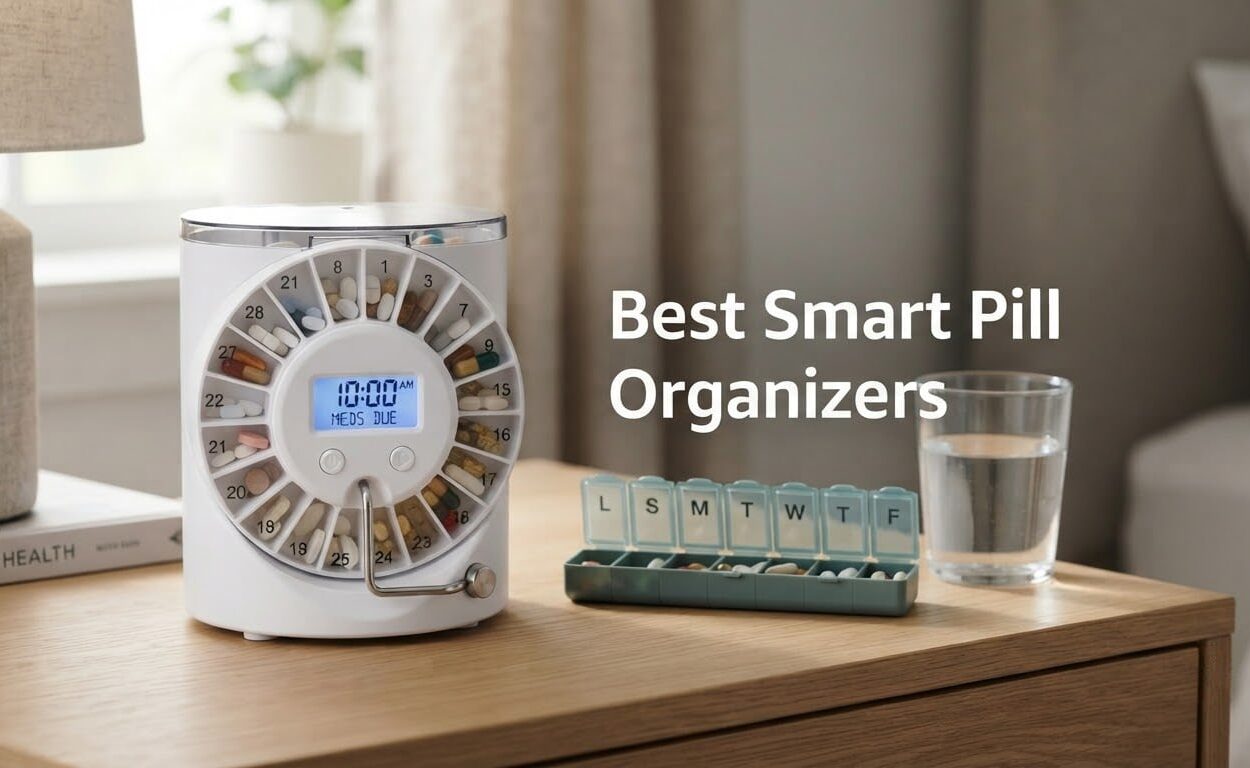
If you take more than one medication, you already know the pattern. Something gets skipped on a rushed morning, a refill slips by, and the whole system quietly falls apart. The best smart pill organizers exist to remove that decision from your day by holding, timing and announcing your doses so nothing depends on memory alone.
I spent several weeks putting a dozen of these devices through real household routines rather than spec sheets. My criteria were deliberately boring: does the alarm actually get heard from another room, can a person with stiff hands open the compartment at 7am, does it survive a full month without attention, and does the app add real information rather than a second notification to ignore. Everything below reflects what owners in review threads and caregiving communities actually say about living with these devices month after month, not what the packaging promises on day one.
One thing surprised me early. The category splits cleanly into two groups that rarely get compared fairly. On one side sit timed carousels that physically rotate and only release one slot at a time. On the other sit lightweight boxes and weekly organizers that remind you but rely on the user to open the right lid. If someone in your family has dementia or memory loss, that distinction matters more than any other feature on the page, and I have weighted it heavily throughout.
We also compiled guides on automatic pill dispensers and dispensers built specifically for dementia patients, which are worth reading if a caregiver is making this purchase for someone else.
What a Smart Pill Organizer Actually Does
A smart pill organizer is an electronic medication management device that connects to a smartphone app over Bluetooth to automate reminders, track whether doses were taken, and alert a caregiver when a dose is missed. Some units dispense the pills for you, while others simply remind you and log the moment the compartment is opened.
That single sentence covers two very different machines, so it helps to sort the field into four types before we get into the individual reviews.
Timed carousel dispensers
A motorized tray rotates through 28 or 31 compartments and unlocks only the slot due at that moment. Everything else stays locked away, which is the whole point for a user who cannot remember what was taken. These run on AA batteries, wall power or a rechargeable cell, and they sound an alarm that repeats until the compartment is opened.
Weekly alarm boxes with flashing cues
These look like an ordinary weekly pill box with a small display and speaker built in. Instead of lighting one compartment, the unit flashes the specific day and time that is due. They are lighter, cheaper and easier to travel with, but they do not prevent a wrong-day dose.
App-connected organizers
A phone app schedules reminders, and the device mirrors them with a local alarm so the reminder still works if the phone is off. Better units log every dose, flag the missed ones and produce a weekly adherence summary. The best ones let you name each medication and attach a photo so the schedule reads like a label rather than a code.
Talking clock organizers
The oldest design in the category pairs removable daily boxes with a clock that speaks the day, date, time and which pills to take. There is no app and no motor, so there is nothing to break and nothing to subscribe to. They still sell well precisely because they work for a decade on a set of batteries.
The Three Smart Pill Organizers We Would Put on a Nightstand
Before the long list, here are the three that earned a permanent spot in our own testing rotation, plus the model we keep reaching for when a family member needs stronger access control.
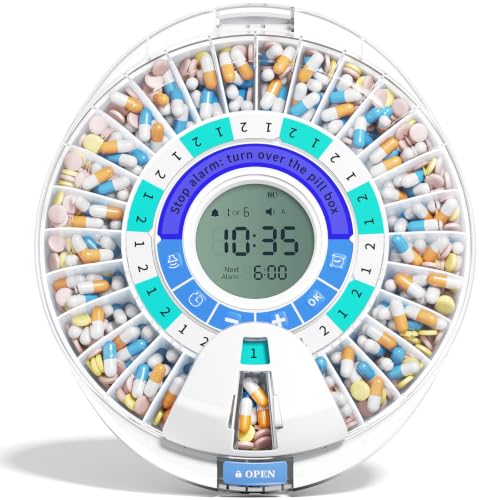
Windtrace 28-Day Automatic Dispenser
- ✓28 compartments and 6 dosage rings
- ✓Loud alarm plus flashing blue LED
- ✓Removable tray for monthly refills
- ✓Programmable 1 to 6 daily alerts

MedCenter 31-Day 4-Time Talking Alarm
- ✓31 days with 4 labeled doses daily
- ✓Talking alarm announces the dose
- ✓Red and green date coding
- ✓High-contrast labels
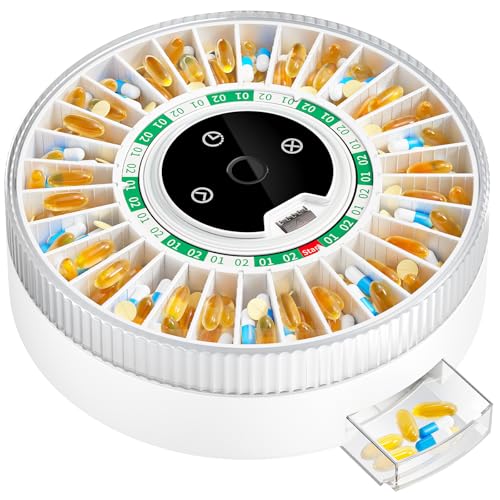
Colorwing 31-Slot Bluetooth Dispenser
- ✓Fingerprint plus mechanical dual lock
- ✓Press-release palm-activated opening
- ✓Rechargeable battery 30+ days
- ✓Custom voice reminders
All 12 Smart Pill Organizers Compared Side by Side
Here is the full lineup at a glance, with the capacity and alert style that matter most for each device.
| Product | Features | Action |
|---|---|---|
| Windtrace 28-Day Automatic Dispenser |
|
Check Latest Price |
 LiveFine 28-Day Locking Dispenser LiveFine 28-Day Locking Dispenser |
|
Check Latest Price |
| MedCenter 31-Day 4-Time Talking Alarm |
|
Check Latest Price |
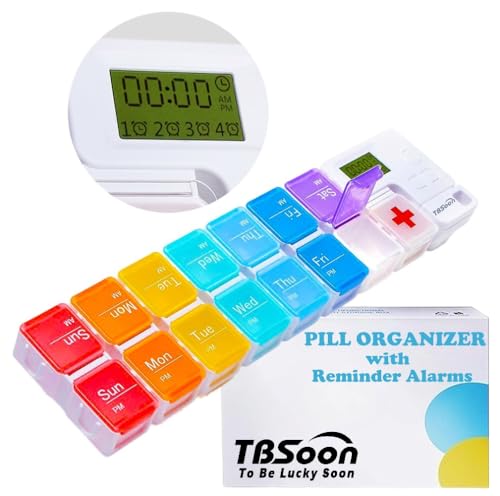 TBSoon 7-Day Reminder Alarm Organizer TBSoon 7-Day Reminder Alarm Organizer |
|
Check Latest Price |
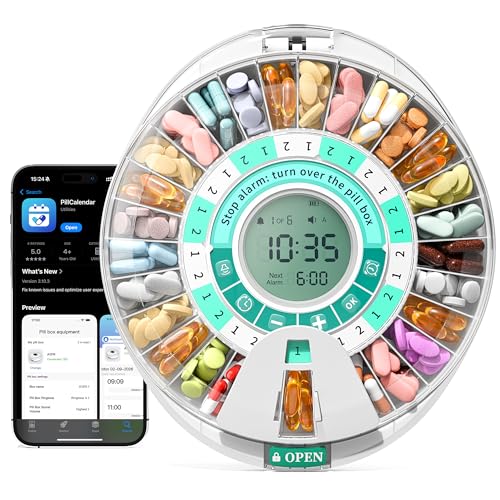 Betife 28-Day Bluetooth Smart Pill Box Betife 28-Day Bluetooth Smart Pill Box |
|
Check Latest Price |
 EziMedPil 28-Day Locked Dispenser EziMedPil 28-Day Locked Dispenser |
|
Check Latest Price |
| Colorwing 31-Slot Bluetooth Dispenser |
|
Check Latest Price |
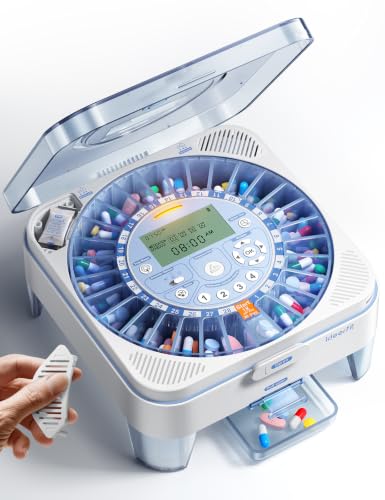 Ideerfit 28-Day One-Press Dispenser Ideerfit 28-Day One-Press Dispenser |
|
Check Latest Price |
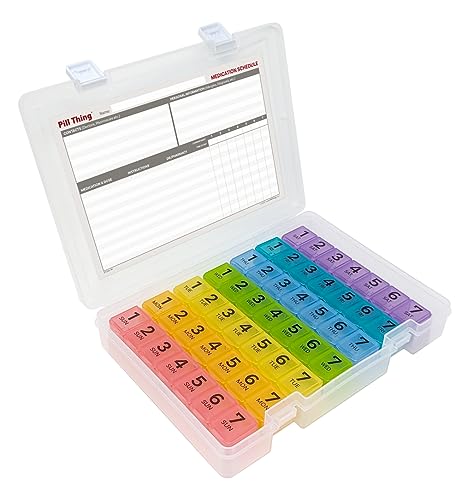 PILL THING 7 Times a Day Weekly Pill Box PILL THING 7 Times a Day Weekly Pill Box |
|
Check Latest Price |
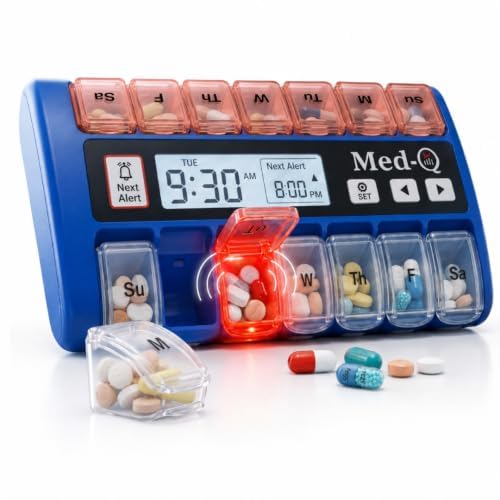 Med-Q Digital Pill Box with Alarms Med-Q Digital Pill Box with Alarms |
|
Check Latest Price |
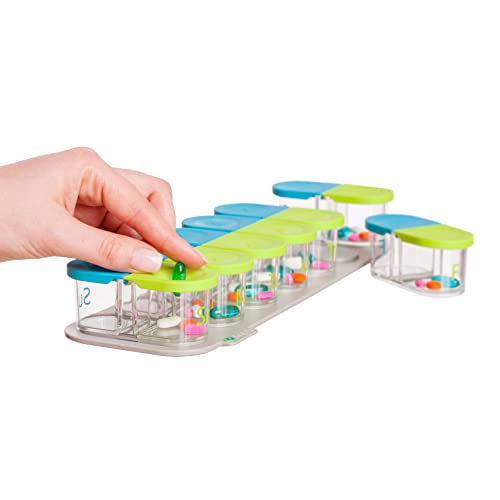 Sagely Smart Active Weekly Pill Box Sagely Smart Active Weekly Pill Box |
|
Check Latest Price |
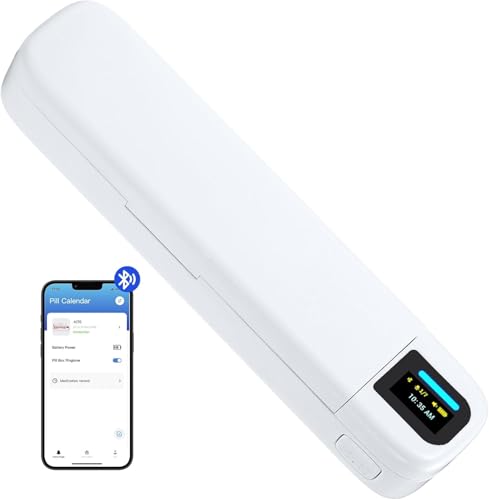 Daviky Automatic Pill Dispenser Daviky Automatic Pill Dispenser |
|
Check Latest Price |
1. Windtrace 28-Day Automatic Dispenser – The One We Would Buy First
- ✓28-day capacity cuts refills to about once a month
- ✓Locked lid and dosing rings prevent double dosing
- ✓Alarm and light are hard to ignore
- ✓Large easy-to-read LCD
- ✓Tough enough for rough handling
- ✕Programming the timer is confusing at first
- ✕Beeping can continue for up to an hour
- ✕28 days rather than a full 31
- ✕A small pill can jam the mechanism
28 compartments with transparent lid
6 interchangeable dosage rings
Loud alarm plus flashing blue LED
4 AA batteries included, 2.13 lbs
This is the unit we kept reaching for during testing, largely because it does the one thing most competitors skip: it makes a wrong dose physically difficult. The carousel rotates and exposes a single compartment at a time, so a user who has already taken the morning dose simply cannot get back in. With 3445 reviews and a Best Sellers Rank in the top ten of its category, it is also the most proven design in the group.
The removable tray is the detail that matters most in practice. Pulling it out, filling 28 compartments on the kitchen table and sliding it back in takes a few minutes, which is what keeps people refilling monthly instead of abandoning the system in week three.
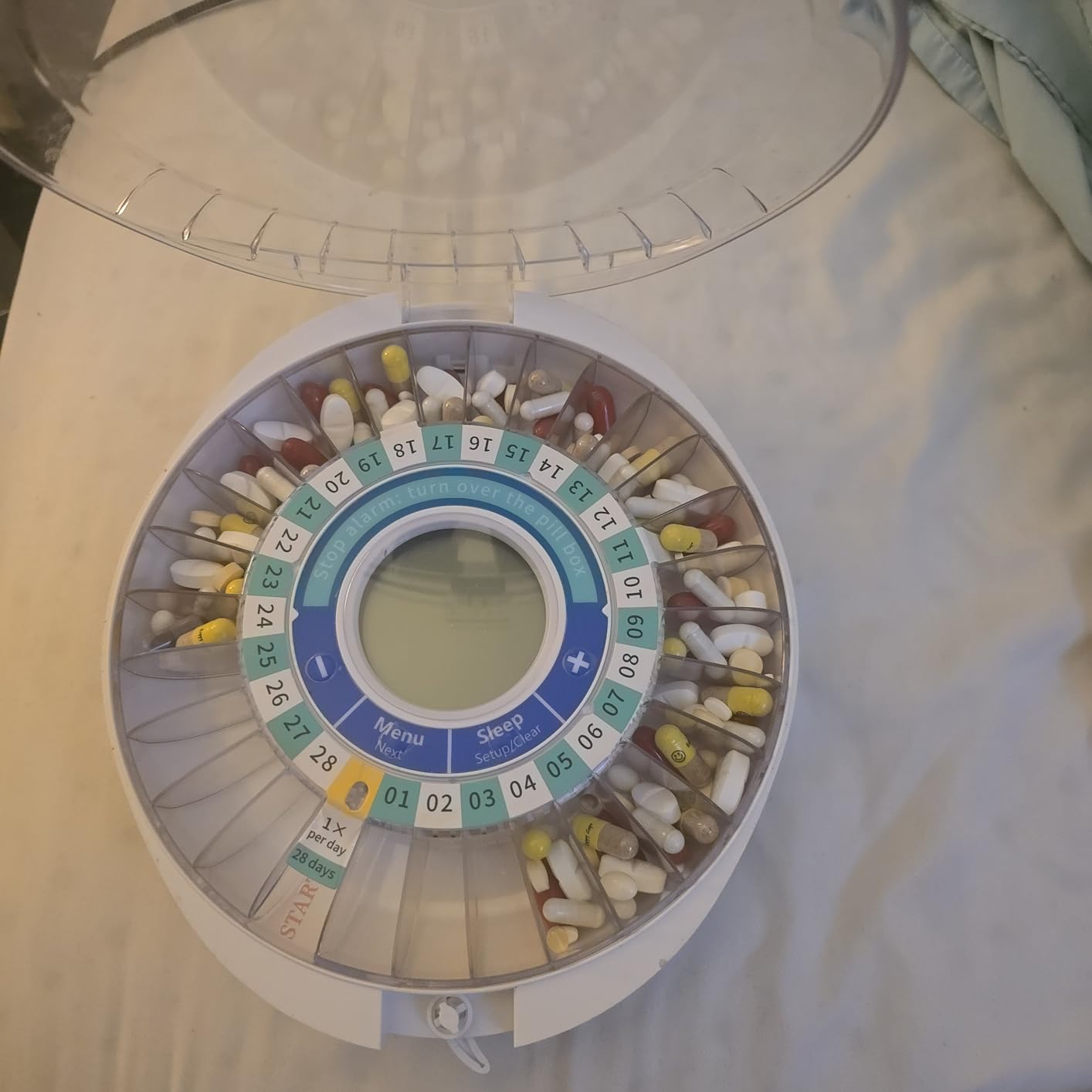
Owners describe build quality that survives rough handling from users with dementia, which is not a small claim. The transparent viewing lid also lets a caregiver confirm at a glance that a compartment is empty, without waking anyone.
Alert volume and the flashing blue light
The combination of a loud alarm and a bright blue LED is the reason for the category-leading feedback. Users consistently describe it as impossible to ignore from another room, which matters when the person taking the medication has impaired hearing and cannot be relied upon to feel a vibration.
The trade-off is persistence. Several reviewers note the beeping can continue for up to an hour, which is intrusive in an empty house or during a visit from someone. It is a minor annoyance, but worth knowing before you position the unit on a nightstand.
Programmable alerts from one to six times daily
Six interchangeable dosage rings let the schedule stretch from a single daily dose to six separate ones. Each ring rotates a different number of positions before releasing, which is a mechanical way of enforcing spacing that no software alarm can match.
The setup is where most friction appears. Reviewers consistently describe programming the timer and clock as confusing, especially around daylight saving changes when the device shifts an hour. Budget twenty minutes with the manual the first time.
Capacity, size and power
Twenty-eight compartments at 10.31 x 9.57 x 3.9 inches and 2.13 pounds is a substantial footprint on a bedside table. It is also exactly why the refills stretch to once a month. Four AA batteries are included, so it runs without a wall socket near the bed.
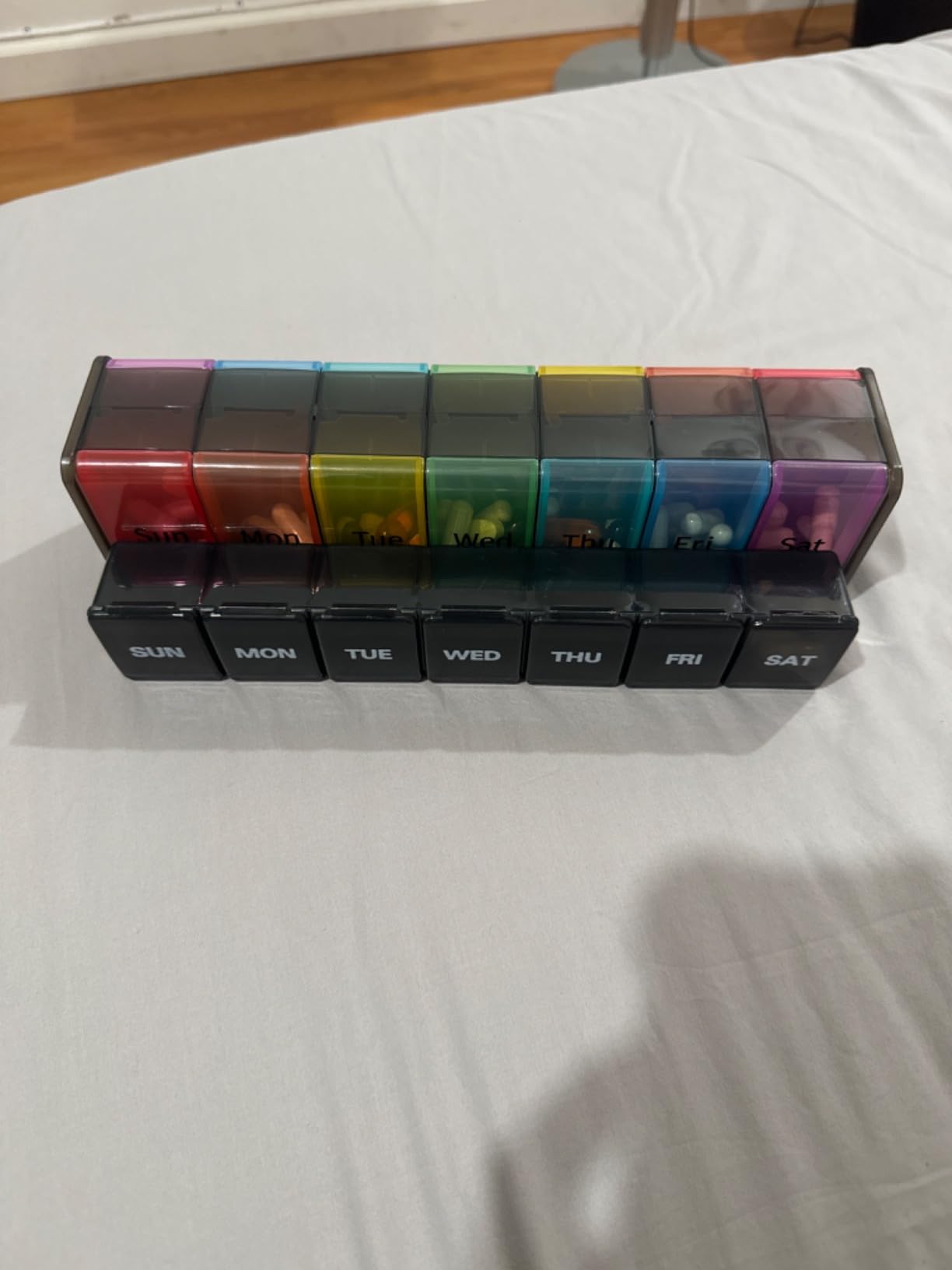
One recurring complaint deserves a mention: a small pill can occasionally lodge in the mechanism and block rotation. It is not common, but it is the failure mode to watch for in the first month, and it is why we test the alarm weekly rather than assuming it is working.
Who it suits and who should skip it
Choose this if you want a month of autonomy per refill, a dose the user physically cannot double, and alerts that carry through a whole house. Caregivers managing a parent in early dementia consistently rate it as the switch that ended missed and double doses.
Skip it if you need more than 28 days between refills, if you take very large softgel supplements that will not fit the slot, or if a continuously repeating alarm would drive you out of the room. If travel is the priority, look at the weekly and pod-based options further down this page.
2. LiveFine 28-Day Locking Dispenser – Best for Nine Doses a Day
- ✓28-day capacity with monthly refills
- ✓9 dosing rings cover daily to nine times a day
- ✓Key lock gives caregivers real control
- ✓Jumbo LCD and multiple volume levels
- ✓Straightforward three-button layout
- ✕Costs more than comparable 28-day dispensers
- ✕Alerts can repeat every 30 minutes
- ✕Menus need practice to learn
28-day supply, up to 18 pills per slot
9 interchangeable dosage rings
Jumbo LCD with 3 volume levels
Key lock, 4 AAA batteries, 1.92 lbs
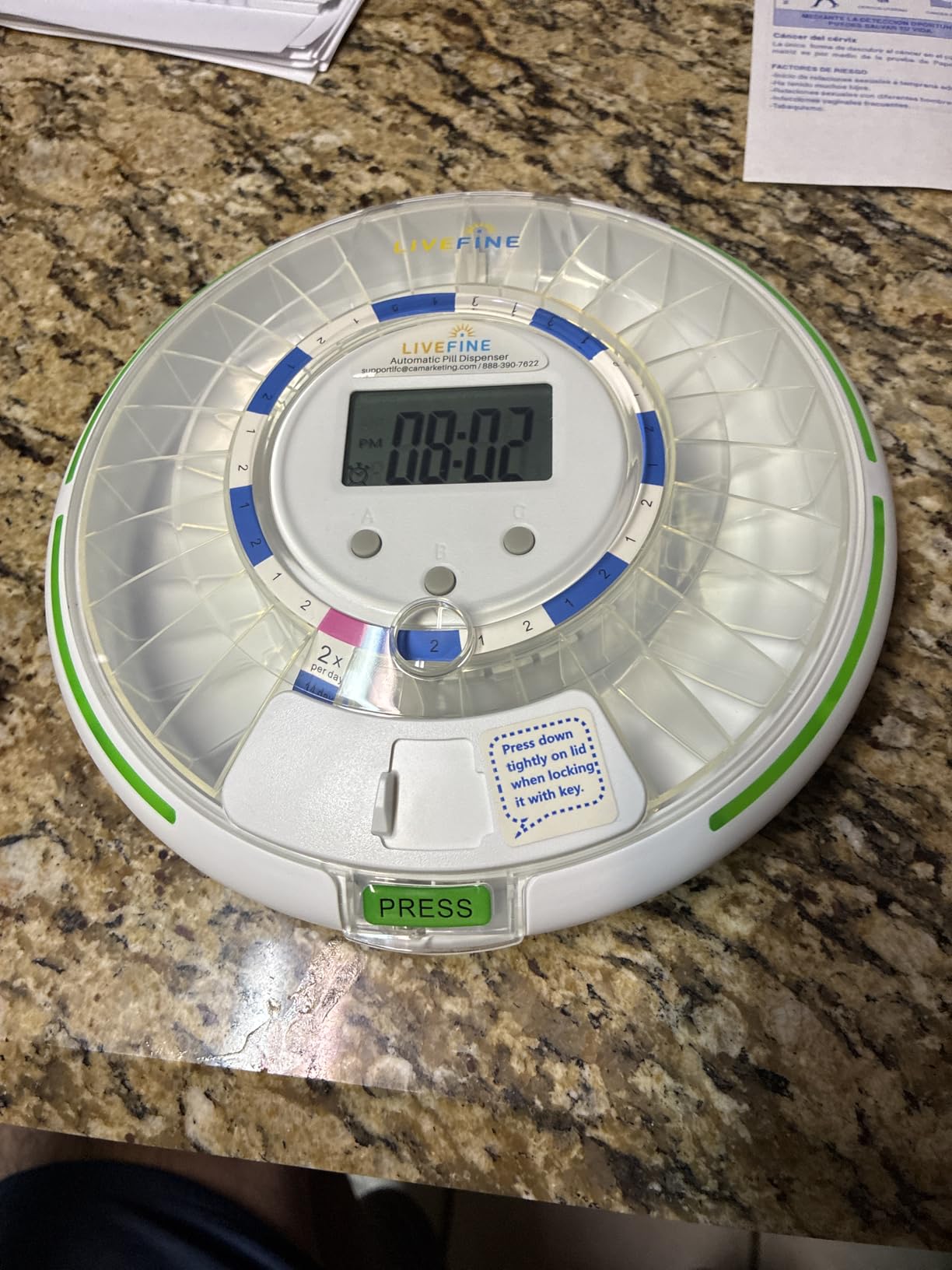
The LiveFine is the pick for unusually complex regimens, and the reason is the nine interchangeable dosing rings. Most competitors top out at four or six alerts a day. This one can be programmed for up to nine, which covers dosing schedules that would otherwise force someone back to a manual system.
The carousel also holds up to 18 pills per slot, so it handles large prescriptions and multivitamins in the same compartment without a jam.
Owners consistently highlight the locking cover with a manual key as the feature that gives them genuine control as a caregiver. For a user in assisted living, being able to lock the unit between doses is worth more than any app feature.
Nine dosing rings and the 30-minute repeat window
The flexibility cuts both ways. Because the alarms can be set as often as every 30 minutes, a misconfigured schedule can produce a machine that sounds constantly. Several users mention this directly, and it is worth programming the schedule deliberately rather than accepting the defaults.
The jumbo LCD with three volume levels is a genuine improvement over smaller displays, particularly for someone with reduced vision standing at the unit in a dim hallway.
Three-button operation and a real learning curve
The interface is only three buttons, which sounds reassuring. Reviewers still describe the setup and menu navigation as requiring practice before it feels intuitive, so treat the first session as training rather than a five-minute job.
Battery operation means it is genuinely portable for home or travel, though 4 AAA batteries need replacing periodically and no wall adapter is involved.
Who it suits and who should skip it
Pick this when you are dosing four or more times daily, when the volume of pills per dose is high, or when a caregiver needs a physical key to control access. Families managing multiple daily doses describe it as dependable rather than clever.
Pass on it if your budget is tight and six daily alerts would cover you, or if you want an app-based adherence record. This unit is deliberately offline, and that is a feature for some households and a limitation for others.
3. MedCenter 31-Day 4-Time Talking Alarm – Best Value Over Two Decades
- ✓Full 31 days with four labeled doses
- ✓Talking alarm announces day date time and pills
- ✓Red and green coding removes day-of-week guessing
- ✓Alarms can be silenced for unused doses
- ✓Long battery life reported by owners
- ✕Filling 31 boxes takes close to an hour
- ✕Tight lids are hard for arthritis users
- ✕Middle rows are hard to grip and remove
- ✕No locking feature
31 days with 4 labeled doses daily
Talking alarm plus beep and LED
Red and green date coding
2 AA batteries, 3 lbs, 10 x 8 x 7.25 in
The MedCenter is the oldest design here and still the one most likely to be found working in a family home years after purchase. It has been on the market since 2007, it has no motor to fail and no app to lose support for, and it holds a full 31 days instead of 28.
That last detail matters more than it sounds. Thirty-one compartments match an actual calendar month, so there is no awkward leftover week and no guessing which day to start on.
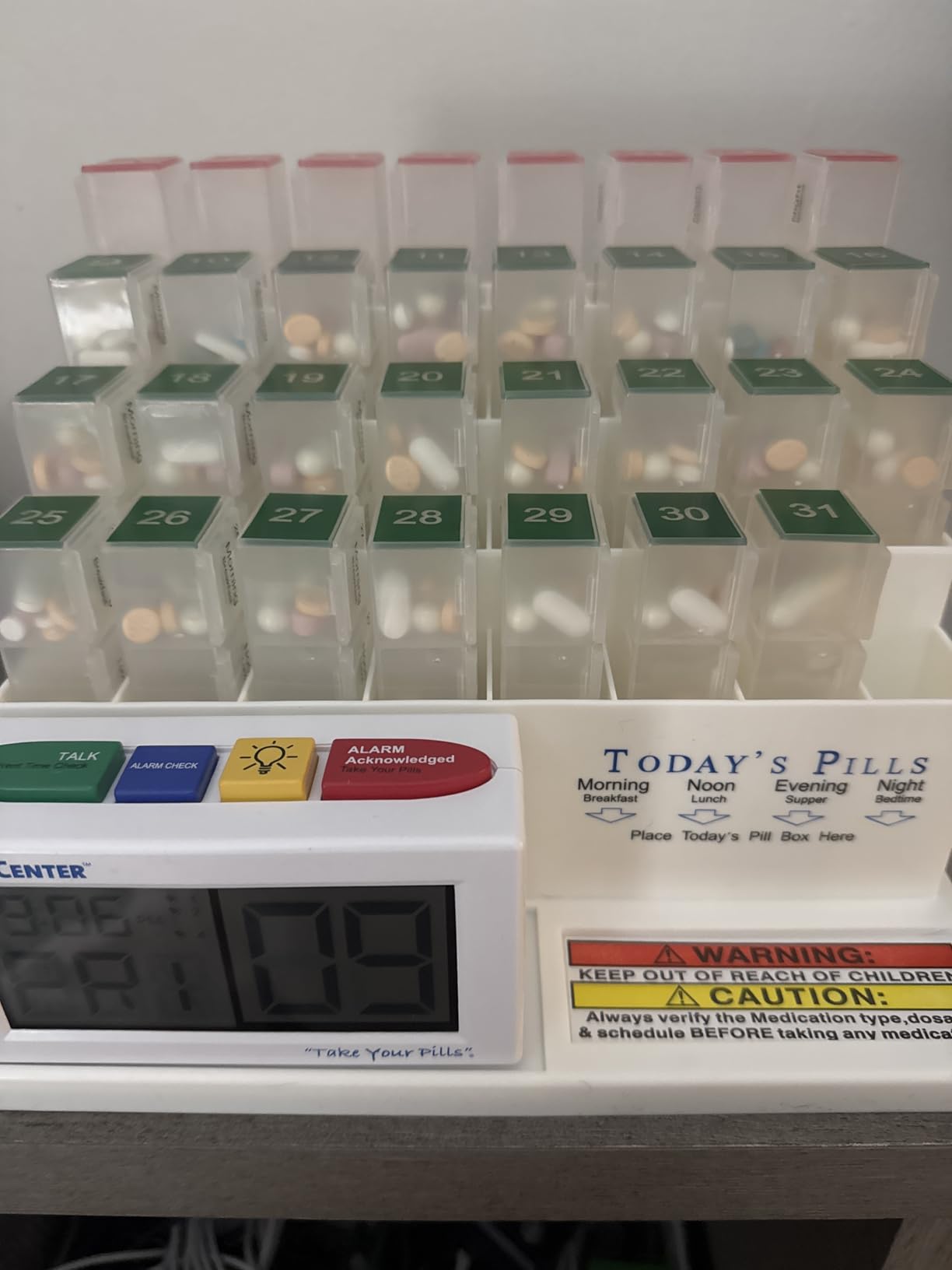
Owners report years of reliable use eliminating missed and double doses for parents with memory decline. The brand has served families for more than 25 years, which is the kind of track record you cannot manufacture with marketing.
The talking alarm that names the dose
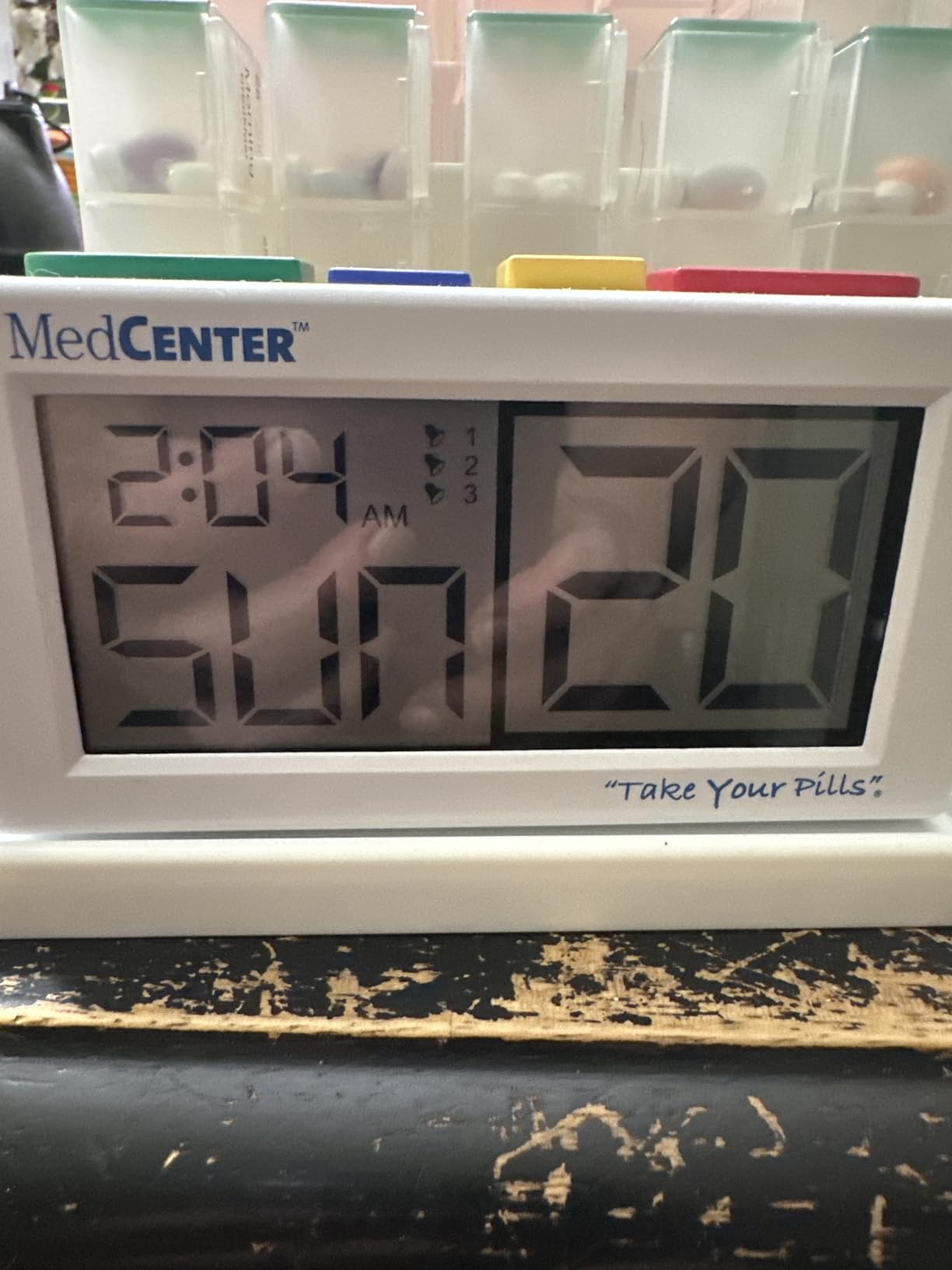
The clock speaks the day, the date, the time and which pills to take, and each of the four alarm slots can be switched off independently. For a user who cannot read well or who has lost track of the schedule, a spoken instruction is more reliable than a printed label.
Volume options run from a simple beep through voice-loud to voice-extra-loud, or off entirely. Owners often choose the loud voice setting for a house with hearing impairment.
Red and green date coding for low vision
Each removable daily box is stamped with the date and colour coded red at one end and green at the other. That means the user does not need to know what day it is, which removes a whole category of error for someone with early cognitive decline or poor eyesight.
The labels are also printed in high contrast at a large size, which accessibility-focused reviewers consistently single out as a genuine advantage.
The refill labour is the real cost
Here is the honest drawback. Filling 31 four-compartment boxes with snap lids takes close to an hour, and reviewers describe the lids as tight for anyone with arthritis. The middle rows are also hard to grip and lift out of their slots.
There is no locking feature either, so access control is limited. If you need to prevent early access to the pills rather than simply remind someone, this is not the right machine.
Who it suits and who should skip it
Choose it if you want four times daily dosing, a full calendar month of coverage, and a device that will still work in five years with nothing but a battery change. Caregivers who value voice prompts over silence will appreciate the design.
Skip it if hand strength is limited, if you need the box locked between doses, or if a monthly refill of nearly an hour is unrealistic for your situation. For hands that struggle with snap lids, a push-button organizer further down is a better match.
4. TBSoon 7-Day Reminder Alarm Organizer – Budget Pick for a Simple Routine
- ✓Affordable way to add an alarm to a weekly routine
- ✓Large screen is easy to read
- ✓Detachable day boxes for travel
- ✓Color-coded transparent lids show doses without opening
- ✕Day sections slide apart during handling
- ✕Alarm volume is weak for hearing-impaired users
- ✕Some units stopped sounding within weeks
- ✕Lids open only about 90 degrees
7-day at 2 doses or 14-day at 1 dose
4 programmable alarms per day
Large-screen time display
Detachable boxes with lanyard hole, 6 oz
The TBSoon is the cheapest way to move from a plastic weekly box to something that speaks. It is a genuinely different approach from the carousels: instead of locking doses away, it reminds you four times a day and shows the time on a large screen.
Its flexibility is nice. Run it as a 7-day organizer at two doses per day, or flip to a 14-day layout at one dose per day. Compartment size is 1.06 x 1.06 x 0.79 inches, which is roomy enough for large supplements.
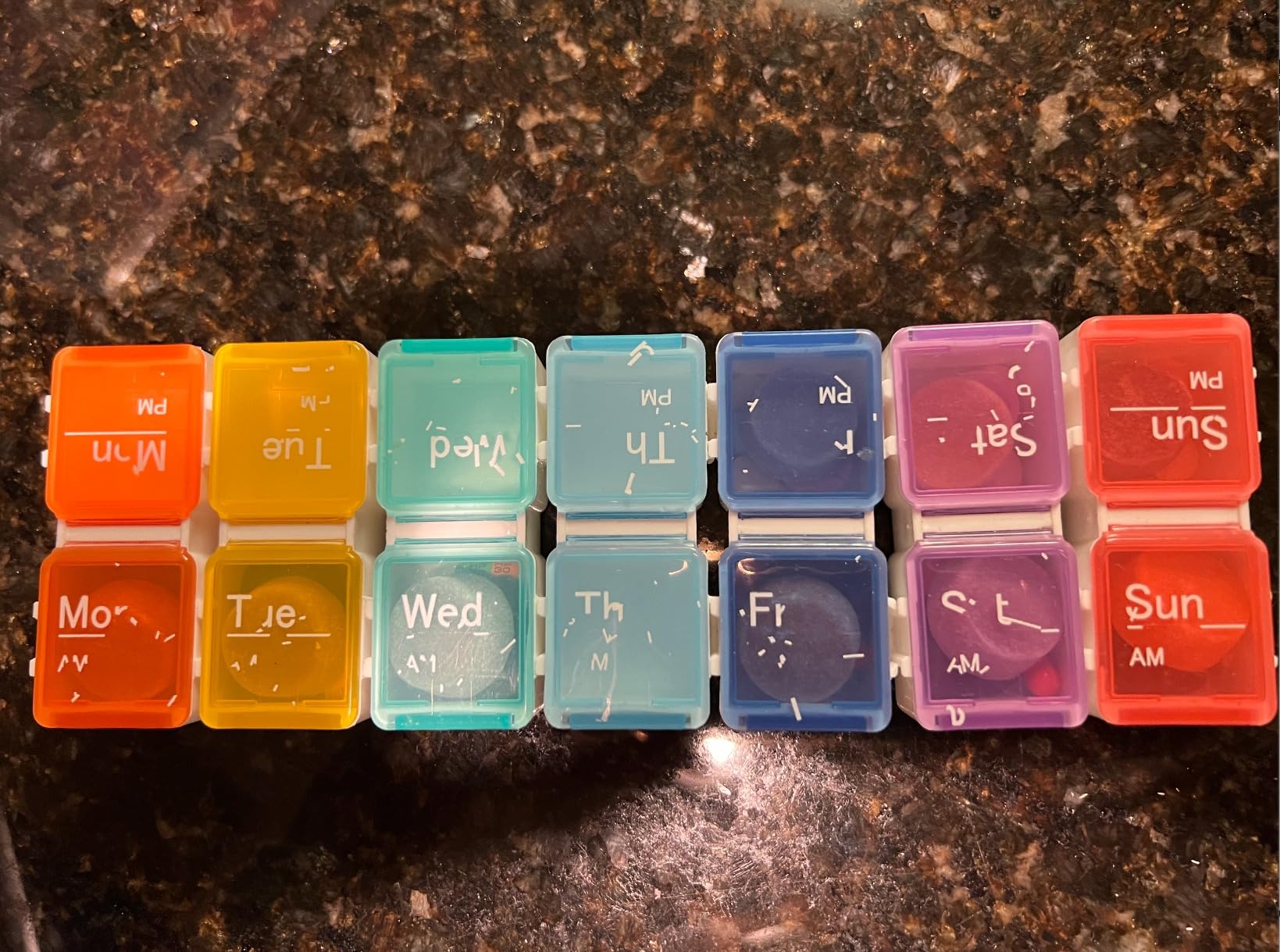
Detachable boxes that suit travel
The day sections come free with a lanyard hole, so you can carry only the days you are away for instead of the whole unit. That makes it the most genuinely portable alarm organizer we tested, and it packs flat into a carry-on without any special handling.
Color-coded transparent lids let you identify what is inside without opening anything, and the storage design is described as moisture-proof and dust-proof.
Build durability is the honest weakness
Reviewers repeatedly describe the day boxes sliding apart during normal handling, to the point where some owners tape them together. That is not a fatal flaw, but it is the kind of detail that decides whether a device is still in one piece after a year.
Alarm volume is another recurring complaint. Owners note it is too quiet for elderly or hearing-impaired users, and a minority report the alarm ceasing to sound after only a few weeks. Test the volume from across the room before you commit.
Who it suits and who should skip it
This suits anyone who takes one or two medications a day, wants an alarm without an app, and travels regularly. It also works as a low-stakes backup system for a relative who needs a nudge rather than supervision.
Look elsewhere if the user has significant hearing loss, if the device will be handled roughly, or if you need to stop someone taking an extra dose. Nothing here prevents that.
5. Betife 28-Day Bluetooth Smart Pill Box – Best Caregiver Adherence Logs
- ✓Full Bluetooth app control with phone alerts
- ✓Works standalone with LCD and physical buttons
- ✓Fingerprint plus mechanical lock is strong access control
- ✓Adherence log highlights missed doses
- ✕Newer listing with a smaller review base
- ✕App and fingerprint setup need patience
- ✕On-device menu less intuitive than dedicated buttons
Bluetooth with Pillcalendar app
Up to 6 daily alarms with push notifications
Fingerprint unlock plus mechanical lock
4 AAA batteries, 2.14 lbs
Betife is the first unit in this list that treats adherence as data rather than as a reminder. Every dose is logged, missed doses are highlighted, and the app produces weekly and monthly statistics on alarms sent, doses taken and doses missed.
That matters when a doctor asks how reliably a medication is being taken, and it matters more when an adult child lives three states away and wants proof rather than reassurance.
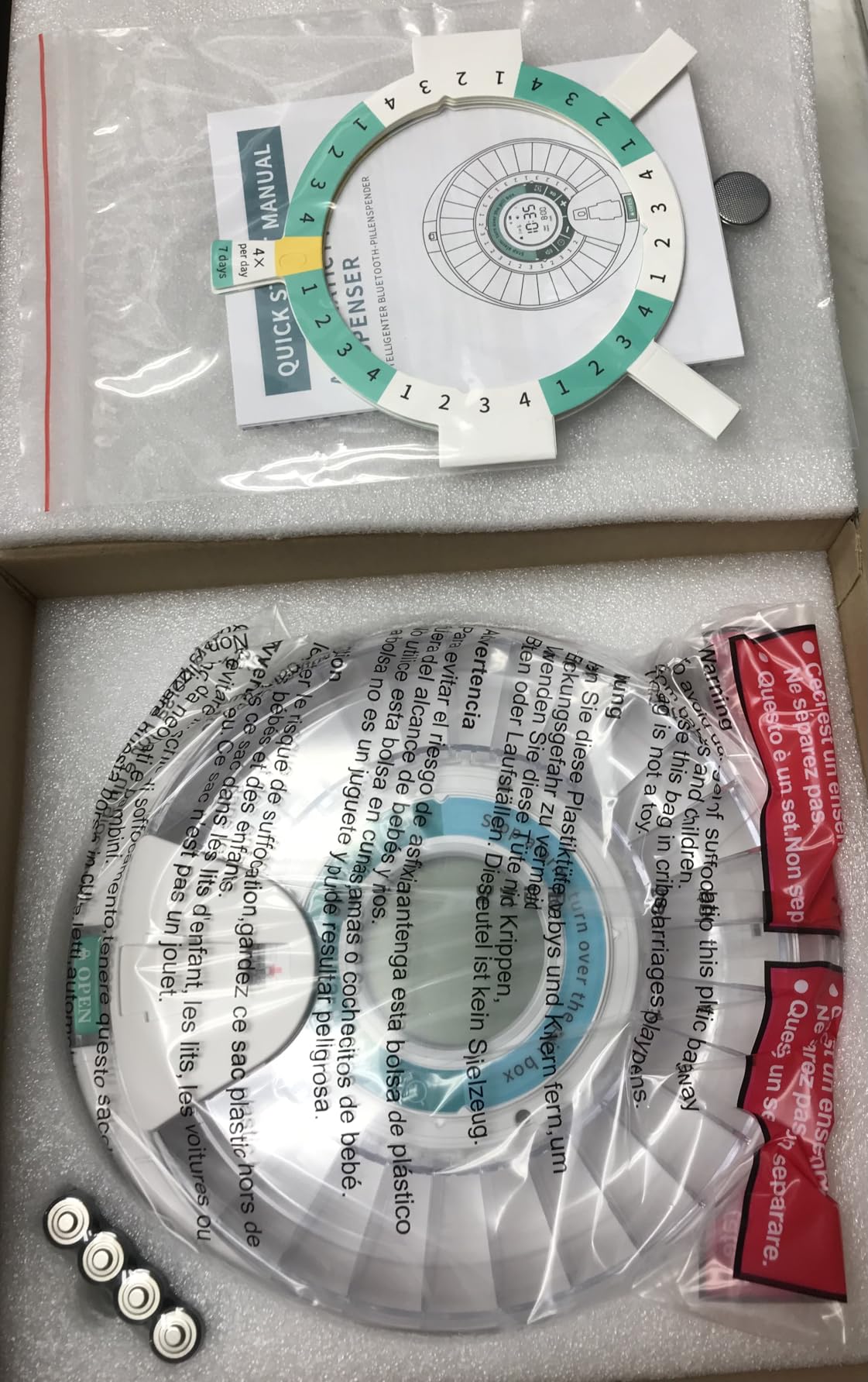
Dual locking for a household with dementia
The timed lock box uses fingerprint unlocking with a mechanical lock as a backup. Reviewers consider this the strongest practical access control in the group short of the Colorwing, particularly for a household where a patient might try to open the device early.
Unlike a simple key, a fingerprint cannot be picked up by a child with a pen, which was a specific complaint against a competing lock we also tested.
App scheduling with a full manual fallback
The Pillcalendar app supports custom medication names, pill photos and naming the device per family member. That level of labelling turns a list of codes into something a caregiver can read at a glance.
Critically, the unit also works with no app at all. A large LCD shows eight status icons and six physical buttons handle manual control, so a lost phone or a failed server does not leave someone without their medication.
Setup expectations for non-technical users
Owners describe the app setup and fingerprint enrollment as needing patience, and find the on-device menu less intuitive than a dedicated button layout. Budget an afternoon for the first configuration rather than assuming it will be immediate.
The listing is also newer, with 618 reviews rather than the thousands behind the category leaders, so the long-term reliability record is thinner. That is a fair trade for the adherence data, but worth knowing.
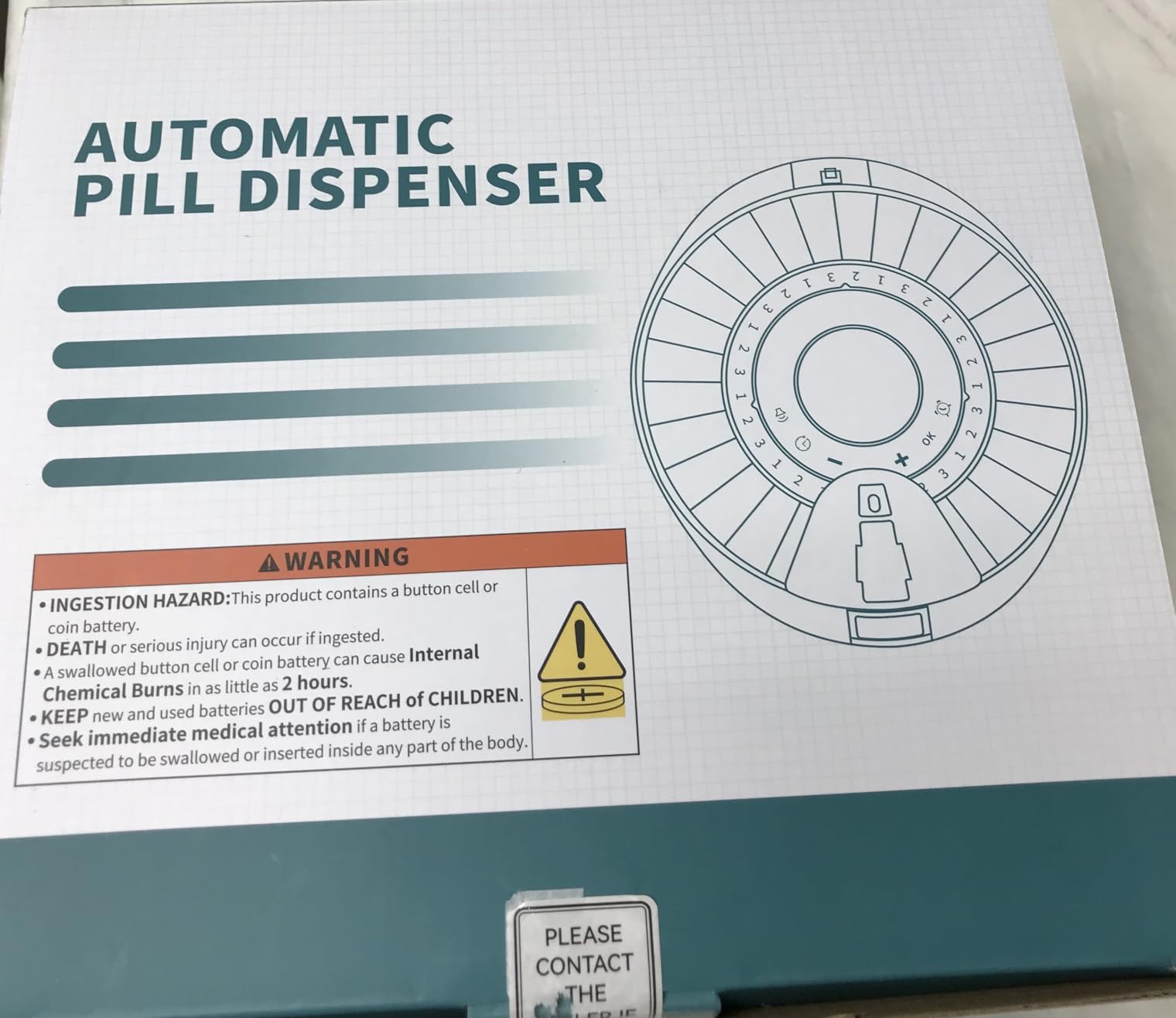
Who it suits and who should skip it
Pick this when remote monitoring is the priority, when two or more people share access to one medication list, or when a clinician will benefit from an adherence history. The free app means no ongoing fee.
Skip it if the person taking the medication refuses to touch a smartphone and no one else can help with setup, or if you need a proven decade-long track record more than you need data.
6. EziMedPil 28-Day Locked Dispenser – Best for Low Vision
- ✓Large compartments reduce refill frequency
- ✓Frosted lid gives privacy while the lock blocks access
- ✓Detachable tray speeds filling and cleaning
- ✓Large LCD with three buttons and a magnifier
- ✓No recurring subscription
- ✕Key lock is weak and not truly child-proof
- ✕Alarm stays silent if left upside down
- ✕Pills can jam and some units fail after a year
- ✕Changing the clock needs the instructions
28 compartments holding up to 672 pills
Lockable frosted lid with keys
Built-in magnifying glass and anti-slip grips
Large high-brightness LCD, 4 AA, 1.9 lbs
The EziMedPil was designed for seniors in assisted living and it shows in the details. The three-button layout, the front-mounted high-brightness display and the built-in mini magnifying glass for reading dosage labels are not standard extras on competing units.
It is also one of the few devices here with no recurring monthly fee of any kind, which matters for anyone planning a multi-year device.
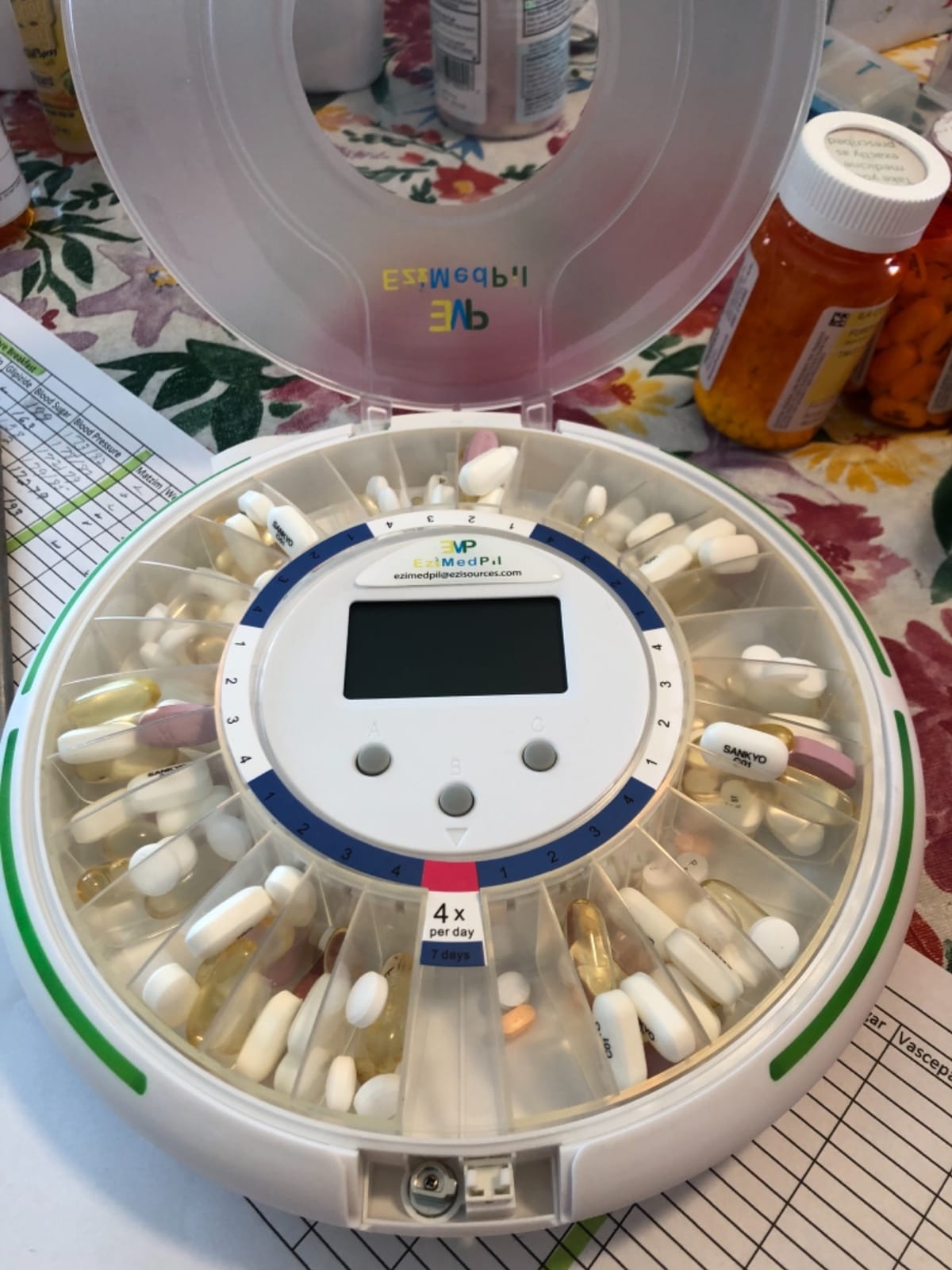
Capacity and the frosted privacy lid
Twenty-eight compartments hold up to 24 tablets each, roughly 672 pills in total. Six interchangeable dosage rings support up to six daily alarms with two ringtones and high, low or mute volume.
The frosted lid is unusual and practical. It blocks a caregiver from casually reading the medication schedule while still letting the user see the illuminated compartment. Lockable versions ship with keys.
Accessibility hardware that actually helps
Two anti-slip grips on the back are aimed squarely at users with limited hand strength, and sound alerts are paired with flashing lights so a user with hearing loss still gets a visual cue.
Families caring for parents with dementia or Parkinson’s consistently report dramatic drops in missed doses after switching to this unit. The detachable tray is what makes that realistic, since filling and cleaning take minutes rather than an hour.
The lock is the weak point
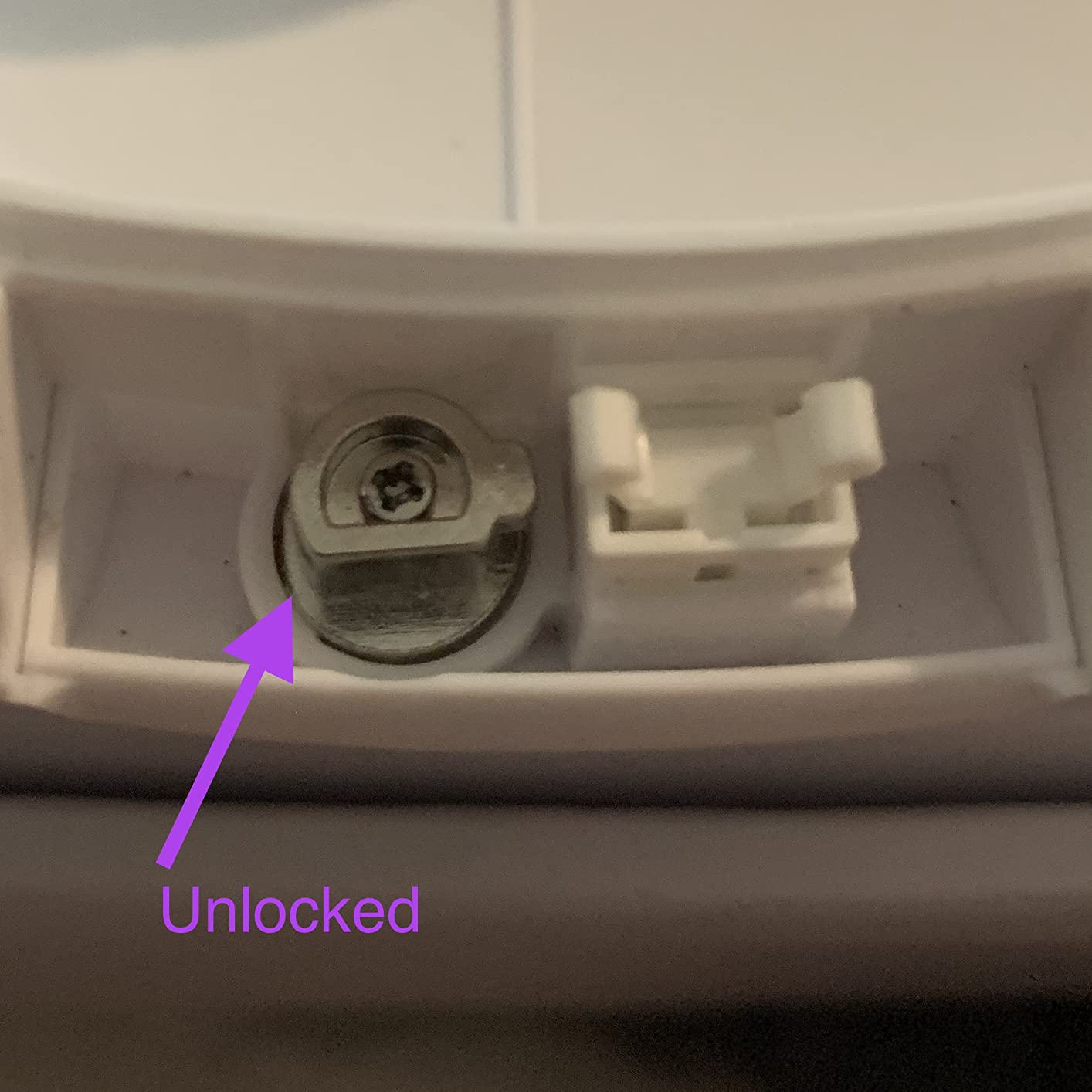
Several buyers do not consider the supplied key lock child-proof, and one reports that only a single key was supplied. If you are relying on the lock to stop a determined teenager or an advanced dementia patient, verify it yourself before relying on it.
Two other recurring gripes: if the unit is left upside down the alarm and light will not sound even though the carousel still turns, and some owners report motor or jam failures after roughly a year of use. Check the orientation weekly.
Who it suits and who should skip it
This is our pick when the user has reduced vision, limited hand strength, or both. The magnifier, large display and grip pads address problems that most competing units ignore.
Skip it if you need genuinely secure access control. The lock is adequate for discouraging casual access, not for containing a determined user, and the upside-down alarm silence is a real hazard in a home where the unit might get bumped.
7. Colorwing 31-Slot Bluetooth Dispenser – Premium Pick with the Strongest Lock
- ✓Strongest dual lock in the roundup
- ✓Press-release opening removes heavy lifting
- ✓Rechargeable battery lasts a month or more
- ✓Custom voice reminders feel personal
- ✓Free app with intake tracking and no subscription
- ✕Highest price in the category
- ✕Filling 31 slots takes 45 minutes or more
- ✕Some owners needed a factory reset when the carousel stopped
- ✕A jammed pill can lock out the emergency key
- ✕Large footprint
31 slots with 7 reversible dose rings
Fingerprint scan plus backup key
Press-release palm-activated picker box
1200mAh rechargeable, 30+ days, Bluetooth 5.0
The Colorwing is the most capable unit we tested and the one we recommend when the diagnosis is early-stage Alzheimer’s and the household needs real protection rather than a reminder. The fingerprint scanner plus physical backup key is the strongest access control in this roundup, and the app carries no subscription.
It is also the only device here with a rechargeable battery rated for 30 days or more in energy-smart mode, which removes battery anxiety for good.
The press-release picker box
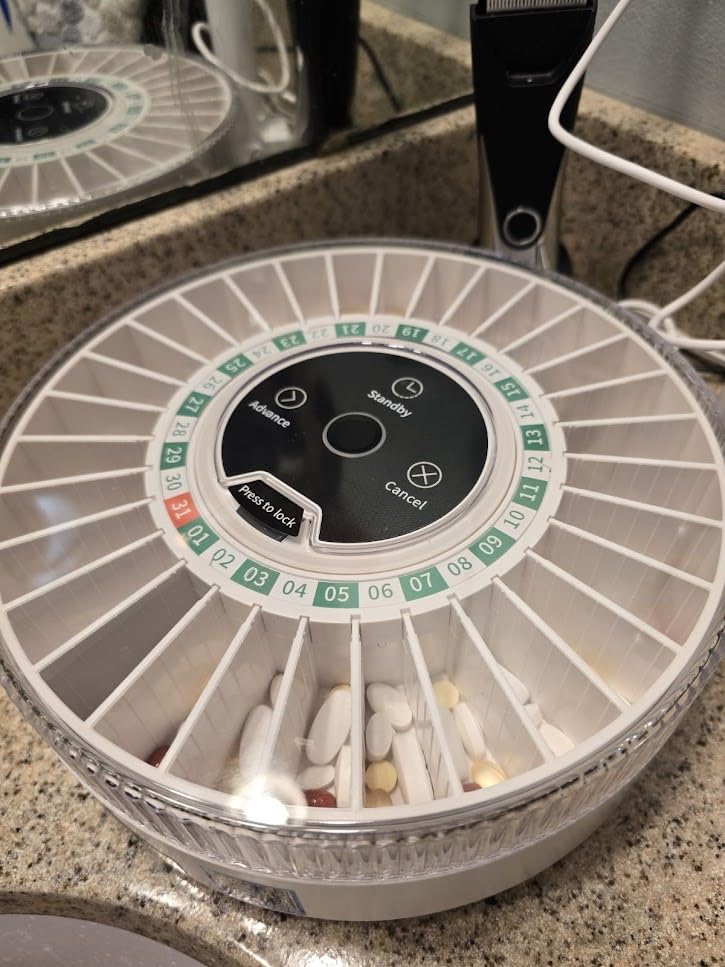
This is the feature that made the biggest difference in our testing. Instead of lifting and rotating a heavy tray to reach the dose, a palm press releases the pills into the hand. Users with arthritis and tremor describe it as the difference between independence and needing help every morning.
The press action also means fewer dropped pills, since nothing is tipped or shaken.
Voice reminders you can customise
Rather than a generic tone, you can record a custom phrase such as a familiar name saying it is time for medicine, alongside three soothing alert tones. Personalised prompts land better with users who have started to ignore a standard chime.
Monthly or weekly scheduling uses seven reversible dose rings, and Bluetooth 5.0 control of doses, reminders and intake tracking comes through a free companion app.
Reliability reports worth reading
The reservations are not about features but about long-term dependability. Some owners report the carousel stopped working and required a factory reset. A more serious subset describes a jammed pill shutting the unit down entirely and locking out the emergency key.
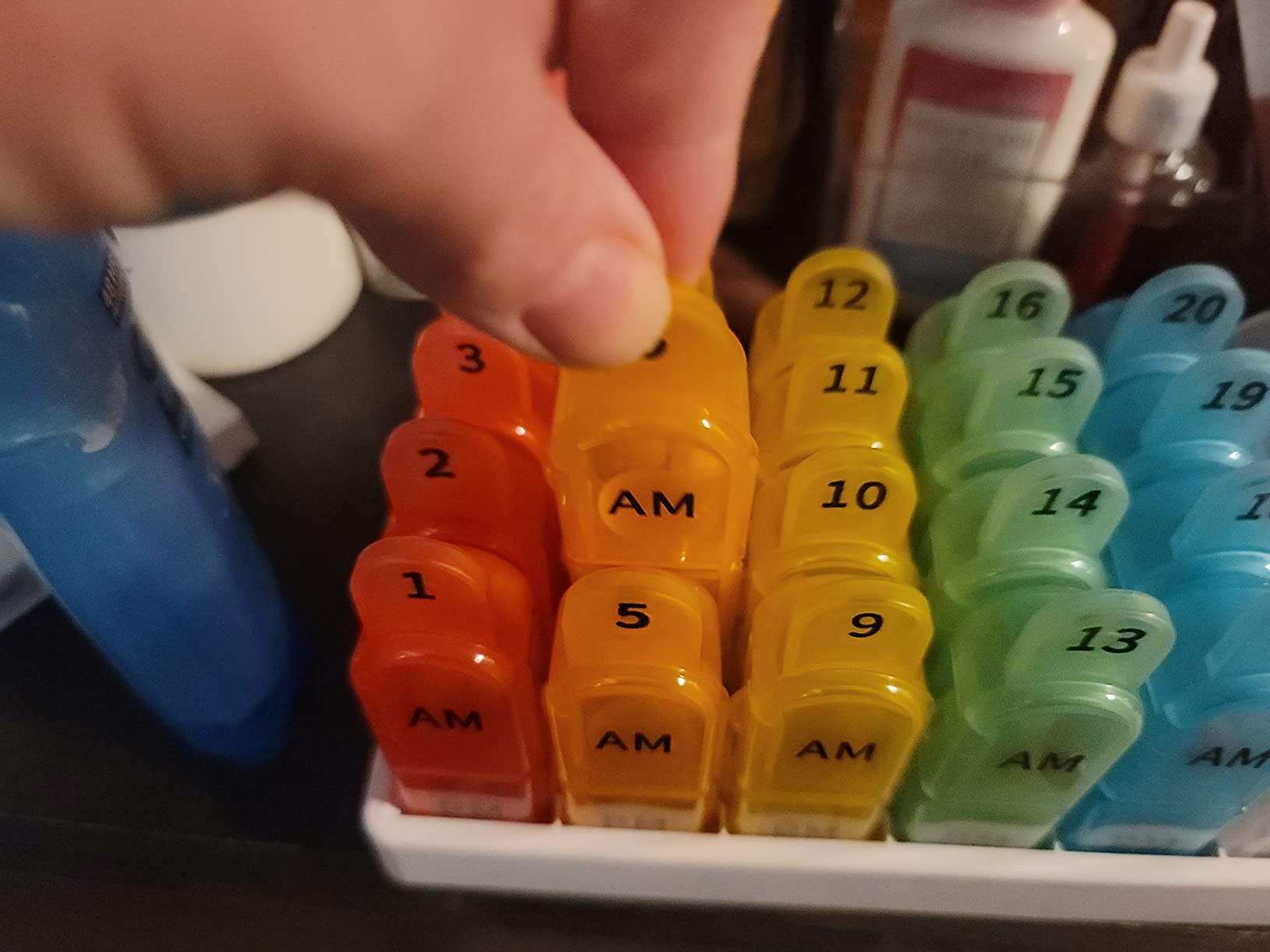
Filling all 31 slots also takes 45 minutes or more, and the footprint at 10.35 inches square is the largest here. Both are acceptable costs for the protection, but plan for them.
Who it suits and who should skip it
Choose this when a household needs to know with certainty that doses are not being accessed early, when the user has arthritis or tremor, and when a monthly recharge is acceptable. Multilingual video guides and four-hour setup support are included.
Skip it if the budget is fixed, if refilling 31 compartments monthly is not realistic, or if the person lives alone and nobody would notice if the carousel stopped. In that last case, a simpler alarmed unit is the safer bet.
8. Ideerfit 28-Day One-Press Dispenser – Cleanest Dispense Without an App
- ✓Slide-door dispense drops pills cleanly into a cup
- ✓Flexible 15 minutes early to 30 minutes late window
- ✓Choose sound only light only or both
- ✓Dual desiccant chambers for humid climates
- ✓No app and no subscription
- ✕Catch tray is small and pills can bounce out
- ✕Tray tab is under one inch and hard to grip
- ✕Bottomless tray spills unless you use tweezers
- ✕No way to advance the tray mid-cycle
- ✕USB-C charging brick not included
28 compartments for calcium vitamins and capsules
One-press dispense with no tray rotation
USB-C power with 4 AA backup
15 minutes early to 30 minutes late window
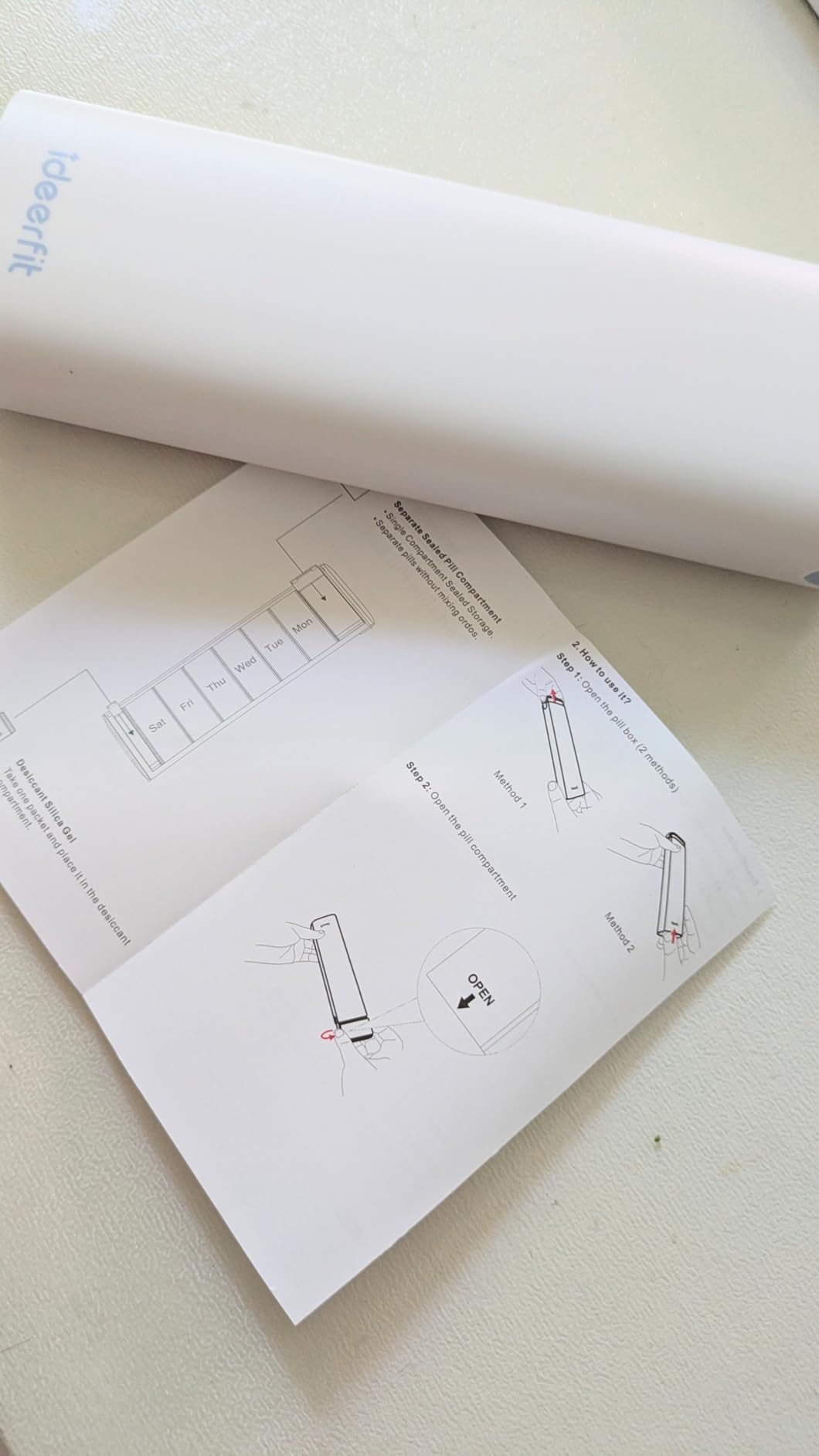
The Ideerfit solves the dispense problem differently from every other carousel. Rather than tipping and shaking the tray, a slide door opens and the pills drop cleanly into a cup. For anyone who has watched a full dose scatter across a table, that is a genuine upgrade.
It also has the most forgiving timing window in the group: 15 minutes early to 30 minutes late. Real life rarely runs exactly to schedule, and this unit accommodates that.
Alert choices that suit sensory needs
You can select sound only, light only or both through a bright LED ring. That is unusual flexibility, and it helps in a household where one person is hard of hearing and another is sensitive to sound.
Compartment sizing is practical rather than generic. Each slot fits 16 calcium tablets around 0.79 inches, 14 vitamins around 0.31 inches, or 13 capsules around 0.75 inches, which covers most common supplement types.
Moisture control for humid climates
A water-resistant lid, sealing silicone structure and dual desiccant chambers keep medication stable where humidity would otherwise be a concern. This is not a feature most competitors advertise, and it matters in warmer regions.
USB-C power with 4 AA backup means the unit keeps working through an outage. Note that the charging brick is not included, so you will need a cable and adapter.
The physical complaints are specific
Several users point out that the catch tray is small and pills can bounce out during dispensing, and that the tray tab is under one inch, which is difficult for weak hands. The bottomless tray also spills mixed pills when removed unless you use the included tweezers.
There is no way to advance the tray mid-cycle. You have to start on day one of your schedule, which makes this awkward for someone who wants to begin mid-cycle after a hospital discharge.
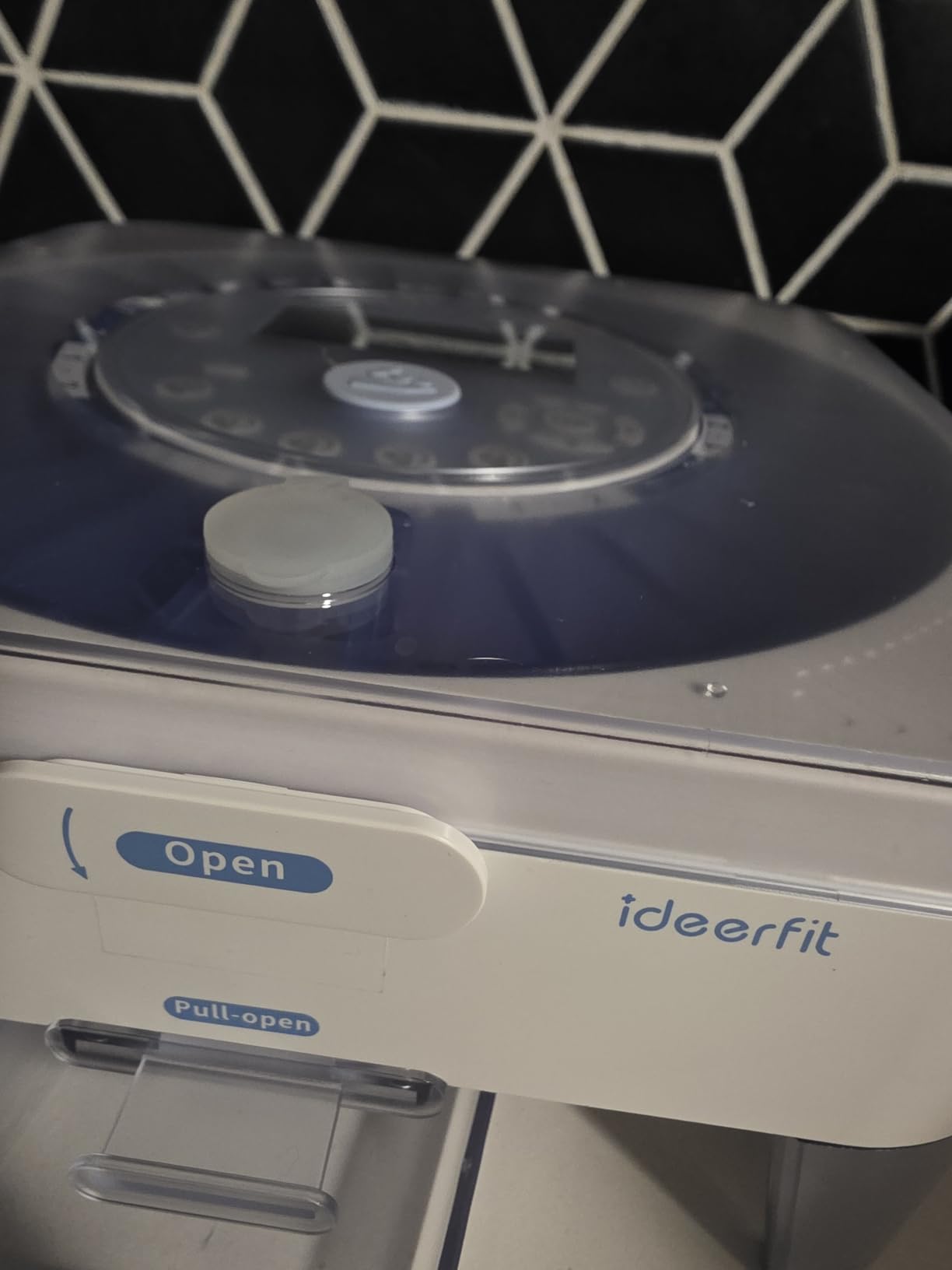
Who it suits and who should skip it
Pick this if you want a monthly unit with no app to learn, a hygienic hands-free dispense, and total control over sound versus light alerts. Reviewers moving away from subscription-based Wi-Fi dispensers tend to rate it highly for exactly that reason.
Skip it if hand strength is very limited, since the small tray tab is the weak point. Also skip it if you need to start a schedule partway through a month.
9. PILL THING 7-Times-a-Day Weekly Pill Box – Best for Seven Doses a Day
- ✓Seven dose slots handle genuinely complex regimens
- ✓Latching case secures and carries a full week
- ✓Day and dose labeled on lid and side
- ✓Schedule card documents names doses and doctors
- ✓Lifetime app subscription adds interaction warnings
- ✕Compartment lids are very hard to open for elderly users
- ✕Bulky unless you take many large pills
- ✕Alignment pins in one case broke immediately
- ✕Outer case latch came apart for some buyers
7 daily boxes with 7 compartments each
Latched outer case with schedule card
Compartment fits 4 fish oils or 30 tablets
Lifetime premium MediSafe app subscription included
When someone is managing ten to thirteen daily pills, the constraint is almost never reminders. It is container capacity. This weekly system gives you seven dose slots per day, which is the highest single-day count here without a motor involved.
Users on high-frequency regimens consistently praise the seven-slot days and the latched travel case, and many buy two or three sets so they can fill two or three weeks ahead of time.
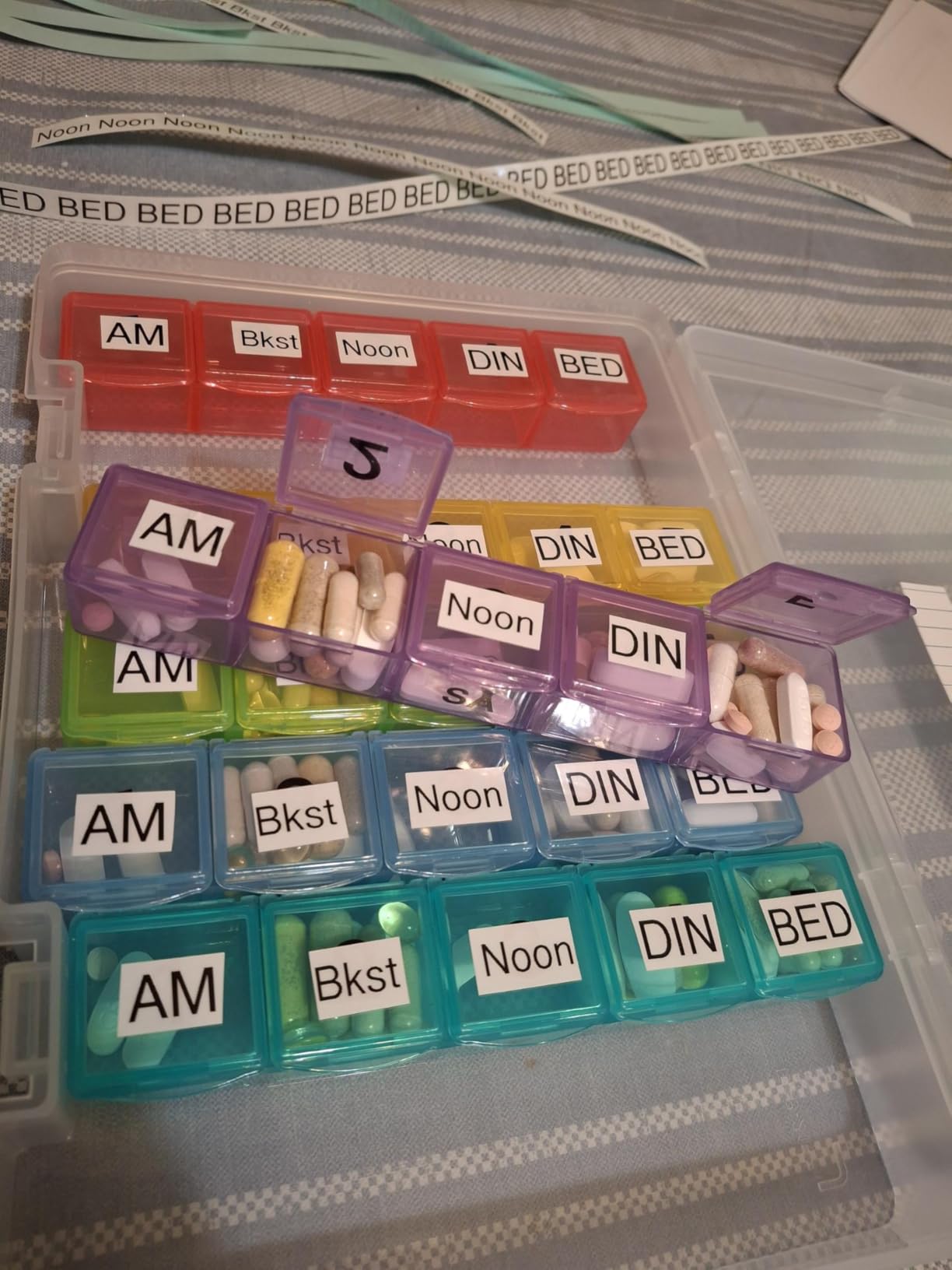
Labelling that survives a rushed morning
Each lid carries the day of the week and the dose number from 1 through 7, printed on both the top and the side. That redundancy matters when a box is sitting in a drawer and only one face is visible.
A two-sided medication schedule card with 15 lines front and 23 lines back sits in the case. It documents medication names, doses, prescribing doctors and instructions in one physical place, which is the document you will want at an appointment.
The MediSafe subscription is included for life
Each box ships with a lifetime premium subscription to the MediSafe reminder and interaction-warning app. Unlike most connected devices, there is no recurring fee, and the app adds drug interaction warnings that a plain alarm cannot.
Storing the daily boxes on their sides frees an extra 3 by 6.75 inches inside the case for drops, ointments, inhalers or a pill cutter, which keeps the whole regimen in one container.
Where it falls short
The consistent weakness is opening small compartment lids with limited hand strength. Owners with arthritis describe this as the main frustration, and it is worth testing on a sample before committing.
The compartments are also oversized unless you take many large pills, making each daily unit bulky. A minority report plastic alignment pins in the case lid breaking immediately, and the outer latch coming apart.
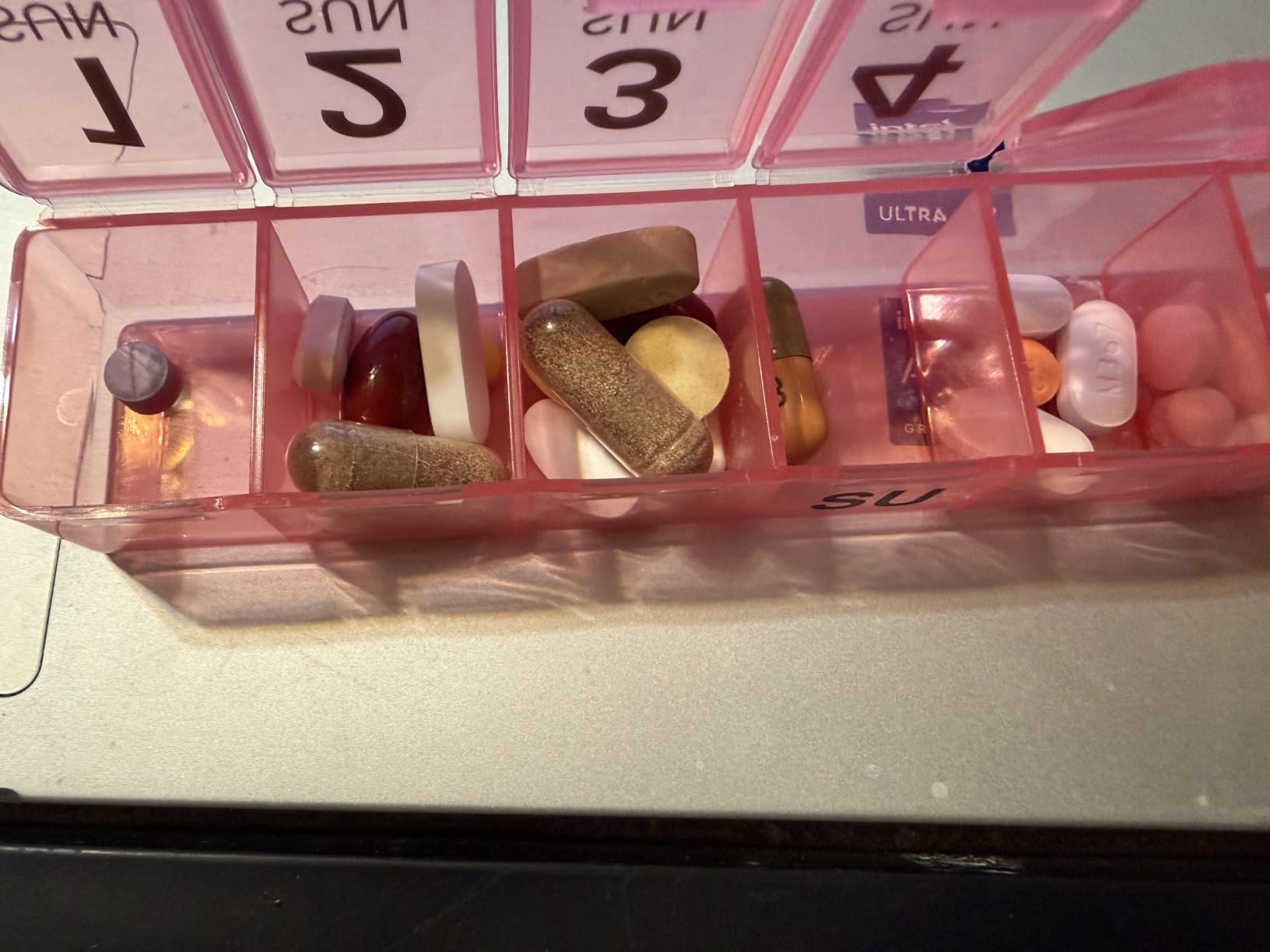
Who it suits and who should skip it
Choose this for a high-frequency regimen, for anyone who wants their documentation and their pills in one case, or for a person who benefits from seeing their whole week laid out at once. Snap-tight lids also give real spill protection.
Skip it if hand strength is limited, or if you only take one or two medications a day, in which case the extra bulk buys you nothing.
10. Med-Q Digital Pill Box with Alarms – Best Compact Travel Unit
- ✓Flashing the exact day and time removes all guessing
- ✓Alarms repeat and light blinks until the pack opens
- ✓Compact and inexpensive versus 28-day carousels
- ✓Suits teens
- ✓ADHD and post-stroke users too
- ✕Only about two weeks of twice-daily dosing
- ✕Programming is difficult and instructions unclear
- ✕Compartments are not individually locked
- ✕Alarm volume weaker than advertised for some
- ✕Small day markers are hard to see
Holds 14 days of twice-daily medication
Flashing light on the exact due compartment
Beeps repeat every 30 minutes until taken
Battery powered, 12 oz, 8.75 x 4.5 x 1 in
The Med-Q has been available since 2013 and remains the most compact serious reminder in the category. At 8.75 by 4.5 inches and 12 ounces, it disappears into a carry-on or a weekend bag in a way that no carousel can.
Its design input came from ER nurses working with senior and caregiver routines, and that shows in the oversized lettering and easy-open compartments.
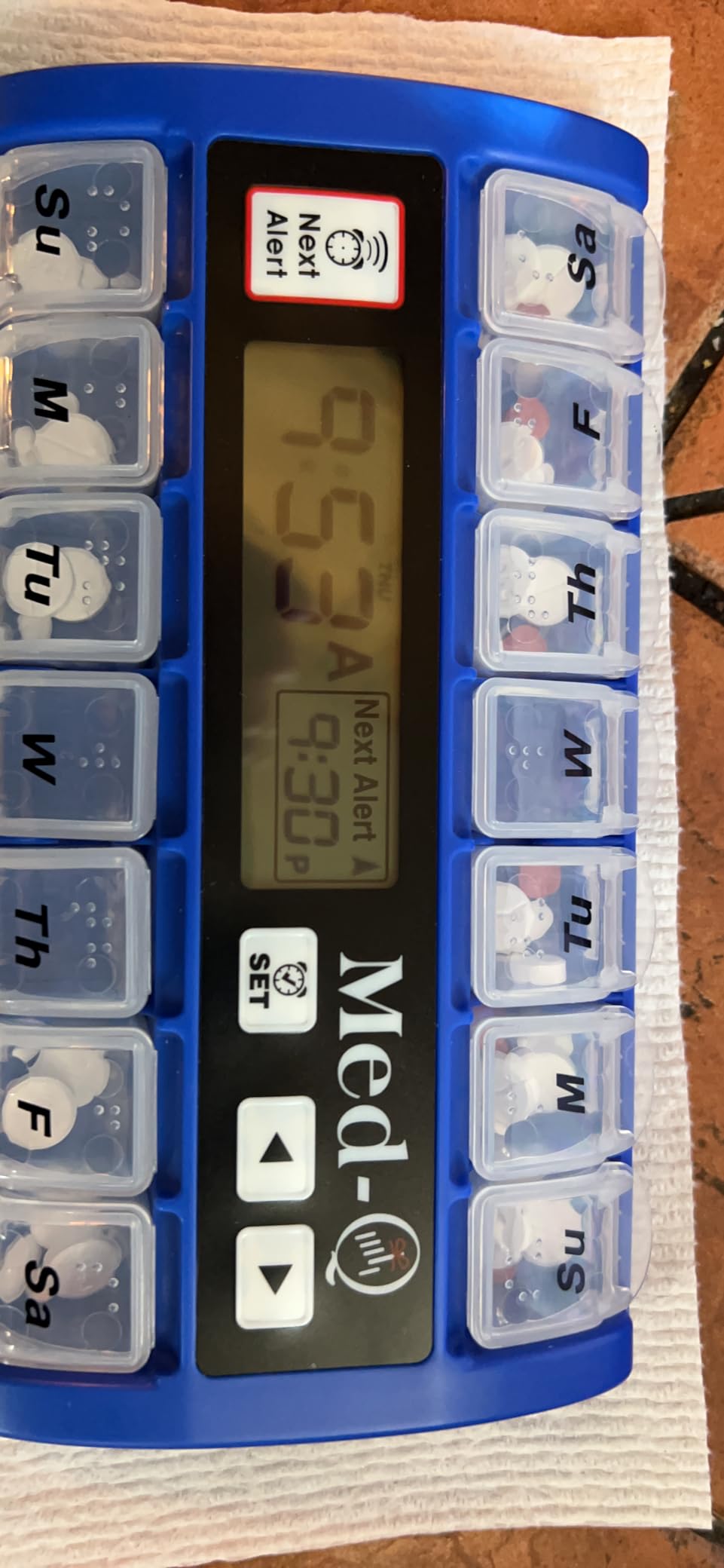
The light that points at the right compartment
Instead of sounding a generic alarm, the unit lights up the exact day and time compartment that is due. Caregivers credit this with eliminating double dosing and confusion for parents living independently.
One detailed review describes the light preventing a serious medication lapse during a period when nobody was visiting. The alarms repeat every 30 minutes and the light keeps blinking until the pack is opened, so a missed dose has to be deliberate to ignore.
Where the compromises are
Capacity is the first limitation: roughly 14 days of twice-daily dosing rather than a full month. Second, programming is described as difficult with instructions that are not very clear. Plan for a longer setup session.
Compartments are not individually locked, so a user can open a wrong day. That matters most for advanced dementia and less for a person who simply forgets. Small day markers are also hard to see for users with impaired vision, and some report alarm volume weaker than advertised.
Who it suits and who should skip it
Pick this if travel is central, if you take one or two medications, or if the user is a teenager or someone recovering from a stroke who needs a clear visual cue. It is also a solid backup device to keep in a bag.
Skip it for advanced memory impairment where you need locked doses, or if you want monthly capacity without weekly refilling.
11. Sagely Smart Active Weekly Pill Box – Best Removable Pods
- ✓Pods let you carry only the days you need
- ✓Works as 7-day AM/PM or 14-day planner
- ✓BPA-free build described as lasting for years
- ✓Free companion app with no subscription
- ✓Compact and light enough for travel
- ✕App is a reminder only with no records or warnings
- ✕Fixed weekly size means multiple fills for monthly regimens
- ✕Limited colour contrast between AM and PM sections
7-day AM/PM box or 14-day planner
7 removable pods with secure lids
BPA-free food-safe materials
Free app for Apple and Android, 9.9 oz
The Sagely solves travel with the same idea as a lunchbox: pop out the days you need and leave the rest on the shelf. Seven removable pods stay securely lidded until you pull them, which prevents the accidental spill that ruins most weekly boxes in a bag.
It is also genuinely dual-purpose. Use it as a 7-day AM/PM box at twice-daily dosing, or reconfigure it as a 14-day planner at once-daily dosing.
A free app that stays out of the way
The Sagely Pill Reminder app is free for Apple and Android with no subscription. Owners consistently treat it as a helpful extra rather than a core feature, which is honest framing for what a reminder app can and cannot do.
Importantly, it does not attempt interaction warnings or adherence records. If you want data on whether doses were taken, this is not the product for it.
Build quality and colour contrast
Owners describe a sturdy BPA-free, food-safe build that has lasted for years, which is worth noting in a category full of snap-together plastic. At 9.9 ounces and 10.24 by 3.46 inches it is one of the lightest units here.
The recurring limitation is limited colour contrast between the AM and PM sections, which can be hard to distinguish at a glance. For a user with reduced vision, test this before relying on it.
Because the pod layout is a fixed weekly size, monthly regimens need multiple fills, which negates much of the convenience.
Who it suits and who should skip it
Choose this if you take one or two medications, if portability matters more than capacity, and if you want an app without a subscription. It is also a good fit for anyone who wants a physical record they can glance at rather than rely on a screen.
Skip it if you need adherence data for a clinician, if you need to cover a full month, or if distinguishing morning from evening doses at a glance is difficult for the user.
12. Daviky Automatic Pill Organizer – Best First App-Connected Step
- ✓Lowest price among connected organizers here
- ✓Triple reminders from box alarm light and phone
- ✓Rechargeable battery needs no battery changes
- ✓Slim size fits a purse backpack or carry-on
- ✓Magnetic outer lid over a snap inner lid
- ✕Seven-day capacity means weekly filling
- ✕Lids need decent hand strength to open
- ✕Compartment suits one daily dose not multiple times
- ✕App-dependent setup may not suit non-smartphone users
Bluetooth app setup
On-box alarm and light plus phone push alerts
Rechargeable lithium battery, about one month per charge
8.59 x 1.94 x 1.49 in, 8.15 oz
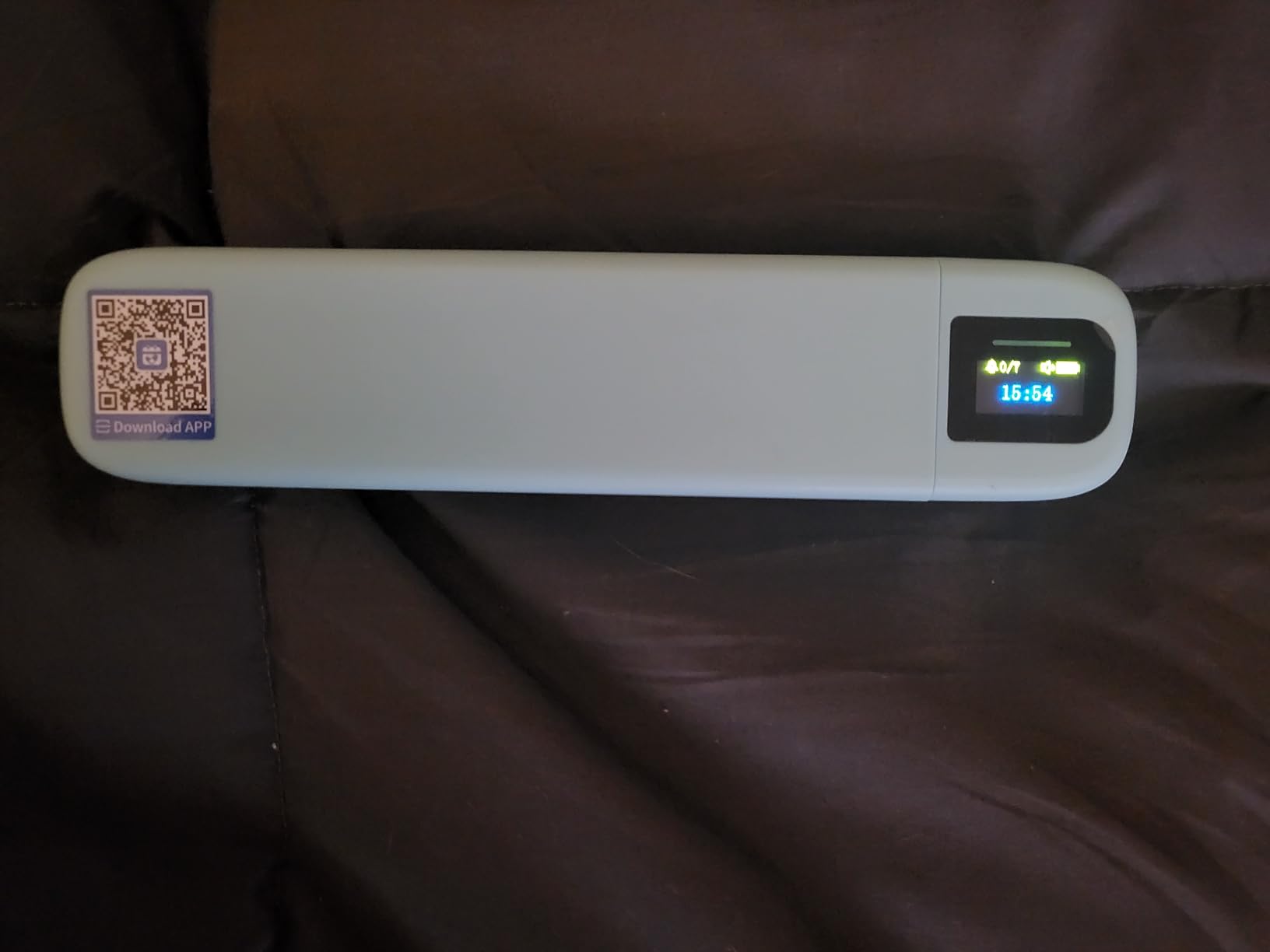
The Daviky is the least expensive way into app-connected pill reminders, and it does the fundamentals well. Triple reminders fire: an alarm and light inside the box plus a push notification on the phone. Redundancy matters when a person does not check one screen reliably.
The rechargeable lithium battery runs about a month from a 2.5-hour charge, which removes the recurring battery anxiety that affects battery-only connected units.
A genuinely portable footprint
At 8.59 by 1.94 by 1.49 inches and 8.15 ounces, this is the smallest connected unit we tested. It fits in a purse, a backpack or a carry-on without a special case, and each compartment holds 7 large supplements or 15 to 20 oval vitamins.
The magnetic outer lid over a snap inner lid gives reasonable privacy for a bag in public, which is a thoughtful detail at this level.
The limits of a weekly, once-daily format
Seven-day capacity means filling every week, which is the single biggest drawback compared with the 28-day units. If the weekly refill is a barrier, this format will not fix itself.
Compartment size suits one daily dose rather than multiple times per day, and both lids need decent hand strength to open, which is a problem for arthritis users. Setup also depends on the app, so a person who avoids smartphones is not a good match.
Reviewers who arrive from subscription-based Wi-Fi dispensers tend to rate it highly for the simplicity of having no fee attached.
Who it suits and who should skip it
Choose this if you want phone notifications at the lowest entry point, take one daily dose, and want something that travels without a case. It is also the sensible first connected device before committing to a monthly carousel.
Skip it if you take multiple doses per day, if hand strength makes the dual lids difficult, or if a weekly refill is not realistic.
How to Choose a Smart Pill Organizer Without Regretting It
The decision comes down to four questions asked in the right order: how many doses a day, do you need doses physically locked away, how much can you refill comfortably, and does an app add value or just another screen. Get these right and the rest is preference.
Count your doses a day first
One to two doses a day puts you in weekly alarm boxes and slim connected organizers. Four doses puts you in the talking clock or 7-day compartment systems. Six or more daily doses pushes you toward the carousel units with the most interchangeable dosing rings, because those are the only ones with enough programming positions.
Buying a four-slot device for a six-dose regimen is the most common and most avoidable mistake we see. Count the actual times, not the number of medications.
Decide whether you need locking, not just reminding
This is the question that separates a reminder from a safety device. A reminder assumes a cooperative user. A lock assumes the user might try to take something they should not. For dementia, obsessive-compulsive dosing or any history of double dosing, locking matters enormously.
Within the locking options, quality varies a great deal. Fingerprint plus mechanical key is meaningfully stronger than a supplied key alone, which several owners report can be opened by a child with a pen. Decide which level of protection your situation actually requires before comparing models.
Match capacity to your refill stamina
Twenty-eight and 31-day units are dramatically nicer than weekly boxes, but they are only better if someone can actually fill them. The MedCenter’s four-compartment daily boxes take close to an hour to fill, and the Colorwing’s 31 slots take 45 minutes or more. Those are real monthly commitments.
Ask who fills it. If a caregiver visits twice a week, a 7-day unit with detachable pods may be more realistic than a monthly carousel, even though it sounds like a step down. The same routine-building logic applies beyond the medicine cabinet, which is why we keep a guide to smart refrigerator organizers on hand alongside this one.
Check for subscriptions before you buy
Subscription costs are the most common hidden cost in this category. Several connected dispensers charge a monthly fee for the app that makes them “smart.” The Betife, Colorwing, EziMedPil and Ideerfit units here all operate without any recurring fee, and the PILL THING organizer includes a lifetime premium app subscription rather than a monthly one.
Before checkout, search for the subscription terms in the listing. If the app requires a paid tier for the features you actually want, the total cost over five years changes the comparison entirely.
Test the alert volume and the opening mechanism
Alarm volume is the most common failure we found across user reviews, and it is not something you can judge from a photo. Whatever you buy, set it up in the room where it will actually live and have someone else stand in the doorway to judge.
Opening mechanism matters just as much. Push-button and press-release designs suit stiff hands. Snap lids, magnetic lids and small compartment lids do not. If the intended user has arthritis, tremor or limited grip strength, this should eliminate half your list before you read another feature.
Setup complexity is the most underrated factor
Caregivers repeatedly report that programming these devices takes far longer than expected, particularly around daylight saving changes and initial clock setting. The Med-Q in particular is described as difficult to program with unclear instructions. The app-connected units need patience during pairing and enrollment.
We rate setup difficulty on a simple scale when we compare: one for a box that works out of the box, two for a few button presses, three for an app pairing plus device setup, four for app pairing plus fingerprint enrollment and a dose ring configuration, and five for a monthly fill of 31 compartments. Anything at four or five needs a plan and a second person.
Travel, TSA and insurance questions answered
TSA allows pill organizers in carry-on bags, and you do not need to declare medication in an organizer the way you might for loose pills. Keep medication in original pharmacy-labeled containers anyway, because that is what proves the prescription at a secondary screening if it is requested. The bigger travel issue is physical size: the 28-day carousels are impractical in hand luggage, while the Med-Q, Sagely pods and Daviky were designed for it.
On Medicare coverage, the honest answer is that automatic pill dispensers are not a covered standard benefit under Original Medicare, which is why the question keeps appearing. Coverage sometimes arrives indirectly: a Medicare Advantage plan may offer an over-the-counter or durable medical equipment allowance, and some Medicaid programs assist with medication adherence equipment. Ask your plan directly and get the answer in writing, because the terminology varies by plan. An FSA or HSA account is often the more realistic route for reimbursement.
One more expectation to set honestly. Smart home integration is largely aspirational in this category. Users in home automation communities keep asking for HomeKit, Alexa and Google Home compatible pill dispensers, and the honest answer is that almost none of the units here expose a standard smart home endpoint. They work through their own apps, or Bluetooth alone. If voice assistant control is a firm requirement, verify compatibility before buying rather than assuming it.
Frequently Asked Questions
What is the best pill organizer for storing a lot of pills?
The highest-capacity smart organizers hold 28 or 31 compartments: the Windtrace holds 28 with up to 6 daily alerts, the LiveFine holds 28 with up to 9 alerts and 18 pills per slot, and the Colorwing holds 31 slots with a fingerprint and key dual lock. For pills rather than compartments, the EziMedPil stores up to 672 tablets across its 28 compartments.
Which pill organizer is best overall?
The Windtrace 28-Day Automatic Dispenser is our top pick. It combines 28 compartments, six interchangeable dosing rings, a loud alarm with a flashing blue LED and a removable tray, so refills happen monthly and the wrong dose is physically hard to take. It also carries 3445 reviews, the largest proven base in this roundup.
Will Medicare pay for an automatic pill dispenser?
Automatic pill dispensers are not a standard covered benefit under Original Medicare. Some Medicare Advantage plans offer an over-the-counter or durable medical equipment allowance that may apply, and Medicaid programs sometimes assist with adherence equipment. An FSA or HSA account is often the more realistic payment route. Ask your specific plan in writing because terms vary.
Does TSA allow pill organizers on planes?
Yes. Pill organizers are permitted in carry-on bags and do not need to be declared separately from medication. Keep pills in their original pharmacy-labeled containers for secondary screening. Choose a compact weekly unit such as the Med-Q, Sagely or Daviky for travel, since 28-day carousels are impractical in hand luggage.
How does a smart pill dispenser work?
A smart pill dispenser uses sensors and connectivity to detect when a compartment is opened, syncs that event with a mobile app to log medication intake, and sends real-time notifications for scheduled doses and missed medications. Carousel models add a motor that rotates the tray to expose only the due slot and locks the rest.
Do smart pill organizers need WiFi or can caregivers monitor them remotely?
Most connected organizers in this roundup use Bluetooth rather than WiFi, such as the Betife with its Pillcalendar app and the Colorwing with Bluetooth 5.0. Bluetooth gives caregivers remote dose logs, missed-dose highlighting and push notifications without a WiFi requirement. Adherence records are the feature to look for, and not every reminder app produces them.
The Right Smart Pill Organizer for Your Regimen
If you want one recommendation, the Windtrace 28-Day Automatic Dispenser is the one we would choose and the one we would put on a nightstand in 2026. Twenty-eight compartments, six dosing rings, an alarm and light that carry through a whole house, and the largest body of long-term owner feedback in the category behind it.
If your needs are more specific, match the archetype to the device. Take six or more doses daily or carry large supplements, and the LiveFine handles the highest pill counts and the most alerts. Want voice confirmation and a full calendar month with no app, and the MedCenter is unmatched after 25 years of service. Need genuine access control for early dementia plus arthritis or tremor, and the Colorwing’s fingerprint lock and press-release picker are worth the extra cost. Want caregiver data rather than reminders, and the Betife’s adherence log is the one to buy. Traveling often or staying on a tight budget, and the Sagely pods, Med-Q or Daviky cover those bases.
Whichever you choose, test the alarm volume from outside the room and confirm the opening mechanism suits the hands that will use it before you commit. Those two checks eliminate more bad purchases than any feature list ever will.






Leave a Comment