
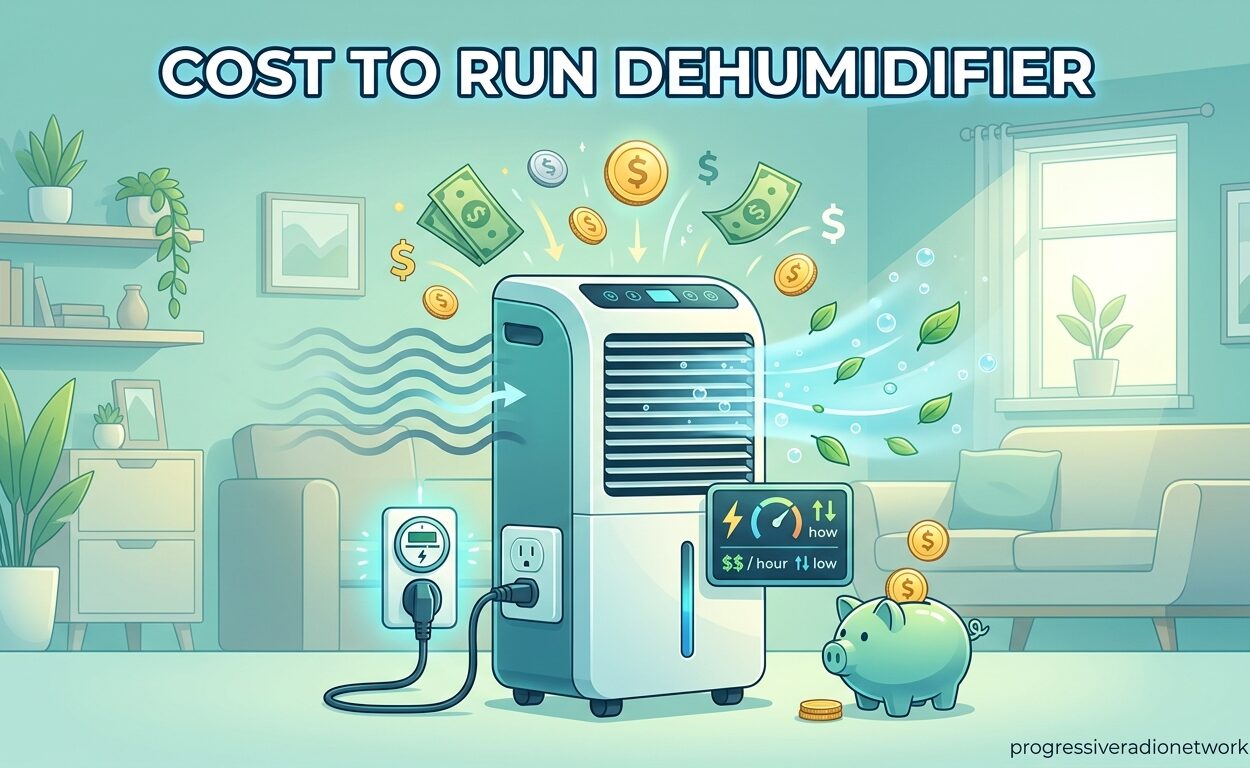
After tracking my basement dehumidifier for three years with a kill-a-watt meter, I’ve learned that electricity costs can surprise homeowners. Running a dehumidifier typically costs between $0.03 and $0.16 per hour, depending on unit size and local electricity rates. This translates to roughly $10-$40 per month for typical household use, though 24/7 operation in humid climates can push costs to $70+ monthly.
Understanding the cost to run a dehumidifier matters because humidity control isn’t optional in many homes. Basements, crawl spaces, and damp climates require consistent dehumidification to prevent mold growth and protect structural integrity. I’ve seen homeowners shocked when their electricity bill doubles after installing a dehumidifier, simply because they didn’t anticipate the ongoing energy expense.
This guide breaks down exactly how much electricity dehumidifiers consume, how to calculate your specific costs, and practical strategies to reduce energy use without sacrificing humidity control. You’ll find real-world data from actual users, cost comparisons by unit size, and answers to the most common questions about dehumidifier operating expenses.
Quick Answer: Dehumidifier Running Costs
Dehumidifiers cost between $0.03 and $0.16 per hour to operate, based on national average electricity rates of $0.16 per kilowatt-hour. Monthly costs range from $10 for part-time use of smaller units to over $70 for continuous operation of large-capacity dehumidifiers.
The cost to run a dehumidifier depends primarily on three factors: unit wattage (200-700W), daily run hours (2-24 hours), and your local electricity rate ($0.10-$0.40+ per kWh). Smaller 30-pint units cost about $15-25 monthly when running 12 hours daily, while larger 70-pint units can cost $50-75 monthly under the same conditions.
Running a dehumidifier 24 hours a day costs approximately $22-115 per month, depending on unit size and electricity rates. At the national average rate, a typical 50-pint dehumidifier running continuously costs about $67-84 monthly. This assumes the compressor cycles on and off rather than running constantly.
Dehumidifier Wattage by Size
Dehumidifier wattage varies significantly based on capacity, measured in pints of water removed per 24 hours. Understanding your unit’s power consumption is the first step in calculating operating costs accurately.
Small dehumidifiers (20-30 pint capacity) typically draw 200-300 watts when running. These compact units work well for single rooms up to 1,500 square feet and cost the least to operate. Medium units (40-50 pint capacity) consume 300-500 watts, making them suitable for larger basements or damp spaces. Large-capacity dehumidifiers (60-70+ pint capacity) draw 500-700 watts and are designed for whole-home use or extremely humid conditions.
The compressor consumes the majority of electricity in refrigerant dehumidifiers, accounting for roughly 80-90% of total power draw. Fans and controls use the remaining 10-20%. Desiccant dehumidifiers, which use a heating element instead of a compressor, can draw even more power in some cases.
Importantly, dehumidifiers don’t run at full wattage continuously. The compressor cycles on and off based on humidity settings, actual moisture levels, and unit efficiency. In moderate conditions, a dehumidifier might only run 30-50% of the time. In very humid environments or during initial dehumidification, the unit may run nearly continuously until reaching the target humidity level.
| Dehumidifier Size | Wattage Range | Hourly Cost (at $0.16/kWh) | Monthly Cost (12 hrs/day) |
|---|---|---|---|
| 30-pint (small) | 200-300W | $0.03-$0.05 | $11-$18 |
| 50-pint (medium) | 300-500W | $0.05-$0.08 | $18-$29 |
| 70-pint (large) | 500-700W | $0.08-$0.11 | $29-$40 |
Cost to Run Dehumidifier: How to Calculate Your Exact Cost
Calculating the cost to run a dehumidifier requires three pieces of information: your unit’s wattage, daily run hours, and electricity rate per kilowatt-hour. Once you have these figures, the calculation is straightforward.
The formula: (Wattage × Hours Run ÷ 1000) × Electricity Rate = Daily Cost
For example, a 500-watt dehumidifier running 12 hours daily at $0.16 per kWh would cost: (500 × 12 ÷ 1000) × $0.16 = $0.96 daily, or approximately $29 monthly. This calculation assumes continuous operation during those hours. In reality, costs may be lower due to compressor cycling.
To find your unit’s wattage, check the specification label on the back or bottom of the dehumidifier, or consult the owner’s manual. The label typically lists watts or amps (watts = amps × volts for standard 120V outlets). Your electricity rate appears on your utility bill, usually measured in cents per kilowatt-hour.
For the most accurate measurement, use a plug-in power meter like a Kill-A-Watt device. These inexpensive tools measure actual power consumption over time, accounting for compressor cycling and real-world usage patterns. Several forum users reported their actual costs were 20-30% lower than calculated due to cycling.
Monthly Cost Estimates by Dehumidifier Size
Monthly dehumidifier costs vary dramatically based on usage patterns. Occasional use in a moderately damp basement costs far less than continuous operation in a humid coastal climate. The following estimates use the national average electricity rate of $0.16 per kWh.
A 30-pint dehumidifier costs approximately $11-18 monthly when running 12 hours daily. This assumes typical cycling where the compressor doesn’t run continuously. For 24/7 operation, expect $22-36 monthly. These smaller units work well for bathrooms, bedrooms, and small basements under 1,500 square feet.
A 50-pint dehumidifier, the most common size for residential basements, costs about $18-29 monthly with 12 hours of daily use. Continuous operation raises this to $36-58 monthly. These units handle spaces up to 3,000 square feet and moderate to high humidity levels effectively.
Large 70-pint dehumidifiers cost approximately $29-40 monthly with 12 hours of daily operation. Running 24/7 increases costs to $58-80 monthly. These powerful units are designed for whole-home use, very large basements, or extremely humid environments where smaller units would run continuously trying to keep up.
| Unit Size | 12 Hours/Day | 24 Hours/Day | Best For |
|---|---|---|---|
| 30-pint (200-300W) | $11-18/month | $22-36/month | Single rooms, small spaces |
| 50-pint (300-500W) | $18-29/month | $36-58/month | Basements, large rooms |
| 70-pint (500-700W) | $29-40/month | $58-80/month | Whole-home, very humid areas |
Key Factors Affecting Dehumidifier Energy Consumption
Several variables impact how much electricity your dehumidifier actually uses. Understanding these factors helps explain why two homes with identical units might have very different operating costs.
Humidity level is the primary factor. Dehumidifiers work harder in very humid environments (70%+ relative humidity) than in moderately damp spaces (50-60%). During rainy seasons or in naturally humid climates, units run longer cycles. In winter or dry conditions, the same unit might barely run at all.
Temperature affects efficiency significantly. Most refrigerant dehumidifiers operate optimally between 65°F and 85°F. Below 65°F, coils may ice up, causing the unit to cycle through defrost mode repeatedly. This increases energy use without extracting much moisture. Some units are specifically designed for cooler basement temperatures.
Unit size and capacity must match your space. An oversized unit will reach the target humidity quickly and cycle off frequently, reducing energy use. An undersized unit will run continuously trying to keep up, actually using more electricity while accomplishing less. Proper sizing is crucial for efficiency.
Unit age and condition matter too. Older units often have dirty coils, worn compressors, or degraded refrigerant, reducing efficiency. Clean filters and coils improve heat transfer and reduce energy consumption. Energy Star certified dehumidifiers are approximately 14% more efficient than standard models.
Humidistat settings directly impact run time. The EPA recommends maintaining indoor humidity between 30% and 50% for comfort and health. Setting the target lower than necessary increases energy consumption significantly. Each 5% reduction below 50% increases runtime and costs substantially.
Electric Bill Impact: Real User Experiences
Forum discussions reveal that actual dehumidifier costs often surprise homeowners. Users tracking their electricity consumption report a wide range of real-world expenses depending on their specific situations.
One Reddit user shared that their basement dehumidifier added $40 to their monthly bill when running 24/7 in a well-insulated home. Another user reported their electricity bill increased from $150-180 to $450 after installing a dehumidifier, though this likely represents extreme usage or an inefficient unit.
A MrMoneyMustache forum member documented 239 kWh monthly consumption from their basement dehumidifier alone. At $0.16 per kWh, this equals approximately $38 monthly. Another Reddit user calculated their unit at 500 watts per hour, resulting in $2.50 daily or roughly $1,000 annually for continuous operation.
More moderate experiences include $14 monthly for a 1,500 square foot home running 24/7, and $20-70 monthly depending on unit size and humidity levels. These variations highlight why individual calculation based on your specific circumstances provides the most accurate estimate.
The consensus among experienced users: expect a noticeable increase in your electric bill, but proper sizing and smart usage can keep costs reasonable. Many find the expense justified by preventing mold damage and improving comfort.
9 Ways to Reduce Dehumidifier Running Costs
Reducing dehumidifier energy consumption doesn’t mean living with excessive humidity. These strategies lower operating costs while maintaining effective moisture control in your home.
1. Set your humidistat correctly. Target 40-50% relative humidity rather than the lowest possible setting. Each 5% increase in target humidity significantly reduces compressor runtime and energy use. The EPA recommends 30-50% for optimal health and comfort.
2. Choose the right size unit. An appropriately sized dehumidifier reaches target humidity faster and cycles off more often. An oversized unit costs more upfront but saves money long-term through shorter run times. Use manufacturer sizing guides based on your square footage and dampness level.
3. Improve your home’s moisture resistance. Fix foundation cracks, improve drainage around your home, and ensure proper ventilation in bathrooms and kitchens. Preventing moisture entry reduces the dehumidifier’s workload. A vapor barrier in crawl spaces can dramatically reduce humidity levels.
4. Invest in an Energy Star model. These certified units meet strict efficiency guidelines and use approximately 14% less energy than conventional models. The slightly higher purchase price typically pays for itself within 2-3 years through electricity savings.
5. Use continuous drainage. Units with built-in pumps or gravity drain options don’t shut off when the reservoir fills. This prevents the unit from running in fan-only mode while waiting for manual emptying, which wastes energy without dehumidifying.
6. Utilize timer and smart features. Run your dehumidifier during off-peak electricity hours if your utility offers time-of-use rates. Some areas charge significantly less at night. Smart dehumidifiers can adjust operation based on actual humidity readings rather than running continuously.
7. Perform regular maintenance. Clean or replace air filters monthly. Dirty filters restrict airflow and reduce efficiency. Clean coils annually to maintain heat transfer efficiency. Check for refrigerant leaks if the unit seems to run constantly without collecting much water.
8. Reduce moisture at the source. Use exhaust fans in bathrooms and kitchens while cooking or showering. Fix leaking pipes promptly. Don’t air-dry clothes indoors in humid seasons. Houseplants can add moisture to the air—consider moving them outdoors in summer.
9. Consider seasonal operation. In many climates, dehumidifiers are only necessary during warm, humid months. Running a unit year-round when it’s not needed wastes electricity. Monitor humidity levels and adjust operation accordingly.
Dehumidifier vs Air Conditioner Cost Comparison
Many homeowners wonder whether to use a dehumidifier or air conditioner for humidity control. While both remove moisture, their energy consumption differs substantially.
Air conditioners typically consume 3,000-5,000 watts during operation—roughly 10 times more power than a standard dehumidifier. However, AC units provide cooling as the primary function, with dehumidification as a secondary benefit. In very humid climates, running the AC alone may not adequately control humidity without overcooling the space.
Dehumidifiers use far less electricity but don’t provide cooling. For summer humidity control, using the AC with a moderate dehumidifier setting often costs less than running the AC at very low temperatures trying to remove humidity. The most efficient approach depends on your climate, home construction, and comfort preferences.
In some cases, running both simultaneously makes sense. The AC handles the cooling load while the dehumidifier maintains optimal humidity levels. This combined approach typically costs less than overworking the AC to achieve both goals. Modern variable-speed air conditioners with enhanced dehumidification modes can sometimes eliminate the need for a separate dehumidifier.
Health Benefits for COPD, Allergies, and Asthma
For individuals with respiratory conditions, the cost to run a dehumidifier represents an investment in health rather than a discretionary expense. Medical professionals often recommend dehumidifiers for people with COPD, asthma, and severe allergies.
Dehumidifiers help COPD patients by reducing airway irritation from excess humidity. High humidity makes breathing more difficult and can exacerbate symptoms. Maintaining humidity between 30-50% creates a more comfortable respiratory environment. The American Lung Association identifies humidity control as an important factor in managing COPD and other respiratory conditions.
For allergy sufferers, dehumidifiers inhibit mold, dust mites, and other allergens that thrive in moist environments. Dust mites cannot survive in humidity below 50%. Mold requires moisture to grow and spread. By controlling humidity, dehumidifiers reduce allergen levels throughout the home.
Asthma patients benefit from reduced triggers. Both mold and dust mites are common asthma exacerbators. Additionally, humid air can trigger asthma symptoms in some individuals. The electricity cost of running a dehumidifier is often outweighed by reduced medication use and fewer asthma attacks.
While dehumidifiers alone don’t cure respiratory conditions, they create an environment that supports better respiratory health. Many physicians consider them a worthwhile investment for patients with moderate to severe respiratory conditions, especially in humid climates.
Frequently Asked Questions
How much does it cost to run a dehumidifier 24 hours a day for a month?
Running a dehumidifier 24 hours a day costs approximately $22-115 monthly, depending on unit size and electricity rates. At the national average rate of $0.16 per kWh, a 30-pint unit costs about $22-36 monthly, a 50-pint unit costs $36-58 monthly, and a 70-pint unit costs $58-80 monthly. Actual costs may be lower due to compressor cycling.
How much will my electric bill go up with a dehumidifier?
Most homeowners see their electric bill increase by $15-40 monthly when adding a dehumidifier for typical use. The exact increase depends on unit size, run hours, and your local electricity rate. Users running dehumidifiers 24/7 in humid climates report increases of $40-75 monthly. Use the formula (Watts × Hours ÷ 1000) × Your Rate to calculate your specific increase.
Are dehumidifiers good for people with COPD?
Yes, dehumidifiers are beneficial for people with COPD. High humidity makes breathing more difficult and can worsen COPD symptoms. The American Lung Association recommends maintaining indoor humidity between 30-50% for optimal respiratory health. Dehumidifiers also reduce mold and dust mites, which can trigger COPD exacerbations. Many pulmonologists recommend dehumidifiers for COPD patients, especially in humid climates.
How much does it cost to run a dehumidifier for 4 hours?
Running a dehumidifier for 4 hours costs approximately $0.12-$0.44 depending on unit size. A 30-pint unit (200-300W) costs about $0.12-0.19 for 4 hours. A 50-pint unit (300-500W) costs $0.19-0.32 for 4 hours. A 70-pint unit (500-700W) costs $0.32-0.44 for 4 hours. These calculations assume the national average electricity rate of $0.16 per kWh.
Does a dehumidifier run up your electric bill?
Yes, dehumidifiers do increase your electric bill. Most units add $15-40 monthly for typical use, while continuous 24/7 operation can add $40-75 monthly depending on size and electricity rates. The increase is significant enough that many homeowners notice the change. However, costs vary based on your unit’s efficiency, humidity levels, and local electricity rates. Energy Star models use approximately 14% less energy than standard units.
Are dehumidifiers expensive to run on electricity?
Dehumidifiers are moderately expensive to run compared to other appliances. They use more electricity than refrigerators (150-400W) but less than air conditioners (3,000-5,000W). Hourly costs range from $0.03-$0.16, or roughly $0.36-1.92 per 12-hour day. For comparison, a central air conditioner might cost $1.50-3.00 per hour. While not cheap, dehumidifiers cost significantly less to run than air conditioning and provide essential moisture control that prevents costly mold damage.
Will a dehumidifier raise your electric bill?
Yes, a dehumidifier will raise your electric bill. The increase depends on usage patterns but typically ranges from $15-40 monthly for normal operation. Continuous 24/7 operation can increase your bill by $40-75 monthly. The exact increase depends on your unit’s wattage (200-700W), how many hours it runs daily, and your local electricity rate ($0.10-0.40+ per kWh). You can calculate your specific increase using a kill-a-watt meter or the formula: (Watts × Hours ÷ 1000) × Your Rate.
What does it cost to run a dehumidifier for 24 hours?
Running a dehumidifier for 24 hours costs approximately $0.72-2.68 depending on unit size and electricity rates. At the national average rate of $0.16 per kWh: a 30-pint unit costs $0.77-1.15 daily (200-300W), a 50-pint unit costs $1.15-1.92 daily (300-500W), and a 70-pint unit costs $1.92-2.68 daily (500-700W). These costs assume continuous operation, though actual costs may be 20-30% lower due to compressor cycling.
Conclusion
The cost to run a dehumidifier typically ranges from $0.03 to $0.16 per hour, or $10-40 monthly for most households. While this represents a noticeable increase in your electric bill, the expense prevents far more costly damage from mold, mildew, and excess moisture. Proper sizing, smart usage, and energy-saving strategies can keep costs reasonable while maintaining effective humidity control.
For optimal efficiency, choose the right size unit for your space, set your humidistat to 40-50%, and perform regular maintenance. Consider an Energy Star model for long-term savings, especially if you plan to run the unit continuously. In humid climates or for homes with respiratory health concerns, the cost to run a dehumidifier is a worthwhile investment in both property protection and personal health.
Calculate your specific costs using the formula provided, and monitor your first few electricity bills after installation to understand your actual consumption. With smart operation, effective humidity control doesn’t have to break the bank.








Leave a Comment