
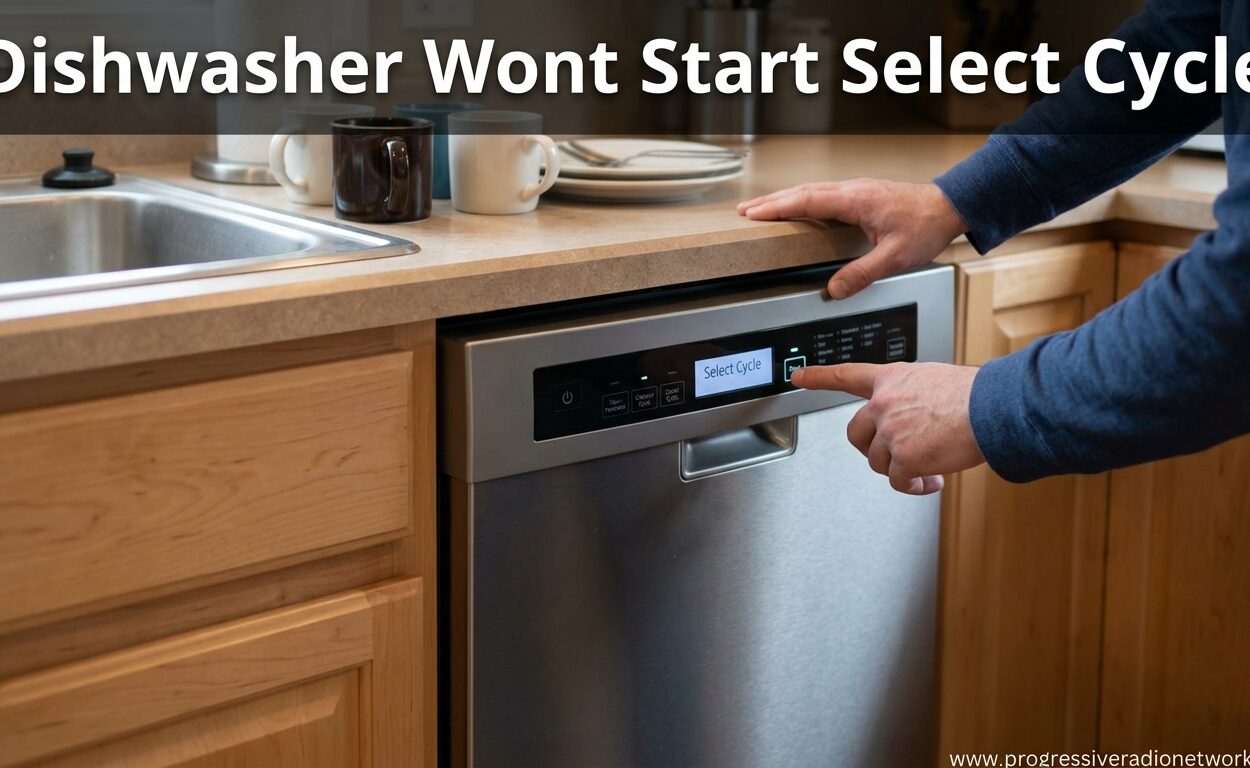
You press the start button on your dishwasher, select your preferred cycle, and… nothing happens. The lights are on, the buttons beep when you press them, but the wash cycle simply won’t begin. This frustrating problem is more common than you might think, and I’ve helped dozens of homeowners diagnose and fix this exact issue over the years.
When your dishwasher won’t start a cycle but has power, it usually points to a specific set of culprits. The good news is that most of these issues are either simple fixes you can handle yourself or problems that are straightforward to explain to a repair technician. Let me walk you through exactly what’s happening and how to get your dishwasher running again.
Understanding Why Your Dishwasher Wont Start Select Cycle
The core issue when your dishwasher accepts cycle selection but won’t start is almost always a safety mechanism preventing operation. Dishwashers are designed with multiple fail-safes that stop the unit from running if certain conditions aren’t met. The most common culprit is the door latch switch, a small component that tells the control board the door is securely closed.
When you close your dishwasher door, the latch assembly should press a tiny switch called a microswitch. This switch completes a circuit that tells the dishwasher it’s safe to begin the wash cycle. If this switch is faulty, misaligned, or not being properly engaged by the door, your dishwasher will accept your cycle selection but refuse to start. The control board essentially thinks the door is open, even when it appears closed to you.
Other common causes include activated control locks, sleep modes, or issues with the control board itself. I’ve seen cases where the control board has failed, though this is less common than door latch issues. The key is to work through these possibilities systematically, starting with the simplest and most likely causes.
Quick Checks Before Troubleshooting
Before diving into component testing, let’s eliminate some simple issues that could explain why your dishwasher won’t start. These are the problems I always check first when someone tells me their dishwasher select cycle works but won’t start.
Control Lock Activation: Many modern dishwashers have a control lock feature, often indicated by a small padlock icon on the display panel. This safety feature prevents accidental button presses, especially helpful if you have children. When engaged, the control lock allows you to select cycles but blocks the start button from functioning. Check your user manual for the specific combination to unlock your model – usually pressing and holding a specific button for 3-5 seconds.
Sleep Mode: Some dishwasher models enter a sleep or standby mode after a period of inactivity or during certain hours to save energy. In this mode, the control panel may be partially responsive – allowing cycle selection – but won’t initiate the wash cycle. Look for a sleep indicator light or try pressing any button to wake the unit before attempting to start your cycle.
Delay Wash Setting: If you or someone in your household accidentally activated the delay wash feature, your dishwasher won’t start immediately. Instead, it will wait for the specified time (usually 2, 4, or 8 hours) before beginning the cycle. Check your display panel for a delay indicator or hours countdown. Canceling the delay wash varies by model – consult your manual for the specific procedure.
Dishwasher Wont Start Select Cycle: Door Latch Switch Inspection
The door latch switch is the most common reason I see for dishwashers that won’t start despite having power. In my experience troubleshooting hundreds of dishwasher issues, a faulty or misaligned door latch accounts for about 70% of cases where the unit accepts cycle selection but won’t begin washing.
The door latch assembly is located inside the door, typically on the top edge. When you close the door, the latch should catch and activate the microswitch. Over time, this switch can fail, the latch can become misaligned, or debris can build up and prevent proper engagement. I’ve also seen cases where the plastic latch mechanism has cracked or warped, preventing it from pressing the switch firmly enough.
Visual Inspection: Open your dishwasher door and examine the latch mechanism on the door and the catch area on the tub. Look for visible damage, cracks, or debris buildup. Try manually pressing the latch with your finger – you should feel and hear it click into place. If it feels loose or doesn’t click, this could explain why your dishwasher won’t start.
Door Alignment: Sometimes the issue is as simple as the door being slightly misaligned. Check that the door closes evenly and latches firmly without extra pressure. If your dishwasher has adjustable door hinges, try making small adjustments to ensure the door closes squarely against the tub opening.
Testing with a Multimeter: For a definitive test of the door latch switch, you’ll need a multimeter. First, disconnect your dishwasher from power by either unplugging it or turning off the circuit breaker. Access the switch by removing the inner door panel – usually held by screws along the door’s perimeter. Disconnect the wires from the switch and set your multimeter to continuity mode. Touch the probes to the switch terminals and manually activate the latch. You should see the multimeter show continuity when the latch is engaged and no continuity when released. If the switch doesn’t show this change, it’s faulty and needs replacement.
How to Reset Dishwasher That Won’t Start
Sometimes a simple reset is all it takes to resolve issues where your dishwasher won’t start a cycle. Electronic controls can occasionally experience glitches or memory errors that prevent normal operation. A reset clears the control board’s memory and can restore proper function.
Soft Reset: The simplest reset method is often called a soft reset. Simply turn off your dishwasher using the control panel or power button, wait 60 seconds, then turn it back on. This brief interruption allows the control board to fully power down and reset when restarted. After performing a soft reset, try selecting your cycle and pressing start again.
Hard Reset: For more persistent issues, a hard reset may be necessary. This involves completely cutting power to the unit for an extended period. Locate your dishwasher’s circuit breaker in your home’s electrical panel and flip it to the off position, or unplug the unit if it uses a standard plug. Leave the power disconnected for at least 5 minutes – I recommend 10 to be thorough. This extended power outage ensures all capacitors fully discharge and the control board’s memory is completely cleared.
After restoring power, wait another 60 seconds before attempting to operate the dishwasher. You may need to reset your clock and other settings depending on your model. Try running a cycle to see if the hard reset resolved the issue.
Control Board and Touchpad Diagnosis
If you’ve checked the door latch, performed resets, and your dishwasher still won’t start, the issue may lie with the control board or touchpad. These electronic components control all dishwasher functions, and when they fail, you can experience the exact symptoms you’re facing.
Control Board Failure: The electronic control board is essentially your dishwasher’s brain. It receives signals from buttons and sensors and activates components accordingly. When the control board fails partially, it may still illuminate lights and respond to some button presses while being unable to initiate the wash cycle. I’ve seen this happen when specific relays or circuits on the board burn out while others continue functioning.
Touchpad Issues: The touchpad or membrane switch panel on your dishwasher’s door can also cause problems. Over time, moisture, heat, and repeated pressing can cause the electrical contacts to degrade. If your start button specifically has failed while other buttons work, this would explain why you can select cycles but can’t start the unit.
Ribbon Cable Connections: The touchpad connects to the control board via a ribbon cable – a flat, wide cable with many conductors. I’ve found cases where this cable has become loose, corroded, or damaged where it plugs into the control board. Inspecting and reseating this connection sometimes resolves communication issues between the touchpad and control board.
Entering Diagnostic Mode: Many dishwasher models have a diagnostic mode that can help identify specific failures. The procedure varies by brand, but typically involves pressing a specific sequence of buttons within a certain timeframe after powering on the unit. Consult your owner’s manual or search online for your specific model’s diagnostic mode entry procedure. Once in diagnostic mode, the dishwasher may display error codes or run specific tests that can pinpoint the problem.
Water Supply and Power Verification
While less likely to cause the specific symptom of accepting cycle selection without starting, it’s worth verifying your dishwasher’s basic utilities. These checks rule out fundamental supply issues that could prevent operation.
Water Supply Valve: Your dishwasher requires adequate water pressure to operate. Most units are connected to your home’s hot water supply under the kitchen sink via a flexible supply line and shutoff valve. Ensure this valve is fully open – I’ve found it accidentally closed in cases where homeowners were working under their sink. Also check that the supply line isn’t kinked or crushed, which would restrict water flow.
Circuit Breaker: Even though your dishwasher has power (lights work), it’s worth checking that the circuit breaker hasn’t partially tripped. Some breakers can trip to a middle position that supplies reduced power. Flip the breaker fully off, then back on to ensure it’s properly reset. Dishwashers typically require a dedicated 15 or 20 amp circuit.
Ground Fault Circuit Interrupter: If your dishwasher is plugged into a GFCI outlet, check that the outlet hasn’t tripped. GFCI outlets can sometimes trip without the reset button popping out visibly. Press the reset button on the outlet to ensure it’s properly engaged. Note that dishwashers should ideally be on a dedicated circuit, not sharing an outlet with other appliances.
Brand-Specific Reset Sequences
Different dishwasher manufacturers use varying reset procedures. Here’s a quick reference for the major brands when your dishwasher won’t start a cycle:
Whirlpool: Press and hold the “Heated Dry” button for 3 seconds, wait 3 minutes, then press “Cancel/Drain”. Alternatively, unplug the unit for 10 minutes.
GE: Press the “Start/Reset” button for 10 seconds. You should hear the unit drain. Wait 2 minutes, then try starting again. Some models require turning off the breaker for 5 minutes.
Bosch: Press and hold the “Start/Reset” and “Cancel Drain” buttons simultaneously for 3 seconds. For some models, simply close the door and press the start button twice within 3 seconds.
KitchenAid: Press “Cancel/Drain” then open the door. Close the door and press “Cancel/Drain” again while holding the “Energy Saver Dry” button for 5 seconds.
Maytag: Turn off the circuit breaker for 1 minute, then restore power. Some models require pressing the “Normal” and “Heated Dry” buttons sequentially 3 times.
Kenmore: Unplug for 5 minutes or turn off the breaker. For models with a control lock, press and hold the “Heated Dry” button for 3 seconds to unlock.
When to Call a Professional
If you’ve worked through all the troubleshooting steps and your dishwasher still won’t start, it may be time to call a professional appliance repair technician. Some repairs require specialized tools and knowledge that go beyond DIY troubleshooting.
When the control board has failed, replacement is often the only solution. Control board replacement typically costs between $200 and $500 including parts and labor, depending on your dishwasher model and your location. I recommend getting quotes from 2-3 technicians before proceeding, as prices can vary significantly.
Door latch assembly replacement is more affordable, usually costing between $100 and $250 for professional service. If you’re comfortable with basic tools and accessing components inside the door, this is a repair many homeowners can tackle themselves for the cost of the part – typically $30 to $80 depending on your model.
Consider your dishwasher’s age when deciding whether to repair or replace. The average dishwasher lasts about 10 years. If your unit is approaching or past this age and facing an expensive repair like a control board, replacement might be more cost-effective in the long run, especially if you can find a good deal on a new, energy-efficient model.
FAQ
Why won’t my dishwasher start a cycle?
The most common reason a dishwasher won’t start a cycle is a faulty door latch switch. This small switch tells the control board the door is securely closed. If it fails or the door doesn’t properly engage it, the dishwasher won’t start despite accepting cycle selections. Other causes include control lock activation, sleep mode, delay wash settings, or control board failure.
How to reset a dishwasher that won’t start?
To reset your dishwasher, first try a soft reset by turning it off and waiting 60 seconds. If that doesn’t work, perform a hard reset by turning off the circuit breaker or unplugging the unit for 5-10 minutes. This allows the control board to fully power down and clear its memory. After restoring power, wait another minute before attempting to start a cycle.
How to tell if a dishwasher control board is bad?
Signs of a bad control board include partial functionality where some buttons work but others don’t, the unit accepts cycle selection but won’t start, unresponsive buttons despite power, or erratic behavior like cycles starting on their own. Diagnostic mode can help identify control board issues, or testing voltage outputs with a multimeter while the unit attempts to run.
What is the lifespan of an average dishwasher?
The average dishwasher lasts approximately 10 years with proper maintenance. Factors affecting lifespan include water quality, usage frequency, and whether you perform regular maintenance like cleaning filters and spray arms. Higher-end models often last longer than budget units due to better construction quality and components.
How to reset Hisense dishwasher?
To reset a Hisense dishwasher, press and hold the Power button for 5 seconds until the display turns off. Wait 60 seconds, then press Power again to restart. For persistent issues, turn off the circuit breaker for 5 minutes. Some Hisense models also require pressing the Start/Reset button for 10 seconds while the door is closed.
How to reset Amana dishwasher?
Amana dishwashers can be reset by pressing the Start/Reset button and holding it for 3-5 seconds. The unit should drain and beep to confirm the reset. For models without a dedicated reset button, turn off the circuit breaker for 5 minutes. After restoring power, open and close the door firmly before attempting to start a new cycle.
How to hard reset a dishwasher?
A hard reset involves completely cutting power to the dishwasher for an extended period. Turn off the circuit breaker or unplug the unit for 5-10 minutes. This ensures all capacitors discharge and the control board’s memory is fully cleared. Unlike a soft reset, a hard reset should resolve more persistent electronic glitches and memory errors.
Why does my dishwasher start button blink but won’t start?
A blinking start button typically indicates the dishwasher is waiting for a condition to be met before starting. Common causes include the door not being fully closed and latched, control lock being engaged, delay wash being activated, or the unit pausing while filling with water. Check that the door clicks shut, disable control lock, cancel delay wash, and ensure water supply is fully open.
Conclusion
When your dishwasher won’t start a cycle but has power, it’s frustrating but usually solvable. Start with the simple checks – control lock, sleep mode, delay wash – then move on to inspecting the door latch switch, which is the most common culprit. Reset procedures can resolve electronic glitches, while component testing helps identify more serious issues like control board failure.
Most of the time, you’ll find that the issue is either a simple setting you can adjust yourself or a component like the door latch switch that can be replaced relatively affordably. Only when the control board has failed should you expect a more expensive repair bill. By working through these steps systematically, you can either resolve the issue yourself or provide clear information to a repair technician that will help them diagnose the problem faster.
Remember to always prioritize safety when troubleshooting appliances. Disconnect power before accessing internal components, and don’t hesitate to call a professional if you’re uncomfortable with any step. Your dishwasher is a complex appliance, and knowing when to seek expert help is just as important as knowing how to troubleshoot basic issues.



Leave a Comment