
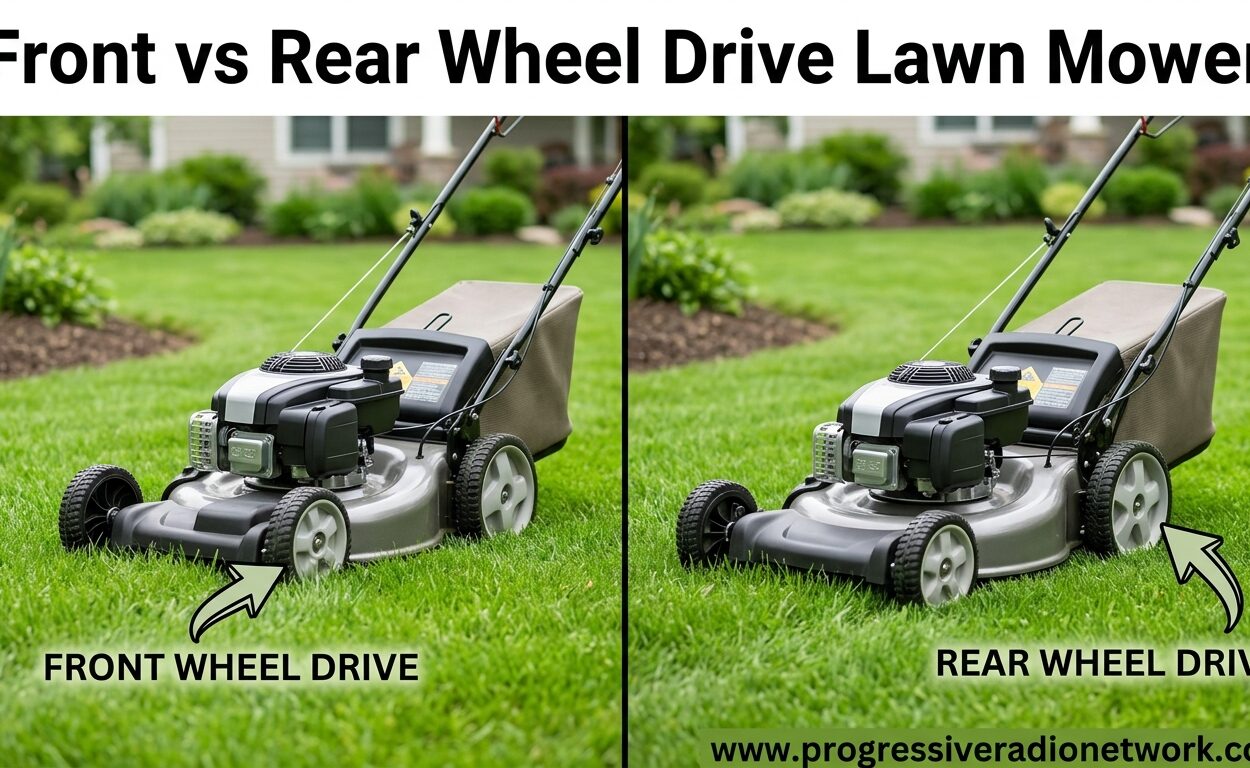
Choosing between front vs rear wheel drive lawn mower configurations can make or break your mowing experience. The drive system you select affects how easily your mower handles hills, navigates obstacles, and maintains traction when bagging heavy grass clippings. After testing both systems extensively and analyzing real user experiences, I’ll break down exactly which drive type fits your lawn.
The difference comes down to physics. Front-wheel drive (FWD) mowers pull themselves forward, while rear-wheel drive (RWD) mowers push from behind. This mechanical distinction creates completely different handling characteristics that matter more than most buyers realize.
How Self-Propelled Drive Systems Work
Self-propelled lawn mowers use a transmission system to transfer engine power to the wheels, eliminating the need to push. A belt-and-pulley system connects the engine to either the front axle (FWD) or rear axle (RWD), engaging when you squeeze the drive bail on the handle.
FWD systems power the front wheels to pull the mower forward. RWD systems transfer power through a driveshaft or chain to the rear wheels, pushing the mower from behind. The difference in power delivery creates distinct advantages depending on your terrain.
Front Wheel Drive Lawn Mowers: Best For Flat Terrain
Front-wheel drive mowers excel on flat, open lawns with minimal slope. The front wheels pull the mower forward, making it easier to maneuver around obstacles like trees, flower beds, and garden decorations.
What Makes FWD Different
Front-wheel drive systems deliver power to the front wheels through a simple belt-and-pulley mechanism. This design reduces weight at the front of the mower and creates a natural pivot point when you lift the handle slightly. The front wheels lose contact with the ground, disengaging the drive and allowing effortless turning.
FWD Advantages
Enhanced maneuverability tops the list of FWD benefits. You can pivot sharply around obstacles without disengaging the drive system. Simply lift the handle slightly to raise the front wheels, turn, and drop the wheels back down.
FWD mowers typically cost less than their RWD counterparts. The simpler transmission design reduces manufacturing costs and makes repairs more affordable.
On flat terrain, FWD provides adequate traction for most mowing conditions. The pulling action works well when the grass bag is empty and weight is evenly distributed.
FWD Disadvantages
Traction loss on hills is the biggest drawback. As you mow uphill, weight shifts to the rear wheels, reducing front-wheel grip. Your FWD mower may spin out or bog down on slopes steeper than 10 degrees.
Bagging performance suffers as the grass bag fills. A full bag transfers weight to the rear wheels, reducing traction exactly when you need it most. This physics problem makes FWD mowers struggle during heavy bagging sessions.
Best For: Flat Lawns (0-10 degree slopes)
- Small to medium yards with minimal elevation change
- Lawns with numerous obstacles requiring frequent turns
- Side-discharge mowing (no bag weight issues)
- Budget-conscious buyers
- Users who prioritize easy turning over hill performance
Rear Wheel Drive Lawn Mowers: Best For Hills
Rear-wheel drive mowers dominate on sloped terrain and challenging conditions. The rear wheels push the mower forward, maintaining traction even when climbing steep inclines or navigating uneven ground.
What Makes RWD Different
Rear-wheel drive systems transfer power through a more complex transmission to the rear axle. This design places the drive wheels directly under the heaviest part of the mower—the engine and operator’s hands on the handle. The weight distribution creates superior traction in demanding conditions.
RWD Advantages
Hill performance sets RWD mowers apart. The rear wheels maintain excellent traction on slopes up to 20 degrees because weight naturally shifts rearward when climbing. This physics advantage prevents the bogging-down issues common with FWD mowers on hills.
Bagging capability improves significantly with RWD. As the grass bag fills, additional weight presses down on the rear wheels, actually increasing traction. You won’t experience the traction loss that plagues FWD mowers during heavy bagging.
RWD handles wet grass and thick growth better than FWD. The pushing action from the rear wheels maintains grip even in challenging mowing conditions where front wheels might spin.
Professional-grade mowers almost universally use RWD for a reason. Commercial landscapers need reliable performance on varied terrain, and rear-wheel drive delivers consistent results job after job.
RWD Disadvantages
Reduced maneuverability in tight spaces is the primary tradeoff. RWD mowers don’t pivot as easily around obstacles because the drive wheels stay engaged. Sharp turns require disengaging the drive bail or using the handle adjustment to lift the front wheels.
RWD can tear up soft lawns during aggressive turns. The powered rear wheels may dig into soft turf when you pivot quickly, especially on wet ground.
Higher cost reflects the more complex transmission system. RWD mowers typically cost 15-25% more than comparable FWD models, and repairs can be more expensive.
Best For: Hilly Terrain (10-20 degree slopes)
- Lawns with significant elevation change
- Properties with uneven ground or rough terrain
- Frequent bagging use
- Wet climates or thick grass growth
- Users prioritizing traction over maneuverability
Front vs Rear Wheel Drive Lawn Mower: Terrain Comparison
Understanding how each drive system performs on different terrain types helps you make the right choice for your specific lawn conditions.
Flat Terrain (0-10 degree slopes)
FWD mowers handle flat lawns exceptionally well. The pulling action provides sufficient traction, and the easy turning makes navigating around obstacles effortless. If your yard is mostly level with minimal hills, FWD offers better value without sacrificing performance.
RWD works fine on flat terrain but doesn’t provide significant advantages. You’ll pay more for capabilities you may not need unless you bag frequently or encounter wet grass regularly.
Moderate Slopes (10-15 degree slopes)
This is where the decision becomes more nuanced. FWD mowers begin struggling as slopes approach 10 degrees. Weight shifts rearward, reducing front-wheel traction and potentially causing the mower to bog down.
RWD mowers maintain solid traction in this range. The rear-wheel drive actually benefits from weight transfer to the drive wheels, providing consistent climbing power. If your lawn has moderate slopes, RWD prevents frustration and fatigue.
Steep Slopes (15-20+ degree slopes)
RWD is clearly superior for steep terrain. FWD mowers become nearly unusable on slopes above 15 degrees as front wheels lose grip completely. The mower may slip backward or fail to climb, creating safety concerns.
RWD handles steep slopes up to 20 degrees effectively. However, consider safety first—slopes steeper than 20 degrees may require specialized equipment or professional mowing services regardless of drive type.
Uneven Ground and Rough Terrain
Bumpy lawns favor RWD. The rear-wheel drive maintains better contact with the ground over bumps and dips, providing consistent power delivery. FWD mowers may bounce and lose traction on uneven surfaces.
Wet Grass Conditions
RWD outperforms FWD in wet conditions. The pushing action maintains grip better than pulling when grass is slick with morning dew or rain. FWD front wheels are more prone to spinning on wet grass, especially on any slope.
Bagging Performance: FWD vs RWD
Grass collection significantly impacts drive system performance. The physics of weight distribution creates a clear winner for bagging applications.
As your grass bag fills, weight transfers to the rear of the mower. On an FWD model, this reduces traction on the drive wheels exactly when you need it most. You may notice the mower struggling to maintain speed as the bag approaches capacity.
RWD mowers benefit from bag weight. The additional load presses down on the rear drive wheels, increasing grip and power delivery. This makes RWD the superior choice if you regularly bag clippings, especially in tall or wet grass.
Reddit users frequently mention this difference. One commenter noted: “FWD boggs down when doing heavy bagging” because “the weight shifts off the front wheels” when using a bagger on hills.
Cost and Maintenance Considerations
Price differences between drive systems reflect their mechanical complexity. FWD mowers typically cost 15-25% less than comparable RWD models due to simpler transmission design.
Repair costs follow the same pattern. FWD systems use fewer components and straightforward belt drives that most DIYers can service. RWD transmissions involve more complex mechanisms that may require professional repair.
However, consider long-term value based on your terrain. An RWD mower that handles your hills without frustration may last longer and provide better service life than a cheaper FWD model that struggles and wears out prematurely.
Electric mower buyers should also consider battery weight. Heavy batteries in rear-mounted electric models further enhance RWD traction, making rear-wheel drive especially advantageous for battery-powered mowers.
Which Drive Type Should You Choose?
Select your drive system based on lawn characteristics rather than marketing claims. Assess your terrain honestly before making a decision.
Choose FWD if your lawn is mostly flat with minimal slopes under 10 degrees. You’ll save money and enjoy easier maneuverability around obstacles. FWD works perfectly for side-discharge mowing on level ground.
Choose RWD if your lawn has hills, uneven terrain, or you bag frequently. The superior traction prevents frustration and fatigue on slopes. RWD handles wet grass and thick growth better, making it more versatile across varied conditions.
One Reddit user captured the practical difference well: “RWD is better than FWD, and AWD is better than both. With FWD and going up hills, especially if you’re using a bagger, the weight shifts off the front wheels.”
AWD: The Premium Alternative
All-wheel drive mowers represent the ultimate in traction capability. By powering all four wheels, AWD systems combine the easy turning of FWD with the hill-climbing ability of RWD. However, AWD mowers cost significantly more and may be overkill for most residential lawns.
Consider AWD if you have steep slopes (15-20+ degrees), frequently mow wet grass, or want the most versatile option regardless of cost. For typical residential lawns, choosing between FWD and RWD based on your specific terrain provides the best value.
Which is better front or rear self-propelled lawn mower?
Front-wheel drive is better for flat terrain with lots of obstacles due to easier maneuverability and lower cost. Rear-wheel drive is better for hilly terrain, uneven ground, and frequent bagging because it maintains superior traction when weight shifts to the rear wheels.
Is FWD or RWD better for lawn mower?
RWD is generally better overall because it handles hills, wet grass, and bagging more effectively. However, FWD is perfectly adequate and more economical for flat lawns under 10 degrees where easy turning matters more than climbing power.
What are the disadvantages of front wheel drive mowers?
FWD mowers lose traction on hills as weight shifts off the drive wheels. They also struggle when bagging because a full grass bag reduces front-wheel grip exactly when you need it most. FWD performs poorly on slopes steeper than 10 degrees and in wet grass conditions.
Are rear wheel drive mowers harder to turn?
Yes, RWD mowers require more effort to turn because the drive wheels stay engaged. To pivot sharply, you must either disengage the drive bail or lift the front wheels using the handle adjustment. RWD can also tear up soft lawns during aggressive turns.
Are AWD lawn mowers worth it?
AWD mowers are worth it only if you have steep slopes (15-20+ degrees), frequently mow wet grass, or want maximum traction regardless of cost. For most residential lawns, choosing between FWD for flat terrain or RWD for hills provides better value than paying extra for AWD capabilities you may not need.
Final Thoughts on Front vs Rear Wheel Drive Lawn Mower Selection
The front vs rear wheel drive lawn mower decision ultimately depends on your specific lawn conditions. Assess your terrain honestly, consider how often you bag clippings, and choose the drive system that matches your needs rather than automatically selecting the more expensive option.
For flat lawns, FWD saves money and turns easier. For hills and challenging conditions, RWD provides the traction needed to get the job done without frustration. Either way, understanding these differences helps you make an informed decision that will serve you well for years to come.
If you’re looking for electric lawn mower deals, be sure to check whether the models use front or rear wheel drive—especially important for battery-powered mowers where heavy battery placement further affects traction dynamics.






Leave a Comment