
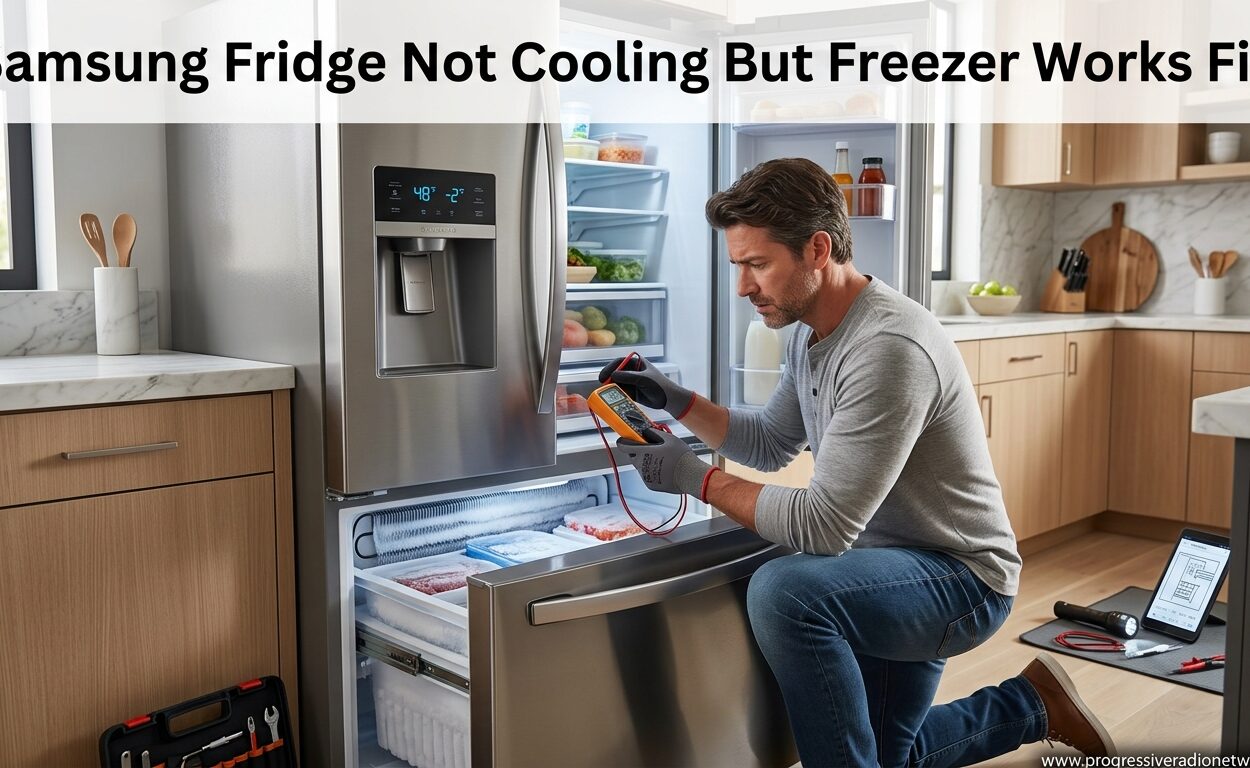
I’ve been there – you open your Samsung refrigerator expecting a cold drink, but instead find warm milk and spoiled food. Meanwhile, the freezer is working perfectly. This frustrating problem is actually one of the most common issues Samsung refrigerator owners face, and I’m going to walk you through exactly how to diagnose and fix it.
Samsung fridge not cooling freezer works is typically caused by an issue in the fresh food section’s cooling system rather than a complete system failure. The good news is that most of these problems are fixable, and many don’t require a professional technician. I’ve researched countless repair forums and spoken with appliance repair professionals to compile this comprehensive troubleshooting guide.
Quick Diagnosis Checklist
Before diving into complex repairs, let’s rule out the simple fixes that often resolve Samsung refrigerator cooling issues:
Step 1: Check your temperature settings. Make sure the fridge compartment is set to 37°F (3°C) and the freezer to 0°F (-18°C). Sometimes settings get accidentally changed.
Step 2: Verify the refrigerator is in cooling mode, not demo mode. Look for “OF OF” or “DEMO” on the display – this means cooling is disabled.
Step 3: Inspect the door seals. Close the door on a dollar bill and pull it out. If it slides out easily, your gasket needs replacement.
Step 4: Check for blocked air vents. Make sure food items aren’t pushed against the back wall where air circulation occurs.
Step 5: Listen for the evaporator fan. Open the door and press the door switch – you should hear a fan running in the back of the fridge compartment.
Samsung Fridge Not Cooling Freezer Works
Understanding why your Samsung fridge not cooling but freezer works requires knowing how Samsung’s cooling system operates. Most modern Samsung refrigerators use what they call “Twin Cooling” – a dual evaporator system that separately controls temperature in the freezer and fresh food compartments.
This means your refrigerator essentially has two independent cooling systems sharing one compressor. When the freezer works but the fridge doesn’t, the compressor is running fine, but something is preventing cold air from reaching or staying in the fresh food section.
The most common culprits are ice buildup blocking airflow, a failed evaporator fan in the fridge section, a faulty damper control that regulates airflow, or a malfunctioning temperature sensor. I’ll walk you through each of these issues in detail, starting with the most frequent cause.
Ice Buildup and Defrost System Issues
Ice buildup on the evaporator coils is the number one cause of Samsung fridge not cooling freezer works problems. When frost forms on the coils in the freezer compartment’s evaporator, it blocks airflow to the fridge section. Since your Samsung Twin Cooling system relies on air circulation to cool the fresh food compartment, any blockage causes immediate cooling issues.
Signs of ice buildup include:
- Frost visible on the back wall of the freezer
- Reduced airflow from fridge vents
- Fridge temperature slowly rising over days
- Freezer still maintaining temperature
The defrost system consists of three main components: the defrost heater, defrost thermostat, and defrost timer or control board. When any of these fail, ice accumulates until it blocks airflow completely.
Samsung’s Drain Heater Clip Issue
Many Samsung refrigerator models have a known defect with the drain heater clip. The plastic clip holding the defrost drain heater can break, causing the heater to fall away from the drain tube. This leads to ice buildup in the drain, which then spreads to the evaporator coils.
This issue affects numerous Samsung models manufactured between 2014-2019. If you have one of these models and experience recurring ice buildup, this is likely your culprit. The fix involves installing a redesigned metal clip replacement.
Forced Defrost Procedure
If you suspect ice buildup, you can force a defrost cycle on most Samsung models without waiting for the automatic cycle. This temporary fix often restores cooling for several days:
For most models: Press and hold the “Energy Saver” and “Power Freeze” buttons simultaneously for 8-10 seconds until you hear a chime. The display will show “Fd” indicating forced defrost mode.
For models with touch display: Press “Freezer” and “Lighting” buttons simultaneously for 8 seconds. Some models use “Power Freeze” and “Power Cool” together.
The forced defrost cycle runs for about 20-30 minutes. You’ll hear the compressor shut off and the defrost heater activate. After the cycle completes, check if cold air starts flowing from the fridge vents again. If cooling returns, you’ve confirmed a defrost system issue that needs permanent repair.
Evaporator Fan Failure
The evaporator fan is responsible for circulating cold air from the freezer into the fresh food compartment. When this fan fails in Samsung Twin Cooling models, the freezer continues cooling normally while the fridge section warms up because no air is being pushed through the damper.
Symptoms of evaporator fan failure:
- No fan noise when pressing the door switch
- Freezer works fine, fridge is warm
- Louder than normal compressor noise
- Intermittent cooling before complete failure
Testing the fan is straightforward. Open the refrigerator door and locate the door switch on the top frame. Press it in with your finger while listening for fan noise from the top rear of the compartment. No sound means the fan isn’t running.
The fan motor could be failed, or there could be ice buildup physically blocking the fan blades. Some users report that simply defrosting the freezer for 24-48 hours with the doors open resolves the issue, indicating ice was the problem rather than a failed motor.
If the fan itself has failed, replacement involves removing the interior rear panel in the freezer section to access the evaporator fan assembly. The part typically costs $50-100, and DIY replacement is feasible for those comfortable with basic appliance repair.
Damper Control Problems
The damper control is essentially a door that regulates how much cold air flows from the freezer into the fresh food compartment. In Samsung Twin Cooling models, this electronically controlled damper opens and closes based on temperature settings and sensor readings.
When the damper fails closed, no cold air reaches the fridge compartment. The freezer continues working perfectly because it has its own evaporator and independent air circulation.
Damper failure symptoms:
- Freezer at correct temperature
- Fridge significantly warmer regardless of settings
- No air flow from fridge vents even when compressor running
- Damper makes clicking or grinding noises
Testing the damper requires accessing it from inside the fridge compartment. On most Samsung models, it’s located behind the temperature control panel at the top rear. With the refrigerator running, observe whether the damper door opens and closes. A stuck damper won’t move at all.
Damper replacements cost approximately $80-150 for the part. The repair involves removing the fridge interior panels and control housing, making it a moderately difficult DIY project. Many users report that damper issues often coincide with control board problems in Samsung refrigerators.
Thermistor and Temperature Sensor Issues
Samsung refrigerators use thermistors – temperature-sensitive resistors – to monitor temperatures in both compartments. These sensors send readings to the main control board, which then operates the compressor, fans, and damper to maintain set temperatures.
A faulty fridge thermistor can send incorrect temperature readings, causing the control board to reduce cooling to the fresh food compartment. Meanwhile, the freezer thermistor works correctly, so that compartment continues cooling normally.
Thermistor failure signs:
- Temperature display doesn’t match actual temperature
- Fridge runs too warm or too cold regardless of settings
- Erratic temperature fluctuations
- Control board error codes related to sensors
Testing a thermistor requires a multimeter to measure resistance at different temperatures. A working thermistor should show approximately 5,000-10,000 ohms at room temperature (70°F). The resistance should decrease as temperature increases and increase as temperature decreases.
Out-of-spec resistance readings confirm a bad thermistor. Replacement thermistors cost $20-40 and are relatively easy to install – they’re typically plug-and-play components located near the evaporator coils.
Door Seal and Gasket Problems
While less common than the issues above, damaged door seals can cause cooling problems specifically in the fridge compartment. When the door gasket doesn’t seal properly, warm air continuously enters the fresh food section while cold air escapes.
This creates a constant cooling load that the system can’t overcome, even though the freezer maintains temperature because its door seals are usually intact.
Testing door seals:
Place a dollar bill between the door and frame, then close the door. Try to pull the bill out. Proper tension should create resistance. Repeat this test around the entire door perimeter. Any area where the bill slides out easily indicates a seal problem.
Visual inspection should reveal cracks, tears, or deformation in the rubber gasket. Clean the seals with warm soapy water first – sometimes buildup prevents proper sealing. If cleaning doesn’t help, replacement gaskets cost $50-100 and are simple to install.
Control Board and Electronic Issues
Samsung refrigerators rely on sophisticated electronic control boards to coordinate all cooling functions. When the main board or inverter board fails, it can cause selective cooling issues where one compartment works while another doesn’t.
Control board issues often manifest alongside other symptoms like display problems, unusual error codes, or complete system failures. However, some board failures cause specific component failures – like the damper control or fan operation – while leaving the freezer functional.
Control board failure indicators:
- Unresponsive touch panel or display
- Error codes on display
- Compressor not running but fans work
- Multiple components failing simultaneously
Diagnosing control board issues requires checking for proper voltage output to components like the evaporator fan, damper motor, and compressor. If the board isn’t sending power to specific components but receives input voltage, the board itself has failed.
Control board replacements are expensive ($200-400 for the part) and complex to install. This is typically a repair best left to professionals, especially since modern Samsung refrigerators often require programming after board replacement.
When to Call a Professional
While many Samsung fridge not cooling issues are DIY-repairable, some situations require professional expertise. Here’s when I recommend calling a qualified appliance repair technician:
Compressor problems: If the compressor itself is failing, this is a sealed system repair requiring specialized tools and EPA certification. Compressor replacement costs $400-800 including labor.
Refrigerant leaks: Low refrigerant charge causes cooling issues and requires leak detection, repair, and recharging – definitely not a DIY job.
Control board replacement: Beyond the cost, modern Samsung boards often require programming after installation that only authorized technicians can perform.
Complex disassembly: If accessing failed components requires removing multiple panels, refrigerant lines, or electrical connections beyond your comfort level, professional help prevents bigger problems.
Professional Samsung refrigerator repair typically costs $150-300 for labor plus parts. Most technicians charge a diagnostic fee of $50-100 that’s often applied to the repair cost if you proceed with their service.
Preventive Maintenance Tips
After repairing your Samsung refrigerator, these maintenance practices help prevent future cooling issues:
Clean condenser coils annually – dust buildup reduces efficiency and stresses components. Unplug the refrigerator and vacuum the coils accessible from the back or behind the kick plate.
Check door seals monthly – catch seal problems before they cause cooling issues. Clean them with mild soap and warm water to maintain flexibility.
Don’t overstuff the refrigerator – proper air circulation is essential for even cooling. Leave space between items and don’t block vents.
Monitor temperatures regularly – a simple fridge thermometer helps you spot cooling problems before food spoils. Normal fridge temperature is 35-38°F; freezer should be 0-5°F.
Address ice buildup promptly – if you notice frost forming, run a forced defrost cycle before it becomes a major blockage. Recurring ice buildup indicates a defrost system problem needing repair.
FAQ
Why is my Samsung refrigerator not cooling but the freezer is?
The most common cause is ice buildup on the evaporator coils blocking airflow to the fridge compartment. Other frequent culprits include a failed evaporator fan, faulty damper control, or malfunctioning temperature sensor. Samsung’s Twin Cooling system uses separate evaporators, so issues affecting only the fresh food section are common.
How do you reset a Samsung refrigerator that is not cooling?
Try a simple power reset first – unplug the refrigerator for 5 minutes, then plug it back in. For forced defrost to address ice buildup, press and hold Energy Saver and Power Freeze buttons simultaneously for 8-10 seconds until the display shows Fd. Some models use Freezer and Lighting buttons together instead. Always check that demo mode isn’t activated – look for OF OF on the display.
Why is my freezer working but fridge not cooling enough?
This typically indicates an airflow problem specific to the fresh food compartment. The evaporator fan in the freezer may have failed, preventing air circulation to the fridge. Alternatively, the damper control that regulates airflow between compartments could be stuck closed. Ice buildup on evaporator coils also blocks airflow to the fridge while leaving the freezer functional. Check that fridge vents aren’t blocked by food items.
How much does it cost to replace a compressor in a Samsung refrigerator?
Compressor replacement typically costs $400-800 for Samsung refrigerators, including parts and labor. The compressor part itself runs $200-350, with professional labor making up the remainder. This is a sealed system repair requiring EPA-certified technicians, so DIY isn’t feasible. Before committing to compressor replacement, have a technician verify the compressor is actually failed – control board or relay issues can mimic compressor symptoms at much lower repair costs.
Conclusion
Samsung fridge not cooling freezer works is a frustrating but usually solvable problem. Start with the simple checks – temperature settings, demo mode, door seals, and blocked vents. If those don’t resolve the issue, ice buildup on the evaporator coils is the most likely culprit, followed by evaporator fan failure or damper control problems.
Forced defrost mode often provides temporary relief from ice-related issues, giving you time to arrange proper repairs. Many of these fixes are DIY-friendly if you’re comfortable with basic appliance repair, but don’t hesitate to call a professional for compressor problems, refrigerant leaks, or complex control board issues.
Regular preventive maintenance helps avoid future cooling problems and extends your Samsung refrigerator’s lifespan. Address cooling issues promptly – waiting too long can lead to complete system failure or food spoilage that outweighs repair costs.



Leave a Comment