
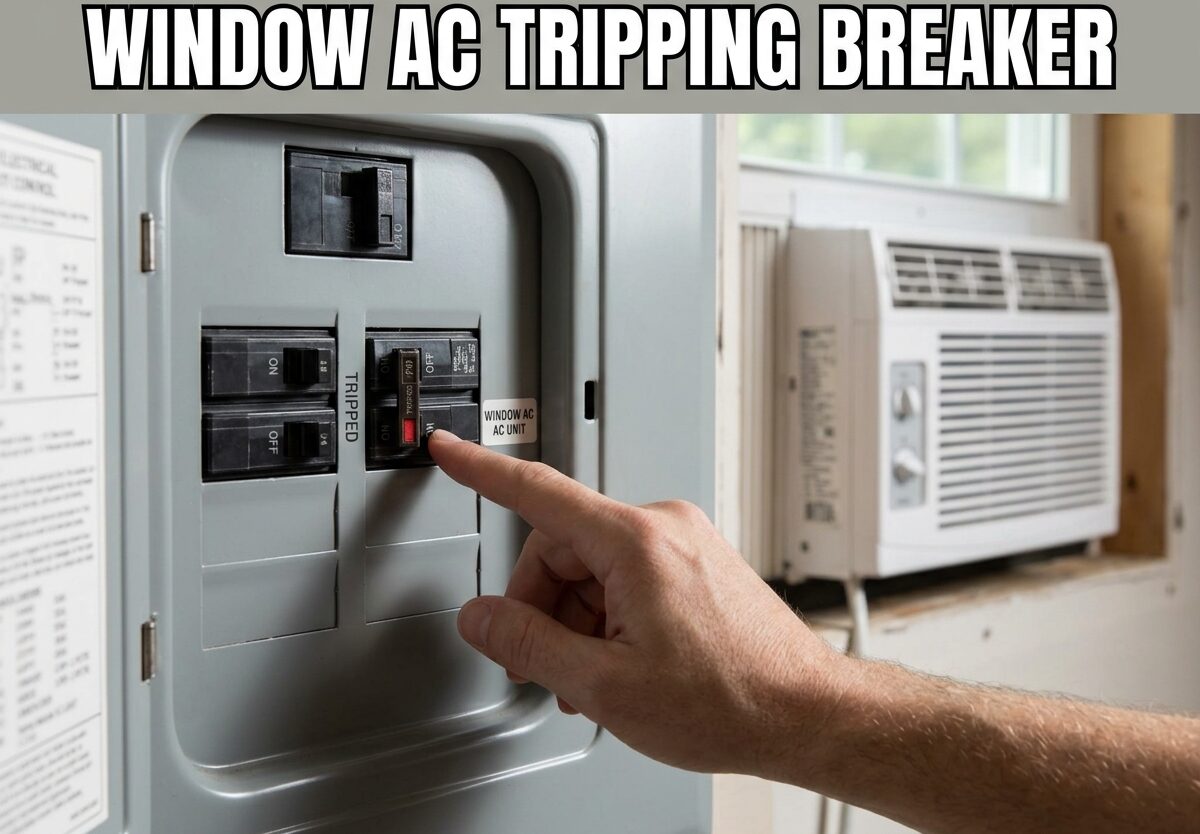
When your window AC unit suddenly stops cooling and you find yourself heading to the electrical panel yet again, you’re dealing with a frustrating but explainable problem. A window AC tripping breaker happens when the unit pulls more electrical current (amps) than your circuit breaker is rated to handle, causing the safety mechanism to shut off power. I’ve seen this issue hundreds of times, and in most cases, you can identify and fix the cause without calling a professional.
This guide will walk you through the six most common reasons why window AC units trip breakers, along with practical solutions for each problem. I’ll also explain when you should call an electrician or HVAC technician instead of attempting DIY repairs.
Safety Precautions Before Troubleshooting
Before you start investigating why your window AC keeps tripping the breaker, I need to share some critical safety warnings. Electrical work can be dangerous, and ignoring these precautions could result in injury or worse.
First, never reset a tripped breaker more than once without identifying the cause. Repeatedly forcing a breaker back on can lead to electrical fires, especially if there’s an underlying short circuit or ground fault. If your breaker trips immediately after resetting, stop and call an electrician.
Second, always unplug your window AC unit before performing any inspection or cleaning. Wait at least 5 minutes after unplugging to allow the capacitor to discharge. The capacitor stores electrical charge even when unplugged and can deliver a painful shock.
Third, if you smell burning or see any signs of melting around your outlet or plug, do not use the unit. These are red flags indicating a serious electrical problem that requires professional diagnosis.
6 Reasons Your Window AC Trips the Breaker
After troubleshooting dozens of window AC units over the years, I’ve found that breaker trips almost always trace back to one of these six causes. Let’s work through each one systematically.
Reason 1: Dirty Air Filter Restricted Airflow
A clogged air filter is the number one cause I see in the field, and it’s also the easiest problem to fix. When your filter becomes clogged with dust, pet hair, and debris, your window AC has to work harder to pull air through the system.
This extra effort causes the compressor to run longer and draw more amps than normal. On a hot day, this increased amp draw can exceed your breaker’s rating and trip the circuit. I’ve measured units pulling 2-3 extra amps when running with severely restricted filters.
The solution is simple: check your filter monthly during cooling season and clean or replace it as needed. Most window AC units have washable foam filters that can be rinsed with warm water and mild soap. Allow the filter to dry completely before reinstalling it.
Reason 2: Dirty Condenser Coils Cause High Pressure
While the air filter is inside your unit, the condenser coils are located on the exterior back panel. These coils release the heat that your AC removes from your room. When they become coated in dirt, pollen, cottonwood, or other outdoor debris, they can’t release heat efficiently.
This causes refrigerant pressure to build up in the system, putting extra strain on the compressor. Under high pressure, the compressor pulls significantly more amps and may trip your breaker, especially on hot afternoons.
Clean your condenser coils at least once per year using a garden hose. Spray from the inside out to push debris through the coils, then from the outside in to finish the job. Avoid using a pressure washer, as this can bend the delicate aluminum fins.
Reason 3: Overloaded Circuit Too Many Devices
This is one of the most common issues I encounter, especially in older homes with fewer circuits. Your window AC might be sharing a circuit with other appliances without you realizing it. Plug in a vacuum cleaner, turn on a TV, or start a computer while your AC is running, and you’ve suddenly exceeded the circuit’s capacity.
Most window AC units require a dedicated circuit, meaning no other devices should share that breaker. A typical 5,000 BTU unit draws around 4-5 amps, while larger 12,000 BTU units can draw 8-12 amps just running normally. Starting up requires even more power.
To test if this is your problem, turn off everything else on that circuit and see if the breaker still trips. If the AC runs fine alone, you need either a dedicated circuit installed or to relocate the unit to a different circuit.
Reason 4: Failing Start Capacitor
The start capacitor is a small cylindrical component that provides an extra burst of power to get your compressor running. When these fail (and they do fail eventually), the compressor struggles to start and pulls excessive current trying to get going.
You might notice your AC making a humming sound before the breaker trips, or the compressor might try to start multiple times before giving up. This is classic capacitor failure behavior. Capacitors typically last 5-10 years depending on usage and temperature conditions.
Replacing a start capacitor is a relatively easy DIY repair if you’re comfortable working with electricity. The part usually costs $15-30, and there are plenty of YouTube tutorials showing the process. Just remember to discharge the old capacitor before removing it and match the microfarad rating exactly when buying the replacement.
Reason 5: Compressor Ground Fault
This is the serious one. A compressor ground fault occurs when the electrical wiring inside the compressor breaks down and contacts the metal casing. This creates a direct short to ground, causing an immediate and massive current spike that trips your breaker instantly.
Signs of a grounded compressor include the breaker tripping the moment you turn on the AC (or within seconds), a burning smell, or visible damage to the compressor terminals. Once a compressor is grounded, there’s no repair option, only replacement.
Compressor replacement typically costs $600-1,200 including labor, which often exceeds the value of an older window AC unit. At this point, you’re usually better off replacing the entire unit unless it’s fairly new or a high-end model.
Reason 6: Worn or Faulty Circuit Breaker
Sometimes the problem isn’t your AC at all, it’s the breaker itself. Circuit breakers can wear out over time, especially if they’ve tripped repeatedly. A worn breaker may trip at lower amperage than its rating, or it may trip randomly even when the circuit is within capacity.
This is particularly common in homes with breakers that are 20+ years old. Heat, corrosion, and mechanical wear all contribute to breaker degradation. If your AC unit is properly sized for the circuit and you’ve ruled out other causes, have an electrician test your breaker.
Breaker replacement is inexpensive ($10-30 for the part) but should only be performed by a licensed electrician since it involves working inside your electrical panel with live power.
The 3-5 Minute Restart Rule
One mistake I see constantly is people immediately restarting their window AC after it trips the breaker. This is actually harmful to your compressor and can cause more frequent trips.
When your AC shuts off, pressure remains high in the refrigerant lines for several minutes. If you try to restart the compressor immediately, it’s fighting against this pressure and pulls 2-3 times the normal starting current. This often trips the breaker again and can permanently damage the compressor over time.
Always wait at least 3-5 minutes after your AC stops running before attempting to restart it. This gives the refrigerant pressures time to equalize, allowing the compressor to start normally. Many modern AC units actually have this protection built in with a time-delay relay, but older units rely on you to follow this rule manually.
Window AC Performance in Extreme Heat
Forum discussions are full of reports from people in desert climates whose window AC units work fine until outdoor temperatures exceed 105-110 degrees. At this point, even perfectly healthy units may trip breakers due to extreme operating conditions.
Here’s what happens: when outdoor temperatures climb this high, your compressor operates under tremendous stress trying to compress refrigerant against already-hot ambient conditions. The compressor can pull 15-20% more amps in 110 degree weather compared to 90 degree weather.
If you live in a desert climate and experience this issue, consider installing a slightly smaller unit than BTU calculators recommend. A smaller unit runs longer cycles at lower amp draw rather than short, high-amp bursts. Also ensure your condenser coils are exceptionally clean and provide shade for the back of the unit if possible.
BTU vs Circuit Capacity Guide
Matching your window AC’s cooling capacity to your electrical circuit is crucial for preventing breaker trips. Here’s a quick reference guide I use when sizing installations:
- 5,000 BTU units: Typically draw 4-5 amps. Will run on most 15 amp circuits with some capacity for other devices.
- 8,000 BTU units: Typically draw 6-7 amps. Should have a dedicated 15 amp circuit for reliable operation.
- 10,000 BTU units: Typically draw 8-9 amps. Require a dedicated 15 amp circuit minimum.
- 12,000 BTU units: Typically draw 10-12 amps. Ideally on a dedicated 20 amp circuit, or a dedicated 15 amp circuit with nothing else running.
- 14,000+ BTU units: Draw 12+ amps. Absolutely require a dedicated 20 amp circuit.
Never use extension cords with window AC units. They cause voltage drop, which increases amp draw and creates a fire hazard. If you must use an extension cord temporarily, ensure it’s a short (under 10 feet), heavy-gauge cord (12 AWG minimum) rated for the amperage of your AC unit.
When to Call a Professional
While many causes of window AC breaker trips are DIY-friendly, some situations require professional expertise. Call a licensed HVAC technician or electrician if:
- Your breaker trips immediately when you turn on the AC (indicates possible short circuit)
- You smell burning or see melting around the outlet or plug
- The compressor is grounded (confirmed with multimeter testing)
- Your home needs a new dedicated circuit installed
- You’ve ruled out all simple causes and the problem persists
A qualified technician can perform precise amp draw measurements, test components with specialized equipment, and safely perform repairs that involve high-voltage components or refrigerant handling.
FAQs
Why is my window AC unit tripping the breaker?
A window AC trips the breaker when it draws more electrical current (amps) than the circuit breaker is rated to handle. Common causes include dirty air filters, dirty condenser coils, overloaded circuits, failing capacitors, compressor problems, or worn breakers.
How to stop AC from tripping breaker?
Start by cleaning or replacing your air filter and cleaning the outdoor condenser coils. Ensure your AC is on a dedicated circuit with no other appliances. Wait 3-5 minutes before restarting after shutdown. If problems persist, have the capacitor and compressor tested by a professional.
What is the 3 minute rule for air conditioners?
The 3 minute rule means waiting at least 3-5 minutes after your AC stops running before attempting to restart it. This allows refrigerant pressures to equalize, preventing the compressor from fighting against high pressure which causes excessive amp draw and can trip breakers or damage the compressor.
Is it dangerous if my AC keeps tripping the breaker?
It can be dangerous. Repeatedly resetting a tripped breaker without fixing the cause can lead to electrical fires, especially if there’s an underlying short circuit or ground fault. If your breaker trips repeatedly, identify and fix the cause before resetting it again.
Can I use an extension cord with my window AC?
You should avoid using extension cords with window AC units whenever possible. Extension cords cause voltage drop which increases amp draw and creates a fire hazard. If you must use one temporarily, use a short (under 10 feet) 12 AWG gauge cord rated for your AC’s amperage.
Why does my window AC trip the breaker only on hot days?
Extreme heat (105-110+ degrees) causes your compressor to work harder and draw more amps. This increased amp draw can push an already-loaded circuit over its limit. In desert climates, consider using a slightly smaller unit that runs longer cycles at lower amp draw, and keep condenser coils exceptionally clean.
Conclusion
Window AC tripping breaker issues are almost always solvable once you identify the underlying cause. Start with the simple fixes: clean your air filter, clean your condenser coils, ensure you’re on a dedicated circuit, and always wait 3-5 minutes before restarting. These four steps alone resolve the majority of cases I see in the field.
If your window AC still trips breakers after addressing these basics, it’s time to test the capacitor and compressor, or have a professional evaluate your electrical system. Don’t keep resetting a tripping breaker without finding the cause, this is how electrical fires start and how compressors get damaged beyond repair.
With proper maintenance and the right electrical setup, your window AC should run reliably for years without tripping breakers. If you found this guide helpful, check back during cooling season for more air conditioning maintenance tips and troubleshooting advice.



Leave a Comment